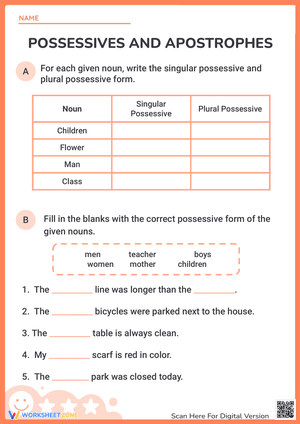
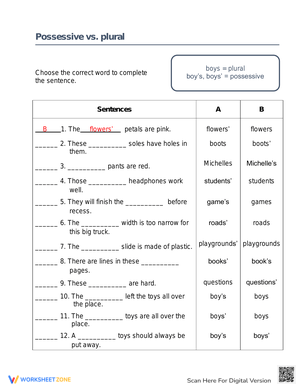
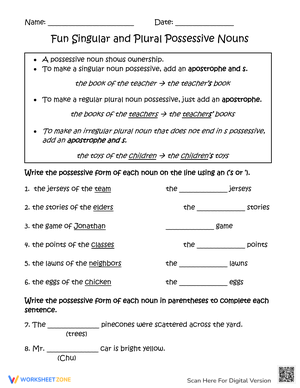
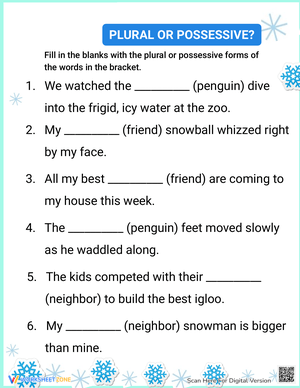
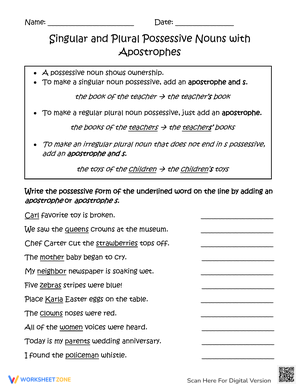
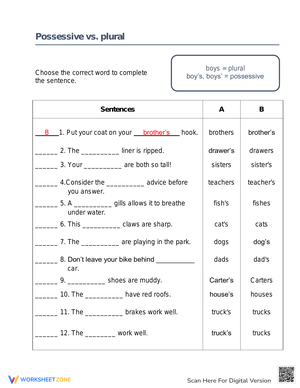
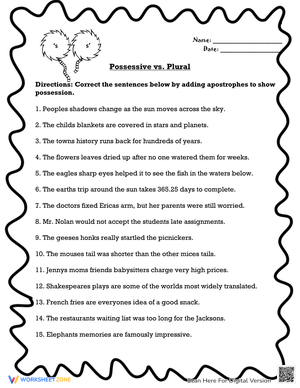
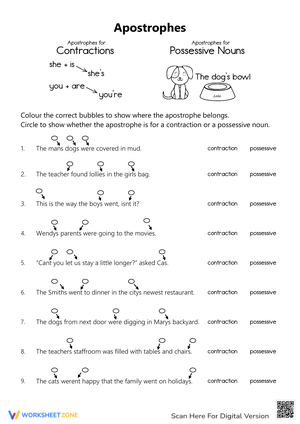
These plural possessives printable worksheets for 4th grade address the two decisions students have to sequence — form the plural correctly, then determine where the apostrophe falls based on how that plural ends. The set covers both regular forms (teachers', players', workers') and the irregular plurals that cause persistent trouble: children's, women's, geese's. Across the set, students rewrite prepositional phrases, sort noun categories, correct marked-up paragraphs, and in later exercises, produce original possessive sentences.
The Two Rules Students Must Keep Separate
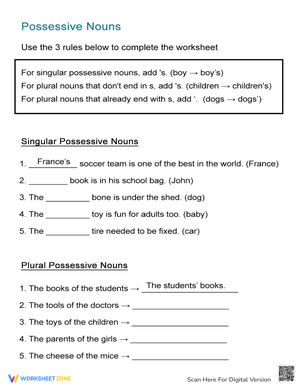
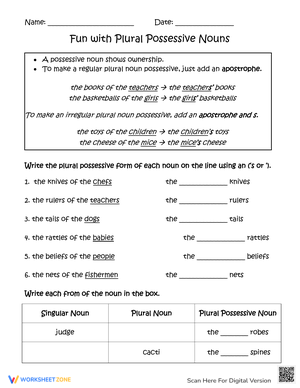
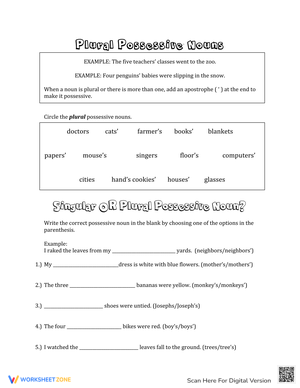
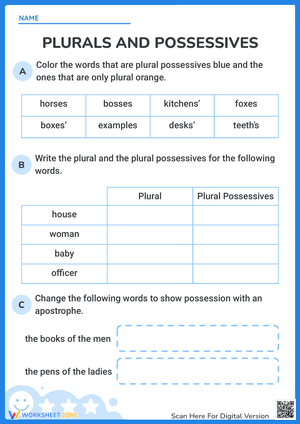
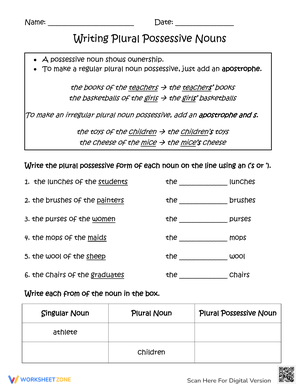
Most plural nouns end in s, so most plural possessives follow a single consistent pattern: write the plural, then place an apostrophe after the existing s. The birds' nest, the coaches' equipment, the farmers' fields. The sentence-transformation exercises on each worksheet in this portion of the set require students to convert phrases like "the equipment belonging to the coaches" into "the coaches' equipment" — a rewrite that forces students to locate the base plural noun before touching punctuation. Students who jump straight to apostrophe placement without naming the plural first tend to put it in the wrong spot, and the exercise structure makes that habit visible.
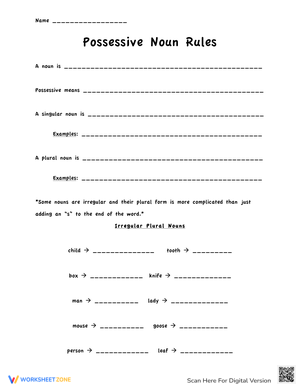
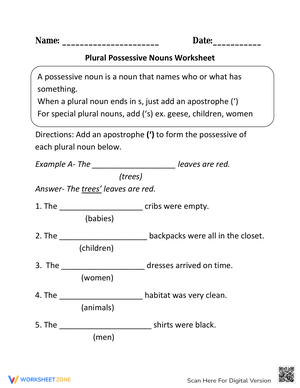
The irregular-plural worksheets operate on different logic. Words like children, men, geese, and people are already plural without an s. To show possession, students treat them as they would singular nouns and add 's — so children's backpacks, not childrens'. These worksheets isolate the irregular forms in the earlier exercises and then mix them with regular plurals in the final sections, where students must make the correct rule choice based on the specific noun in front of them rather than repeating a single pattern across the whole exercise.
Each worksheet in the set uses one of four formats:
- Sentence transformation: converting prepositional phrases into plural possessive constructions
- Noun sorting: categorizing words as plain plural, singular possessive, or plural possessive
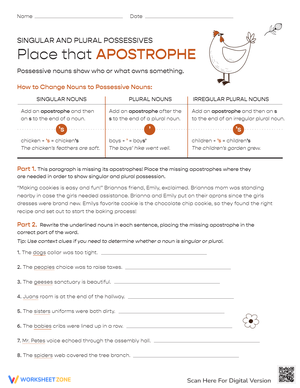
- Error correction: reading a paragraph and rewriting incorrectly punctuated phrases
- Original writing: composing sentences that contain a specified plural possessive — used in the final, most demanding worksheets
Mistakes Students Make That These Worksheets Help You Catch
The most predictable error is adding an apostrophe where no possession exists at all. Students who have just learned "plural nouns ending in s take an apostrophe" will write the dogs' ran across the yard because the plural dogs triggers the rule reflexively. The error-correction exercises include deliberate non-possessive plural sentences for exactly this reason — to surface and break that overgeneralization before it hardens into a habit. This error is harder to undo than it looks, because the student has technically learned something; they've just extended it past its boundary.
A second pattern worth watching is apostrophe position on regular plural possessives. Students write teacher's desks when three teachers are involved, rather than teachers' desks, because singular possessive was learned first and that pattern sticks. A concrete self-check helps: tell students to write the base plural first — teachers — and only then decide where the apostrophe goes. The "Cover and Check" approach extends this further: cover the apostrophe and whatever follows it; if what remains is the correct plural spelling of the owner, the apostrophe is placed correctly. Students who run this check catch most of their own errors before the paper reaches you.
Standard Alignment
The target skill traces directly to CCSS.ELA-LITERACY.L.3.2d — "Form and use possessives" — a standard introduced at third grade that many fourth graders have not yet consolidated, especially across irregular plural forms. Consistent application of that skill is then folded into CCSS.ELA-LITERACY.L.4.2, which requires students to demonstrate command of standard English punctuation and spelling conventions in their own writing. When students move from recognition exercises to sentence transformation and then to original writing, they are advancing along exactly the gradient L.4.2 describes — not just identifying a rule, but applying it under the demands of composition.
Working These Worksheets Into Your Grammar Block
Plural possessives printable worksheets for 4th grade belong after a direct-instruction lesson, not before one. Assigning the transformation exercises without any discussion of the two plural categories typically produces a worksheet full of guessing. A short class activity — five to eight minutes where students sort a handful of familiar nouns together and decide how each looks in plural form — gives students just enough grounding to work through the exercises with reasoning rather than instinct.
The error-correction worksheets fit well in the ten minutes before the end of the literacy block on a Friday, or as a Monday warm-up once the unit is underway. Students correct five marked-up phrases, then trade with a partner for a quick peer check. When two students land on different answers, that disagreement is the lesson — sitting with that moment and asking both students to explain their reasoning surfaces the exact confusion point faster than re-teaching the rule cold ever does.
Adjusting the Set for a Range of Learners
For students still shaky on the foundational rule, start with the regular-plurals worksheets and provide a word bank of pre-formed plural nouns. Removing the plural-spelling task narrows the exercise to apostrophe placement only — a meaningful reduction in cognitive load without cutting the actual target skill. Once those students can reliably place the apostrophe on regular plurals, the irregular-plural worksheets follow naturally.
Students who have the regular forms solid move straight to irregular plurals and then to the mixed exercises. For the highest writers in the room, the plural possessives printable worksheets for 4th grade error-correction exercises can be extended by asking students to write three original sentences each containing a plural possessive — at least one must use an irregular plural noun. That original-writing version gives a much cleaner formative read than a correction exercise does, because it shows whether students can generate correct plural possessives from scratch rather than recognizing errors in pre-written text.
Frequently Asked Questions
What order should I use to introduce regular and irregular plural possessives?
Spend at least two days on regular plural possessives before introducing the irregular forms. When students encounter children's before they've solidified the rule for teachers', the exception muddies the primary rule rather than extending it. Keep the two categories fully separate until each type is reliable on its own, then use the mixed worksheets to build the discrimination skill.
My students already did singular possessives in third grade. Why are they still making errors on the plural forms?
Singular possessives involve one rule: add 's. Plural possessives require students to first answer a factual question about the noun — does the plural end in s or not? — before the apostrophe rule even applies. That prior step is genuinely harder than a retention problem, and many students have never had to name it explicitly. The plural possessives printable worksheets for 4th grade build the "write the plural first" step directly into the exercise structure, so students practice the full two-part decision each time rather than relying on visual pattern-matching.
Can I use these as a diagnostic before starting the unit?
The error-correction worksheets make a useful quick pre-assessment. Students who write childrens' are applying the regular rule to an irregular noun; students who write teacher's desks for multiple teachers are using singular possessive logic. Both patterns tell you exactly which students need the most time on which category — and you get that information in about ten minutes of student work time.












 Interactive Worksheet Maker
 Quiz Maker
 Word Search Maker
 Crossword Puzzle Maker
 Word Scramble Generator
 Sentence Scramble Generator
 Handwriting Worksheet Generator
 Name Tracing Generator
 Fill In The Blank Generator




 BACK TOSCHOOL