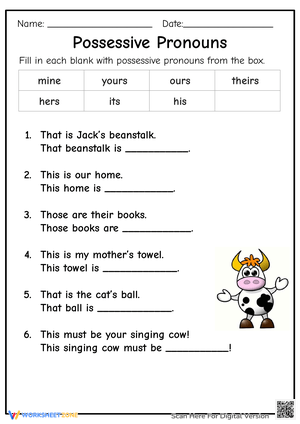
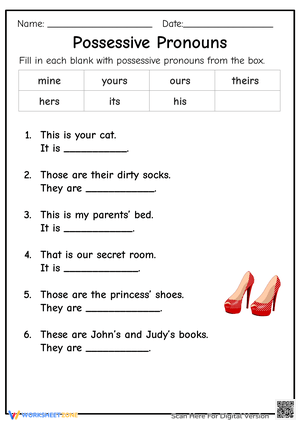
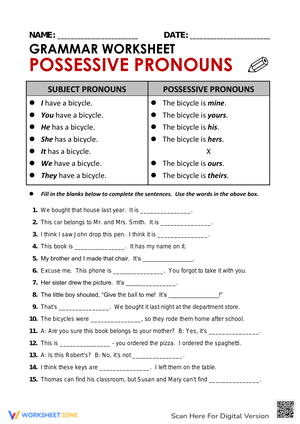
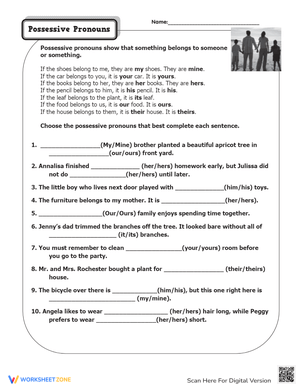
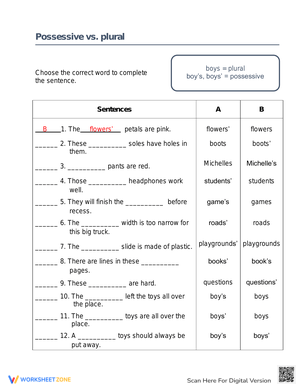
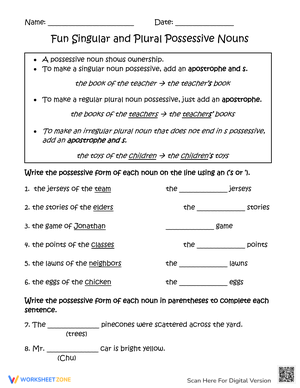
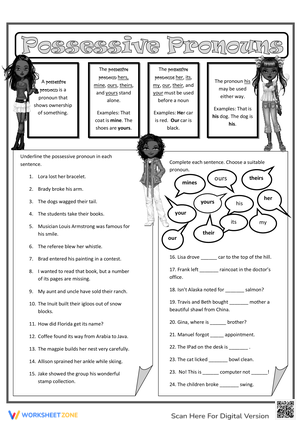
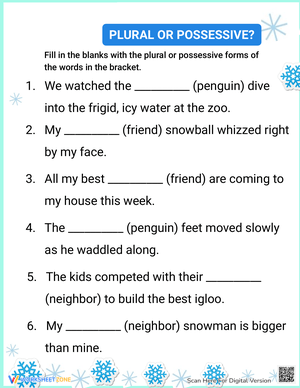
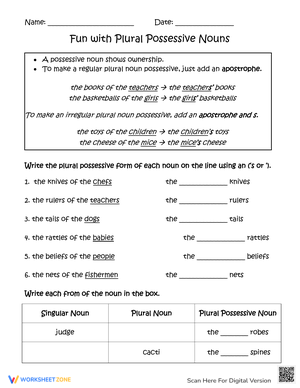
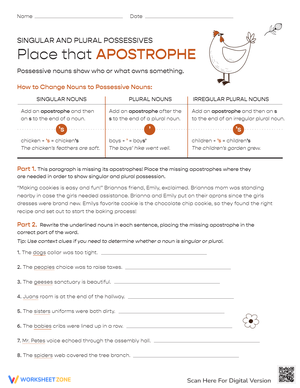
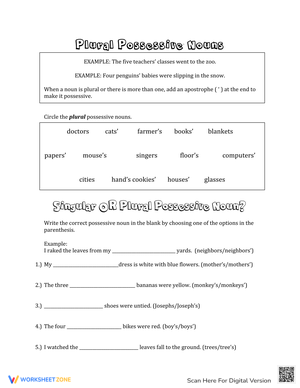
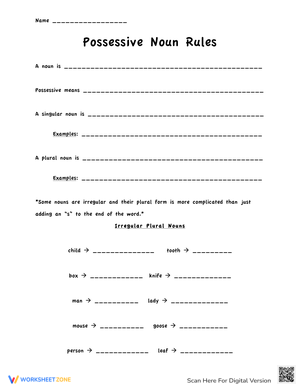
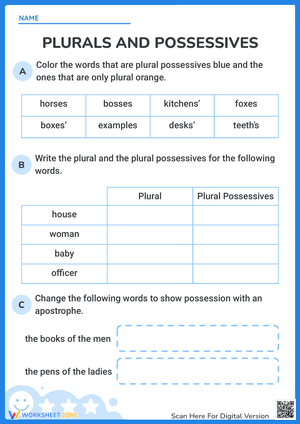
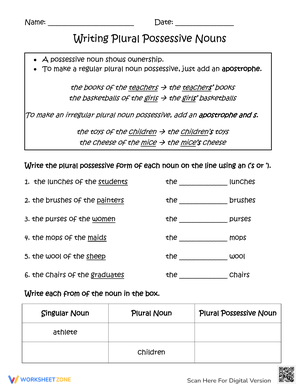
These 4th grade possessive pronouns printable worksheets resources target a gap that shows up in nearly every late-elementary writing sample: students understand ownership conceptually but consistently reach for the wrong grammatical form, writing the notebook is her when the sentence calls for the notebook is hers. Each worksheet focuses on a specific task type — identification, sentence completion, error correction, or short writing — so teachers can choose exactly what a lesson or small-group session needs.
The Specific Skills Each Worksheet Targets
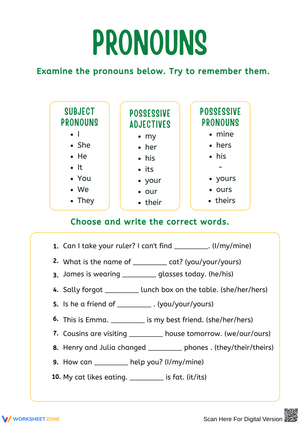
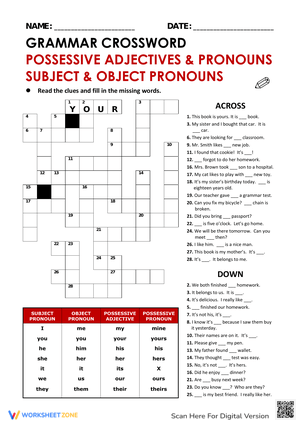
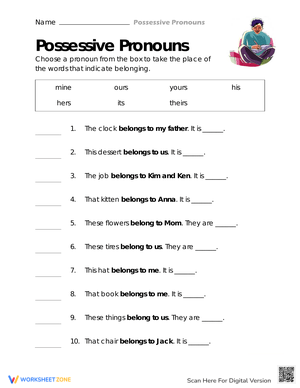
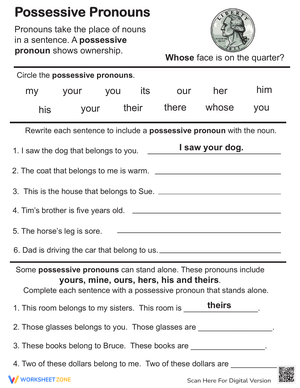
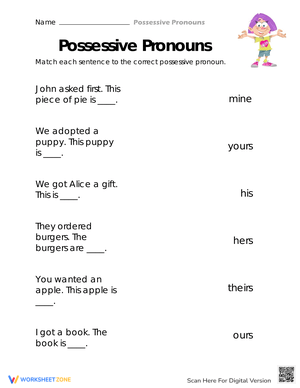
The set works through the core possessive pronouns — mine, yours, his, hers, ours, and theirs — and returns repeatedly to the distinction that matters most for actual writing: possessive pronouns stand alone, while possessive adjectives like my, your, and their precede a noun. Seeing both forms in the same sentence — "Our markers are on the table" beside "The markers are ours" — is more clarifying than any definition.
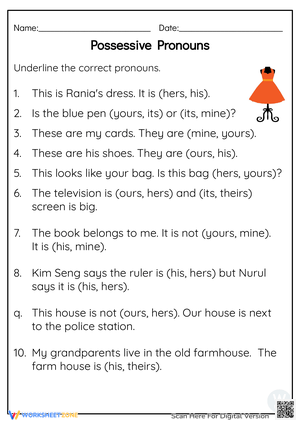
- Identification: Students underline possessive pronouns in sentences and note what ownership relationship each one signals.
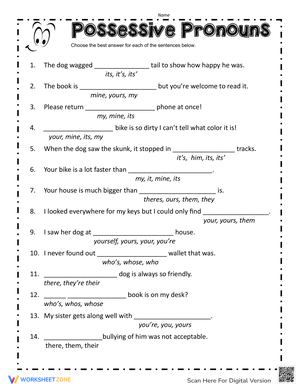
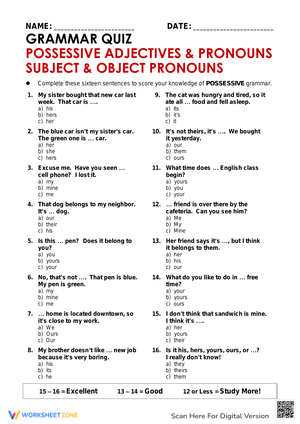
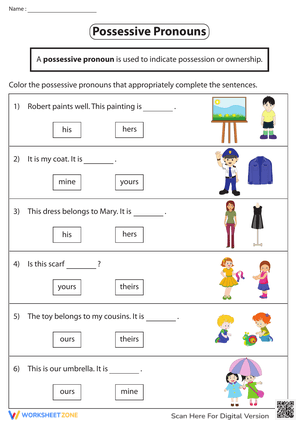
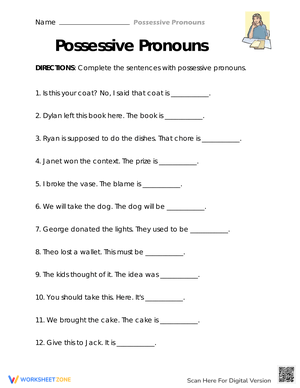
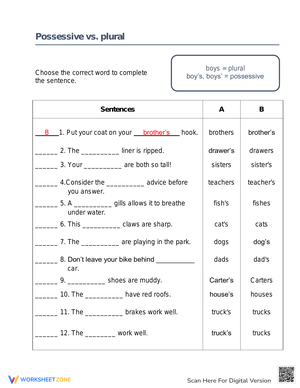
- Sentence completion: Students choose between paired forms — hers versus her, theirs versus their — in context.
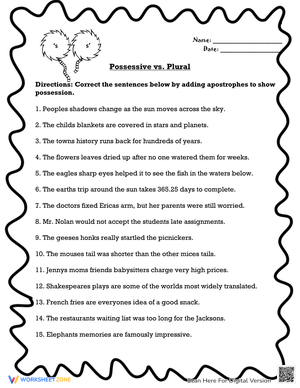
- Error correction: Students revise sentences with common mistakes, including its/it's confusion and incorrectly added apostrophes.
- Sort tasks: Students classify examples as possessive pronouns or possessive adjectives, seeing both forms in the same sentence where possible.
- Short writing: Students produce one or two original sentences using an assigned possessive pronoun.
Answer keys accompany each worksheet. Good keys for this topic go beyond listing correct answers — they note why a commonly selected wrong form doesn't work in context, which saves time when teachers are checking work from homework or a center rotation.
Error Patterns That Surface in Student Writing
The dominant pattern, visible across 4th grade possessive pronouns printable worksheets materials and in live student writing, is the adjective-for-pronoun substitution: "The red notebook is her," "That project is their," "The dog is our." Students aren't confused about who owns what — they're using the form they've seen more often in reading, which happens to be the adjective version. This error responds well to side-by-side correction rather than re-teaching the concept from scratch.
The its/it's confusion runs close behind. The most durable fix is the substitution test: if replacing the word with it is still produces a sensible sentence, the apostrophe is correct; if not, its is the right form. Error-correction tasks on these worksheets apply that test explicitly so students develop a repeatable strategy rather than a rule they memorize once and forget by Thursday.
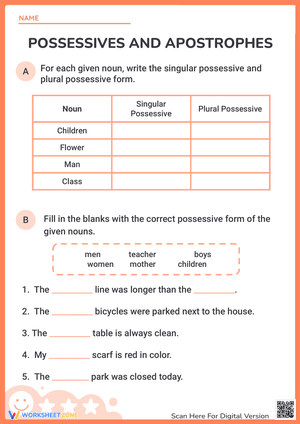
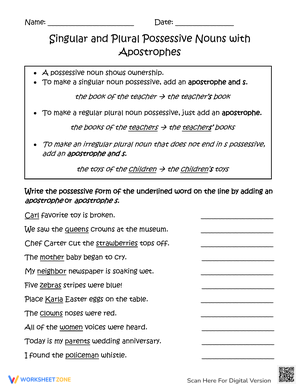
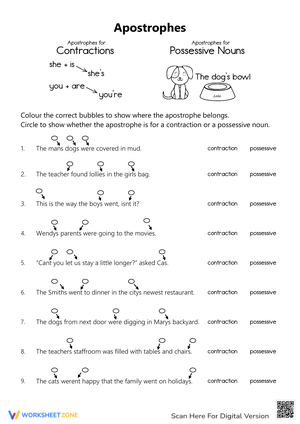
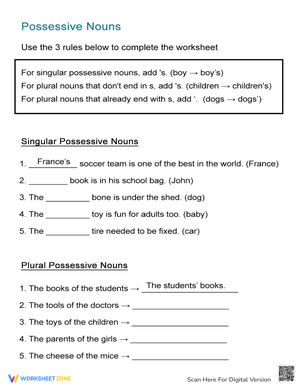
A third pattern — less discussed but worth addressing directly — is apostrophe overgeneralization. Fourth graders have recently internalized that possessive nouns take apostrophes, and some carry that pattern directly to pronouns, writing her's or their's. A worksheet that asks students to evaluate whether each underlined possessive form is correctly written catches this before it solidifies into a writing habit.
Fitting These Worksheets Into the Instructional Week
The natural entry point is a brief direct instruction moment — two sentences on the board, "This is my seat" and "This seat is mine," with a class discussion of what changed and what the pronoun is replacing. After that, even a short identification or sentence-completion worksheet gives teachers immediate evidence of where the class landed. The 4th grade possessive pronouns printable worksheets format works well here because it fits the 5 to 8 minutes between a lesson close and the next transition without requiring any additional prep.
Centers work especially well with the sort tasks. Students can use a highlighter to mark pronouns before categorizing them — that physical step slows the automatic guessing that happens when sentence items feel too familiar. For homework or Friday review blocks, a short error-correction worksheet with 8 to 10 items is a manageable load that doesn't extend grading into the weekend.
One routine worth building early in the unit is what some teachers call the same-frame rotation: write "The project is ______" on the board and rotate through all six possessive pronouns across consecutive mornings. Because the sentence structure doesn't change, students can focus entirely on how each pronoun functions in that position. Students who are still mixing pronoun forms during independent writing often need exactly this kind of repeated low-stakes exposure before the form becomes automatic.
Adjusting the Worksheets for a Mixed-Ability Class
For students still sorting out the pronoun-adjective distinction, narrow the entry point to one pair — my and mine — before expanding to the full set. A two-column reference chart with sentence examples works better than a word list here because students can match the form they're currently using against a real sentence rather than an abstract definition. Oral practice helps too: saying "my backpack" and "the backpack is mine" aloud before writing gives students an auditory version of the distinction alongside the written one.
On-grade students generally move through identification and sentence completion with minimal support and benefit most from the error-correction and short-writing tasks, where they make actual writing decisions instead of selecting a supplied answer. The 4th grade possessive pronouns printable worksheets set includes enough task variety that each worksheet can serve a different instructional purpose within the same week.
Students ready for extension can revise a short paragraph containing several possessive pronoun errors — wrong forms, misplaced apostrophes, pronoun-adjective mix-ups — and then annotate each correction with a brief explanation. That two-part task requires both applying the rule and articulating it, which tends to consolidate understanding more thoroughly than additional practice items would.
Standard Alignment
These worksheets address CCSS.ELA-LITERACY.L.4.1, which requires students to demonstrate command of standard English grammar and usage when writing and speaking. Correct pronoun form and pronoun-antecedent agreement fall within this standard at the Grade 4 level. The skills also reinforce work begun under L.3.1, which introduces pronoun usage in Grade 3. In practical classroom terms, 4th grade is the consolidation year for pronoun work — students have encountered these forms, but independent application in writing is still uneven. That gap is what these worksheets are built to close.
Frequently Asked Questions
What is the difference between a possessive pronoun and a possessive adjective?
A possessive pronoun stands alone in place of a noun phrase: "The markers are ours." A possessive adjective comes before a noun: "Our markers are on the table." Grade 4 students frequently default to the adjective form in positions that require the pronoun, which is why comparing both forms in the same sentence works better than defining them separately.
Which possessive pronouns should 4th graders know?
The core set for Grade 4 is mine, yours, his, hers, ours, and theirs. Students should be able to identify each, use each correctly in a complete sentence, and distinguish them from the corresponding possessive adjectives — my, your, his, her, our, and their.
How do I address the its versus it's distinction efficiently?
Teach the substitution test early: replace the word with it is and check whether the sentence still makes sense. If it does, the apostrophe belongs. If it doesn't, its is the right form. Short editing items give students repeated practice applying that test in actual sentences, which builds the habit faster than a single explanation does.
Can these worksheets work for students who are significantly behind?
Yes, with a narrowed scope. Limit the task to one pronoun pair, keep sentence length short, and let students keep a reference example at the top of each worksheet. Students who freeze when they see an unfamiliar sentence structure tend to benefit from oral rehearsal — saying both versions of a sentence aloud before committing an answer to paper.












 Interactive Worksheet Maker
 Quiz Maker
 Word Search Maker
 Crossword Puzzle Maker
 Word Scramble Generator
 Sentence Scramble Generator
 Handwriting Worksheet Generator
 Name Tracing Generator
 Fill In The Blank Generator