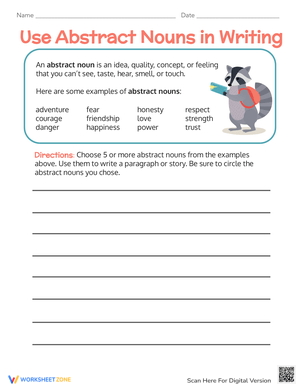
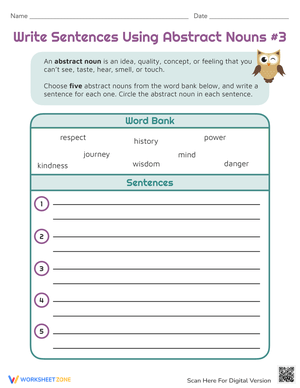
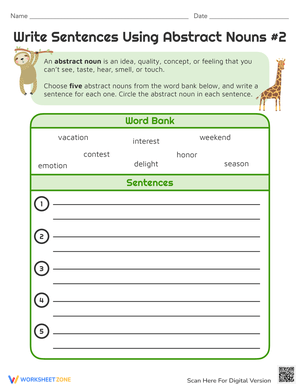
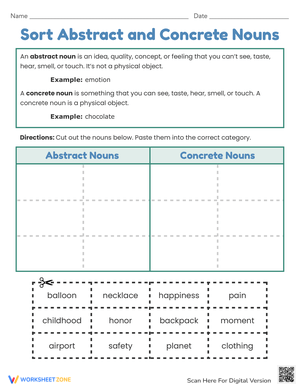
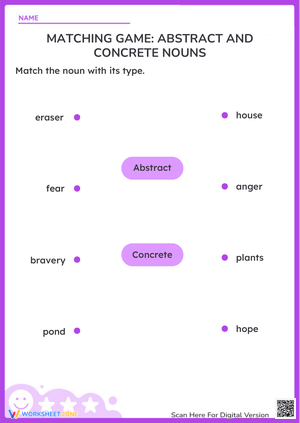
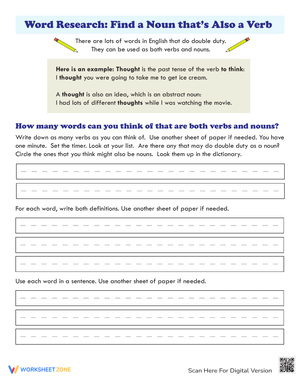
These abstract nouns printable worksheets for 4th grade give teachers a direct way to address one of the most conceptually slippery noun categories students encounter. Unlike concrete nouns, abstract nouns name ideas, feelings, and qualities — things students can think about but cannot point to on a classroom shelf. The set covers identification, noun sorting, sentence completion, and original sentence writing, moving students from recognizing the category to using it with confidence.
The Specific Skills Covered in Each Worksheet
Each worksheet targets a distinct noun skill, keeping directions short so students stay focused on grammar rather than procedure. Across the set, students work through these tasks:
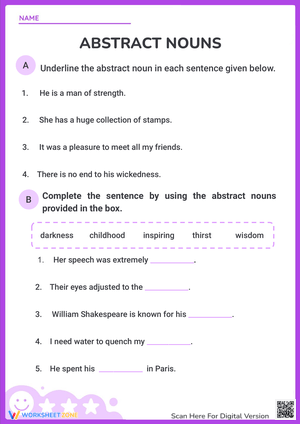
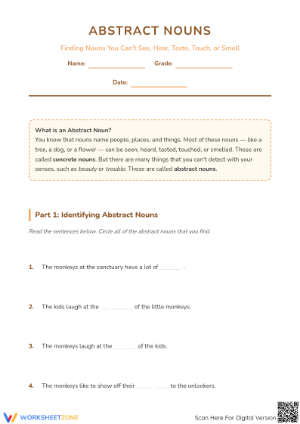
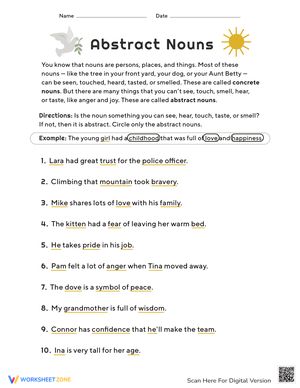
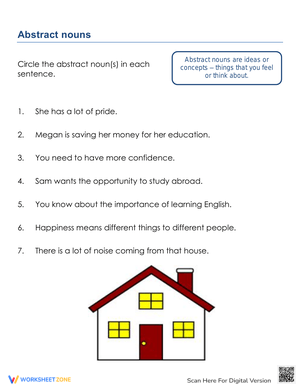
- Identifying abstract nouns in sentences: Students underline or circle the abstract noun in each sentence, distinguishing it from other nouns and modifiers in the same sentence.
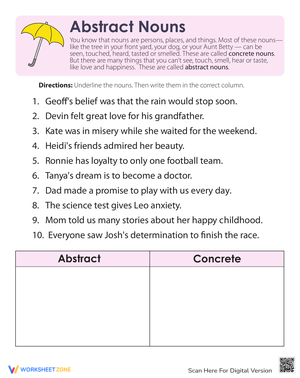
- Sorting abstract and concrete nouns: Students categorize a word bank by placing each noun into the correct column — a task that forces explicit comparison rather than passive recognition.
- Sentence completion with a word bank: Students choose the abstract noun that best fits a sentence, practicing both meaning and grammatical context.
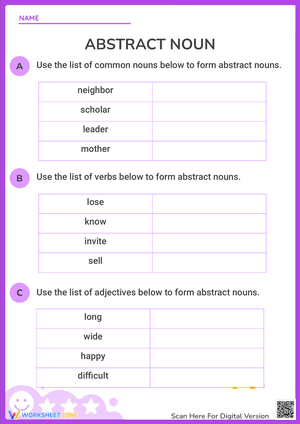
- Matching concrete-to-abstract pairs: Students connect a concrete noun to its abstract counterpart — child to childhood, brave to bravery — reinforcing how a concept shifts in both form and function.
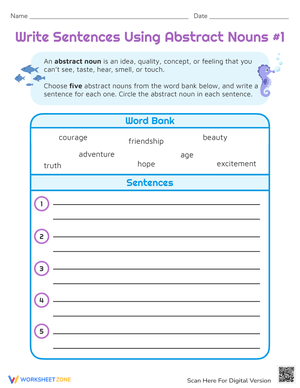
- Original sentence writing: Students write their own sentences using a given abstract noun, which reveals whether they understand the word's meaning and not just its category label.
Because abstract nouns printable worksheets for 4th grade are most effective when students move from recognition toward production, the order matters: identification before sorting, sorting before sentence completion, sentence completion before open sentence writing. Following that progression across a week of grammar instruction gives students time to consolidate the concept before they're expected to generate examples independently.
Frequent Errors That Show Up in Student Work
The most predictable mistake is conflating abstract nouns with adjectives. Students who correctly identify kindness as an abstract noun will sometimes mark kind when they encounter it in a sentence — not because they misunderstand the category, but because they haven't yet anchored the distinction between a quality described by an adjective and a quality named as a noun. Sorting tasks help here because students can physically place words into columns and self-correct when the column doesn't feel right.
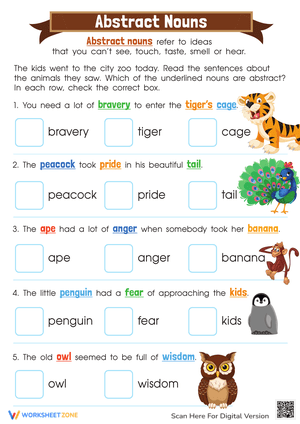
A second error is harder to anticipate: some fourth graders argue that emotion words like anger or fear are concrete because they physically feel them. That's not careless thinking — it's a legitimate sensory argument. The most effective response is to ask students to treat the word as a named concept rather than a sensation: "When the author writes that Marcus felt shame, is shame sitting on his desk? Can you weigh it or measure it?" That question lands faster than repeating a definition from a classroom chart.
Ways to Work These Worksheets Into Your Teaching Week
Abstract nouns printable worksheets for 4th grade fit cleanly into the grammar mini-lesson structure most teachers already use — a brief direct teach, two modeled examples, then independent practice on one focused worksheet. For a fifteen-minute grammar block, that sequence is enough. The identification worksheet works as the follow-up to instruction; the sorting worksheet works two days later as review.
The most effective use, in practice, is tying abstract noun work to character analysis from a read-aloud. When a class has just discussed a character who shows patience or courage, students already have those abstract nouns in their heads. Handing out a worksheet the same day — or the next morning as a warm-up — makes the connection explicit and gives students a reason to notice abstract nouns appearing in texts they're already engaged with.
- Literacy centers: The sorting and matching worksheets work as partner tasks without requiring teacher facilitation.
- Exit tickets: The sentence-writing worksheet gives a fast check of whether students can use the concept correctly, not just identify it.
- Sub plans: Each worksheet has self-contained directions and an answer key, which removes guesswork for a substitute.
- Monday warm-ups: A brief identification worksheet after a weekend keeps noun knowledge active without drawing time away from the week's main unit.
Standard Alignment
CCSS.ELA-LITERACY.L.3.1.C explicitly names abstract nouns as a teaching target — "Use abstract nouns (e.g., childhood)" — and is one of the few ELA language standards that identifies a specific noun subtype by name. Grade 4 teachers return to this standard because many students arrive in fourth grade able to recite a definition but not yet able to apply it consistently in sorting or writing tasks. These worksheets address that gap directly: each exercise moves past definition recall and into applied practice, which is where L.3.1.C mastery actually becomes visible in student work.
Adjusting the Set for a Range of Learners
Abstract nouns printable worksheets for 4th grade work across ability levels with small, targeted adjustments. Students who need more support benefit most from the identification worksheets that include a reference list of abstract nouns at the top — removing vocabulary load lets them focus on the grammar task itself. For students who also need language support, anchoring each abstract noun to a classroom situation helps: kindness at lunch, frustration during a test. Those concrete situations give the abstract concept a foothold.
Students who move through identification quickly benefit from the derivation work: given honest, write the abstract noun form. Given free, write freedom. That task combines morphological knowledge with grammar knowledge, making it a genuine extension rather than more of the same task type. A further step is asking students to use two abstract nouns in a single sentence and explain how those nouns relate to each other — an exercise that surfaces whether they understand meaning, not just form.
Frequently Asked Questions
Can these worksheets work for third graders, since L.3.1.C is a Grade 3 standard?
Yes, and many third-grade teachers use them for exactly that purpose. The identification and sorting worksheets align directly with the standard as written. The sentence-writing worksheet is better suited to Grade 4, where students write full sentences more fluently during independent work. The sorting and matching worksheets are the strongest fit for Grade 3 instruction.
How long does completing one of these worksheets typically take?
Identification and sorting worksheets take most fourth graders between eight and twelve minutes during independent work. Sentence-writing worksheets run closer to fifteen minutes, particularly for students who pause to think through the meaning of the noun before writing. The matching worksheet is the fastest — most students finish in six or seven minutes, which makes it a reliable warm-up or exit task.
What's the recommended order for introducing the different worksheet types?
Start with identification: students underline abstract nouns in sentences, which requires recognition before any production. Move to sorting next, since comparing abstract and concrete nouns in the same task sharpens the distinction. Use sentence completion third, because the word bank provides support while students practice placing nouns in context. Save sentence writing for last — it asks students to generate the abstract noun, place it grammatically, and demonstrate understanding of its meaning. The matching worksheet can appear anywhere in that sequence as a conceptual reinforcement.
Do the worksheets include answer keys?
Each worksheet includes a full answer key. For the sentence-writing worksheet, the key provides sample responses — since student answers will vary, the samples give teachers a reference point for what correct usage looks like, which is especially useful when reviewing work between classes.












 Interactive Worksheet Maker
 Quiz Maker
 Word Search Maker
 Crossword Puzzle Maker
 Word Scramble Generator
 Sentence Scramble Generator
 Handwriting Worksheet Generator
 Name Tracing Generator
 Fill In The Blank Generator




 BACK TOSCHOOL