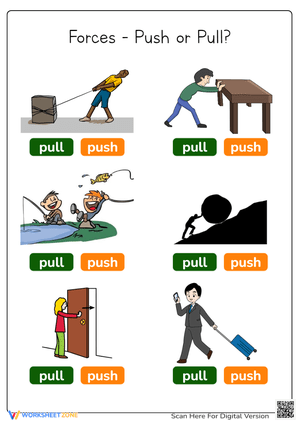
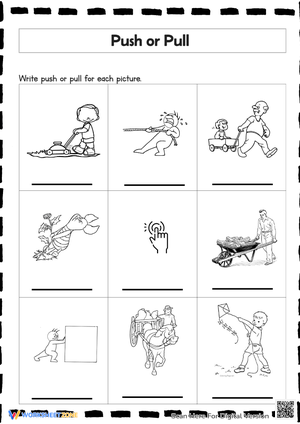
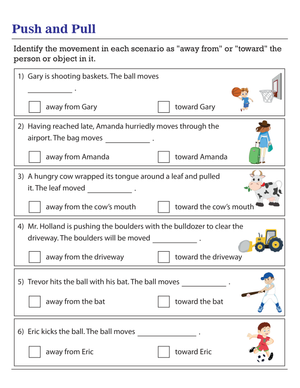
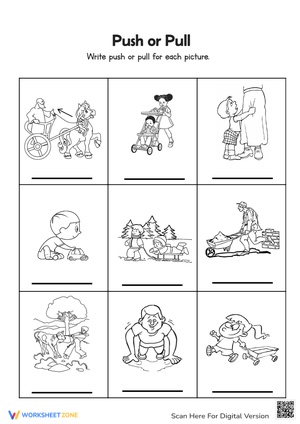
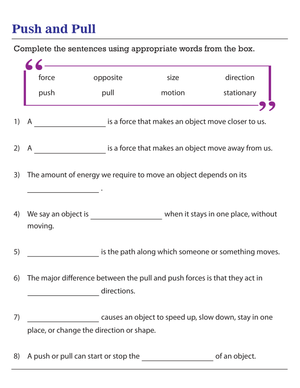
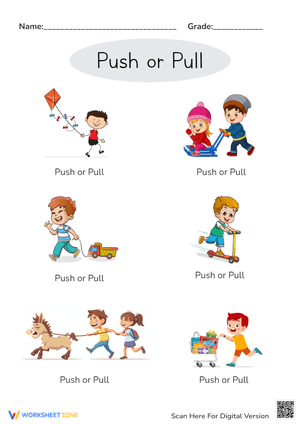
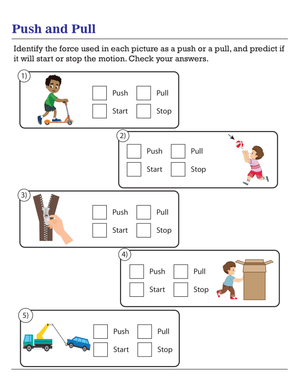
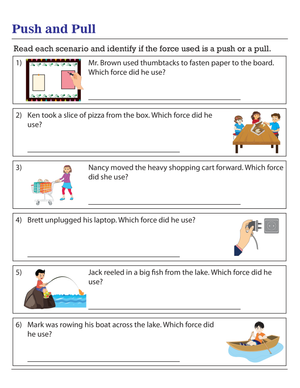
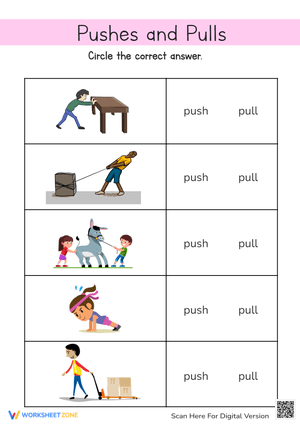
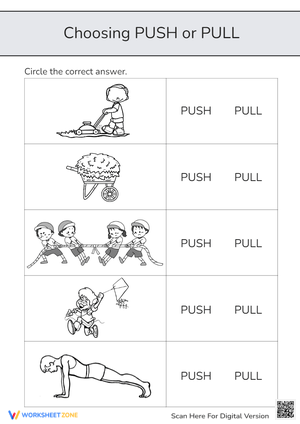
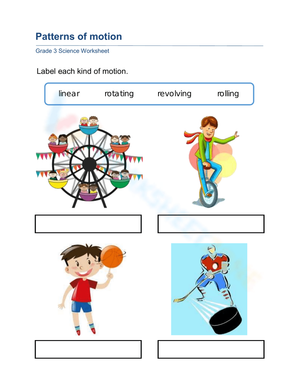
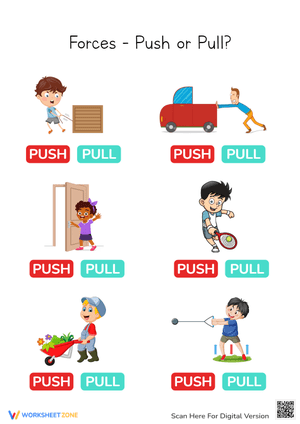
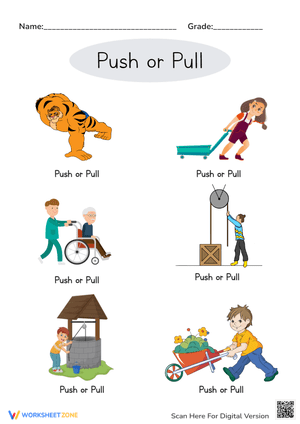
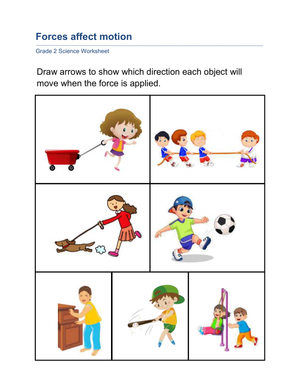
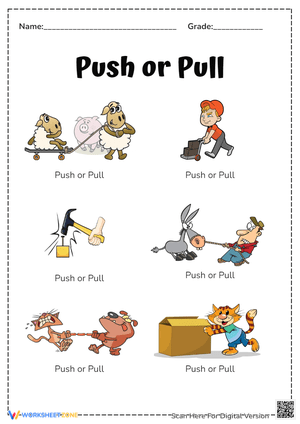
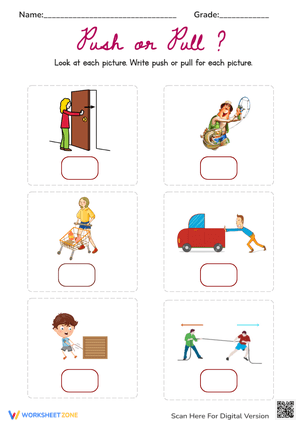
These 3rd grade forces motion and machines worksheets give teachers a print-ready set that moves students from vague physical intuitions—"it rolled because I pushed it"—toward precise scientific language and testable reasoning. The set covers push and pull forces, balanced and unbalanced force scenarios, friction, observable motion patterns, and all six classical simple machines, from the lever to the screw.
What Students Practice Across the Set
Each worksheet targets a distinct skill rather than mixing unrelated concepts, which keeps the cognitive demand manageable for third graders who are just beginning to formalize their understanding of physics. Here is what the exercises specifically ask students to do:
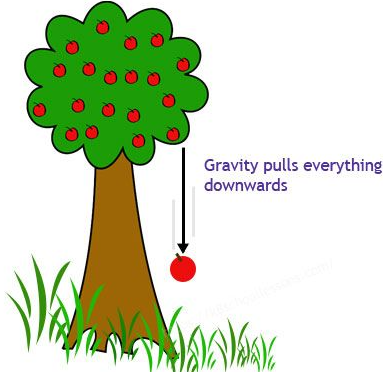
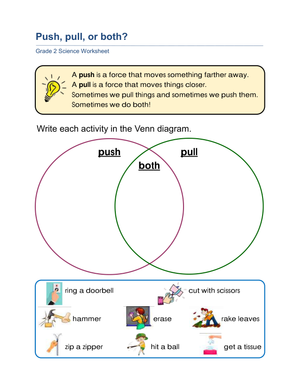
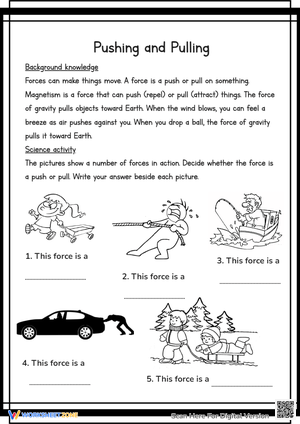
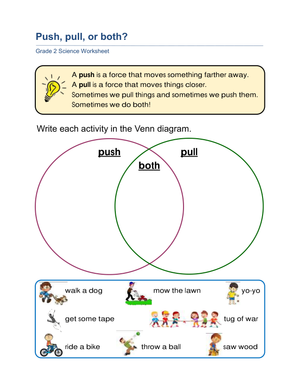
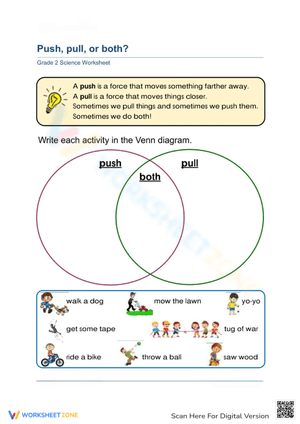
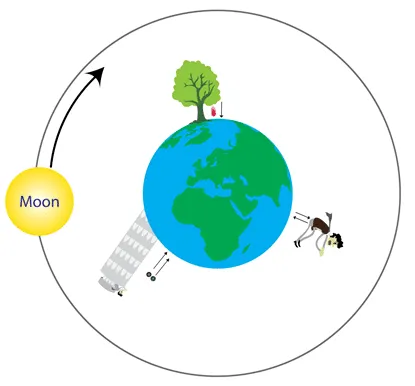
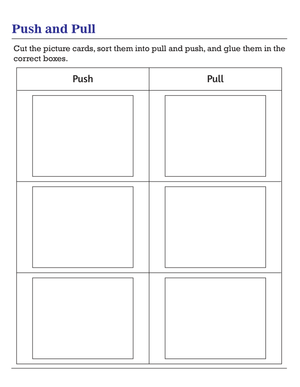
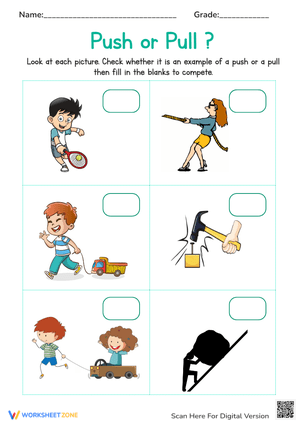
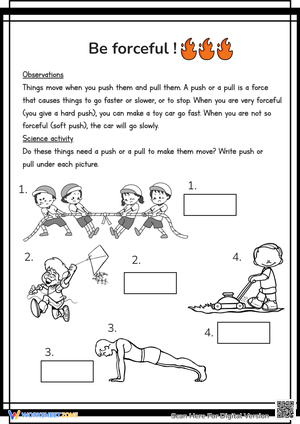
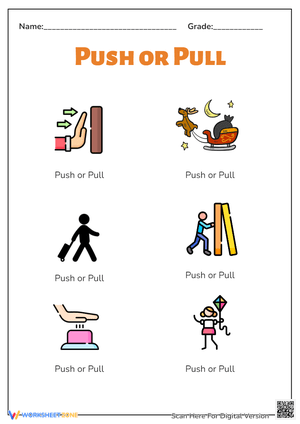
- Identify forces as pushes or pulls and classify them as contact or non-contact — students label everyday scenarios like gravity acting on a falling apple or a hand pushing a door
- Read and interpret force diagrams — arrows of different lengths represent forces of different magnitudes; students determine whether forces are balanced or unbalanced and predict what happens to the object
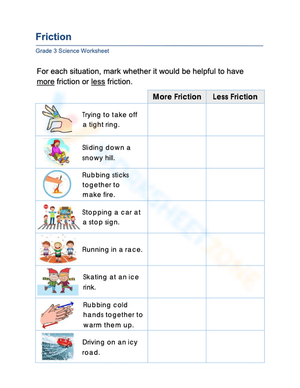
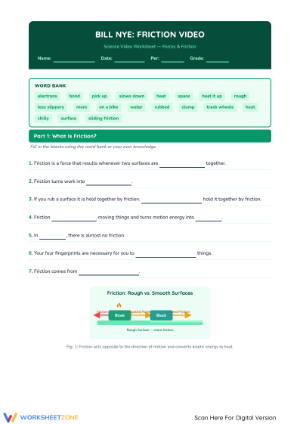
- Analyze friction — students compare surfaces and record predictions, then explain how friction changes the speed and stopping distance of a moving object
- Record and predict motion patterns — short data tables and graph-reading exercises connect measurement to physical outcomes
- Identify the six simple machines — matching, labeling, and sorting exercises build recognition of levers, wheels and axles, pulleys, inclined planes, wedges, and screws in real-world objects
- Explain mechanical advantage in plain language — students write one or two sentences describing how a specific machine reduces the effort needed to do a job
Where Students Reliably Go Wrong in Forces and Motion
The most persistent error at this level is conflating "balanced forces" with "no forces." Students who can correctly identify a stationary book on a desk as not moving will still write that "nothing is pushing on it" — because they confuse the absence of motion with the absence of forces. Force diagram exercises address this directly by requiring students to draw and label both gravity and the normal force, then explain in a sentence why the book stays put despite having two forces acting on it. Until students practice labeling both arrows, the misconception tends to persist even after direct instruction.
Simple machine identification trips students up in predictable ways as well. The wedge is consistently confused with the inclined plane because both have slanted surfaces. The distinction — a wedge moves through a material while an inclined plane stays stationary and the load moves along it — takes repeated exposure to stick. Scissors are a reliable source of confusion: students identify the handles and pivot point as a lever, which is correct, but miss that the blades also function as a wedge. Sorting exercises that require students to name a household object, identify the machine type, and write a justification sentence surface this confusion quickly and give teachers a clear look at who actually understands the concept versus who is guessing from the shape.
Building These Worksheets Into Your Science Block
The most effective placement is immediately after a short hands-on investigation, not before it. Have students build and test a cardboard ramp before completing the inclined plane worksheet — the vocabulary sticks when it names something they just did with their hands. A worksheet used as a pre-activity feels abstract; that same worksheet used to formalize a completed experiment functions as a genuine thinking tool.
Several worksheets in the set work well as a five-minute close-of-period check. The balanced and unbalanced forces diagram worksheet has enough standalone clarity that students can complete it independently while the teacher circulates, gathers materials, or takes anecdotal notes — a real formative window where the error patterns tell you whether the next day needs reteaching or extension. The 3rd grade forces motion and machines worksheets also hold up as homework once concepts have been introduced in class. Send home the simple machines matching worksheet the night after the whole-class identification lesson and most students can complete it without parent help.
A useful whole-class activity to run mid-unit: give students a clipboard with the simple machines identification worksheet and send them on a ten-minute walk through the hallways. Doorknobs, flagpole pulleys, door hinges, ramps at building entrances — the school building contains more examples than most textbook photo libraries. Students who locate and label real examples during the walk return to their seats with stronger concept anchors than students who only practice from diagrams.
Making the Set Work Across Ability Levels
For students who need additional support, pair each worksheet with a laminated reference card showing labeled diagrams of all six simple machines and brief definitions of each force type. The key is keeping the card factual rather than procedural — students should still do the reasoning; the card removes the vocabulary retrieval bottleneck without removing the thinking requirement. This approach works especially well during the simple machine identification exercises, where students who understand the concepts sometimes stall simply because they cannot recall the name "axle."
Students who move quickly through the core exercises benefit from an extension prompt asking them to identify compound machines — tools that combine two or more simple machines. Scissors involve a lever and a wedge. A wheelbarrow combines a lever and a wheel and axle. A hand-cranked pencil sharpener uses a wheel and axle plus a wedge. This adds genuine conceptual complexity without requiring separate materials, since students apply the same concepts to any object they can name and justify.
Standard Alignment
The worksheets address NGSS standard 3-PS2: Motion and Stability — Forces and Interactions, specifically performance expectations 3-PS2-1 (investigating the effects of balanced and unbalanced forces on an object's motion) and 3-PS2-2 (making observations and measurements to produce data that show patterns in how the strength of a force and the mass of an object affect motion). Simple machines connect to the engineering design strand and to disciplinary core idea PS2.A, which establishes that forces change the motion of objects. Teachers sequencing a full unit typically address force identification first, then motion patterns, then simple machines as an application of force principles — placing these worksheets after initial concept introduction and before any formal assessment fits cleanly into that sequence and gives students the retrieval practice the standard expects before end-of-unit evaluation.
Frequently Asked Questions
Do these worksheets require any materials beyond pencil and paper?
No. Each worksheet is self-contained and works with pencil and paper only. A few of the motion-pattern exercises include data tables where students record measurements from a preceding lab, so if you use those worksheets as lab follow-ups, students will need their recorded observations. But every worksheet can also stand alone using the built-in data or diagrams provided directly on each worksheet.
How do I pace the set across a forces and motion unit?
A typical third grade forces and motion unit runs three to four weeks. A reasonable pace is one or two worksheets per week, used at the close of relevant lessons rather than grouped together. Spend the first week on push, pull, and force diagrams; introduce friction and motion patterns in week two; move into simple machine identification in weeks three and four. That spacing lets students retrieve earlier concepts when they appear in later exercises — a spaced retrieval effect that strengthens long-term retention more reliably than massing all the related material in a single week.
Are these appropriate for formal assessment?
The 3rd grade forces motion and machines worksheets work best as formative tools — checks that inform instruction rather than grades that go into a gradebook. That said, several worksheets have enough rigor to serve as a quiz-level check at the end of a concept sequence. The force diagrams worksheet and the simple machine identification sort both require students to apply concepts rather than simply recall vocabulary, which gives teachers usable evidence of understanding. If you need a summative task, use the worksheets for practice and build a separate assessment from the concepts they cover.
Can a student who was absent complete these at home independently?
Yes, for most of the set. The 3rd grade forces motion and machines worksheets include enough context within each worksheet — labeled diagrams, example problems, and clear directions — that a student working at home can follow the task without a prior classroom explanation. The simple machines matching and sorting exercises are especially accessible for independent completion. The force diagram exercises are slightly more demanding to interpret without prior instruction, so for an absent student, a brief parent explanation of what the arrows represent is helpful before they sit down to work.












 Interactive Worksheet Maker
 Quiz Maker
 Word Search Maker
 Crossword Puzzle Maker
 Word Scramble Generator
 Sentence Scramble Generator
 Handwriting Worksheet Generator
 Name Tracing Generator
 Fill In The Blank Generator