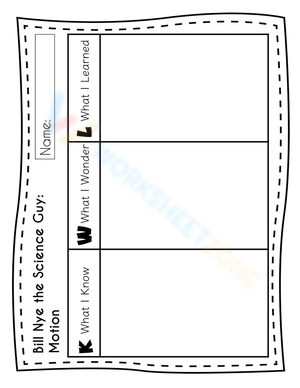
3rd Grade Bill Nye Motion worksheets for Science Class
These 3rd grade bill nye motion worksheets resources give teachers a reliable viewing guide for one of the faster-moving science episodes in the elementary rotation. The Bill Nye "Motion" episode — Season 5, Episode 20 — runs through inertia, friction, force, and Newton's First Law in under 25 minutes, and without something to write on, third graders spend the time enjoying the show rather than processing the science. Each worksheet turns the viewing session into a structured lesson by keeping students recording and thinking from the opening segment through the final experiment.
The Specific Skills Each Worksheet Targets
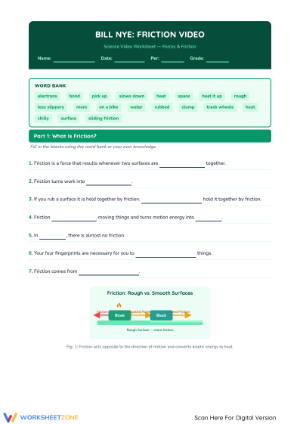
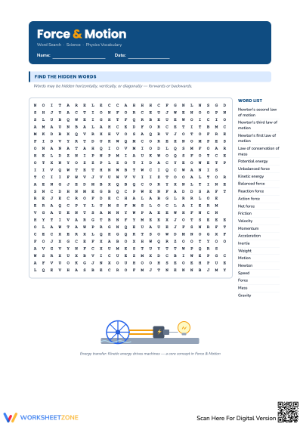
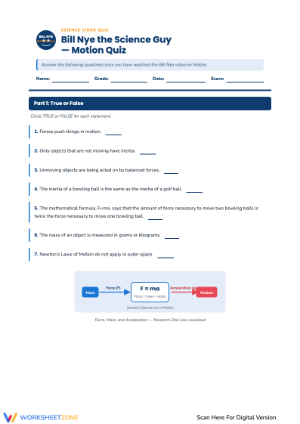
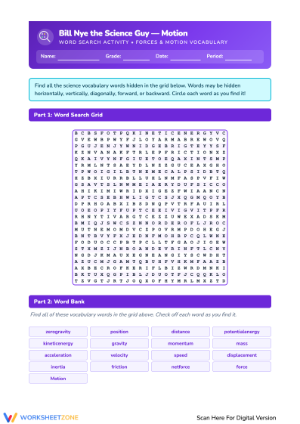
Students work with five core concepts across the episode: inertia, force, friction, mass, and Newton's First Law. Each worksheet has students label, categorize, and explain these ideas as they appear on screen. Several prompts ask students to restate Bill's explanations in their own words — a task that exposes how much of the show's memorable phrasing students have absorbed without fully understanding. "Inertia is a property of matter" sticks in eight-year-old brains precisely because it sounds authoritative, but many students can repeat it long before they can connect it to a specific object in a specific situation.
The tablecloth demonstration anchors the inertia questions. Students watch Bill pull a cloth from under a set of dishes and then answer a prompt asking them to name the force principle that explains why the dishes remained in place. That question separates students who remember what happened from students who understand why. Later in each worksheet, students sort push and pull forces using examples from the video, describe what friction does as a car slows on pavement versus ice, and record predictions during the "Try This" segments before Bill reveals the outcome.
Placing These Worksheets in a Third-Grade Forces Unit
Most teachers use this video at one of two moments in a forces unit. Some open the unit with it — the episode front-loads vocabulary that students need before lab work begins, so when they're pushing toy cars down ramps and measuring distance, they already have the word "friction" in their working vocabulary. Others use it mid-unit, after students have done enough hands-on investigation that the episode names what they've been doing: "oh, that's what inertia looks like." Both placements work, and the choice usually comes down to whether you want the video to introduce concepts or consolidate them.
For pacing, two natural pause points make the lesson easier to manage: after the tablecloth sequence and after Bill's friction segment. Both follow what the show calls "Consider the Following" setups, and students who know the show's structure begin to anticipate the question windows. If you're working with 3rd grade bill nye motion worksheets resources in a standard 45-minute block, the viewing and writing together typically run about 30 minutes, which leaves a workable window at the end for a quick share-out or for running the coin-and-cup demonstration yourself so students see the inertia principle up close rather than only through a screen.
Where Third Graders Tend to Go Wrong With These Concepts
The most durable error involves conflating mass with inertia. When the worksheet asks why the dishes stayed on the table, students commonly write "because they were heavy." That answer is adjacent to correct — mass does affect how much force is needed to move an object — but it locates the explanation in the weight of the dishes rather than in inertia as a property of matter. The open-response format makes this error visible in a way that a multiple-choice question with "mass" as a distractor would not.
The friction questions produce a different pattern. Students reliably write that friction "stops" an object when the more precise description is that friction continuously slows it. That distinction matters later in the unit when students have to explain why a ball rolling across a gym floor eventually comes to rest — the answer requires understanding friction as an ongoing force, not a sudden cutoff. Watch also for students who write that ice "has no friction" after Bill's surface comparison. The episode demonstrates that ice has less friction than concrete; several students interpret less as none, and the worksheet's follow-up prompt is a good place to catch that before the misconception settles in.
Newton's First Law trips students up in a specific way: they hold onto the first half and drop the second. "Objects in motion stay in motion" gets remembered because Bill repeats it with energy; "objects at rest stay at rest" gets forgotten even though the tablecloth demonstration is literally an example of it. On their worksheets, students often leave the second half of the law blank or write something vague like "things don't move unless you push them." Flag those responses for a brief whole-class clarification before the worksheet gets put away.
Standard Alignment
NGSS 3-PS2-1 asks students to plan and conduct investigations to provide evidence of the effects of balanced and unbalanced forces on the motion of an object. The Bill Nye "Motion" episode addresses this standard through demonstration rather than student investigation, but it builds the conceptual ground students need to design and interpret their own experiments. The tablecloth pull, the friction comparisons, and the coin-and-cup sequence each model a force acting on an object and a measurable change in motion — the same relationship students will need to articulate when they run their own ramp-and-car investigations later in the unit.
NGSS 3-PS2-2 connects directly to the episode's treatment of force size and object mass: a small push produces less change in motion than a large push; a more massive object requires more force to accelerate than a lighter one. The 3rd grade bill nye motion worksheets questions tied to these segments ask students to compare outcomes across examples — which object moved farther, which required more force — giving them practice with the evidence-based comparison that the standard expects. These questions also function as informal pre-assessments for the hands-on investigations that follow, showing which students are ready to work with variables and which need more time on the underlying concept.
Making These Worksheets Work for Every Student in the Room
Students who are still building writing fluency struggle when an open-response prompt asks them to carry a full scientific explanation in one go. Breaking a prompt like "explain why the dishes stayed on the table" into two sequential questions — "What did you observe?" followed by "What scientific word explains that?" — reduces the load without lowering the expectation. The student still needs to name inertia and connect it to the observation; they just do those two moves separately instead of all at once.
For students who move through the worksheet quickly, the prediction segments are the most productive extension point. Before Bill runs the coin-and-cup setup, ask those students to write a formal hypothesis: if I do X, I predict Y will happen because Z. After the reveal, they compare their prediction to the outcome and note where their reasoning held up and where it didn't. That sequence — claim, evidence, reasoning — asks for thinking that goes well beyond what the standard requires at grade three, and it's fully accessible using the same worksheet and the same video segment as the rest of the class.
Frequently Asked Questions
Which Bill Nye episode covers motion and inertia, and does it match third-grade standards?
"Motion" is Season 5, Episode 20 of Bill Nye the Science Guy. The episode runs approximately 23 minutes and addresses inertia, friction, force, mass, and Newton's First Law through demonstrations, interviews, and experiments — all squarely within the NGSS 3-PS2 expectations for third grade. Most 3rd grade bill nye motion worksheets versions are formatted to follow the episode's sequence from opening segment to closing summary, so questions appear on each worksheet in the same order students encounter the science on screen.
Does the download include a teacher answer key?
Most classroom-use versions include a teacher key. For the open-response prompts, the key typically provides a model explanation rather than a single correct phrasing, which makes it easier to guide peer review or use student responses as discussion anchors after the video ends.
How do I handle students who miss part of the video?
The two most important rewind points are the tablecloth sequence and the friction segment. Both are short enough to replay in under two minutes without losing the class. For students who are absent during the viewing, each worksheet still works as a structured reading and note-taking exercise if you provide an episode summary — but the deeper understanding of inertia really does come from watching the tablecloth pull happen, not from reading about it afterward.
Can students complete this worksheet on a device?
The PDF format lets teachers upload the file to Google Classroom, Seesaw, Canvas, or any similar platform where students type answers directly while the video streams in a separate window or tab. For remote viewing days, that dual-window setup works better than a combined video-and-worksheet tool because students control the pace themselves and can pause to write without waiting for the teacher to stop the video at the right moment.
Clear All