




























Views
Downloads

Essential Patterns of Motion Worksheet | Grade 3 Science

Paste this activity's link or code into your existing LMS (Google Classroom, Canvas, Teams, Schoology, Moodle, etc.).
Students can open and work on the activity right away, with no student login required.
You'll still be able to track student progress and results from your teacher account.
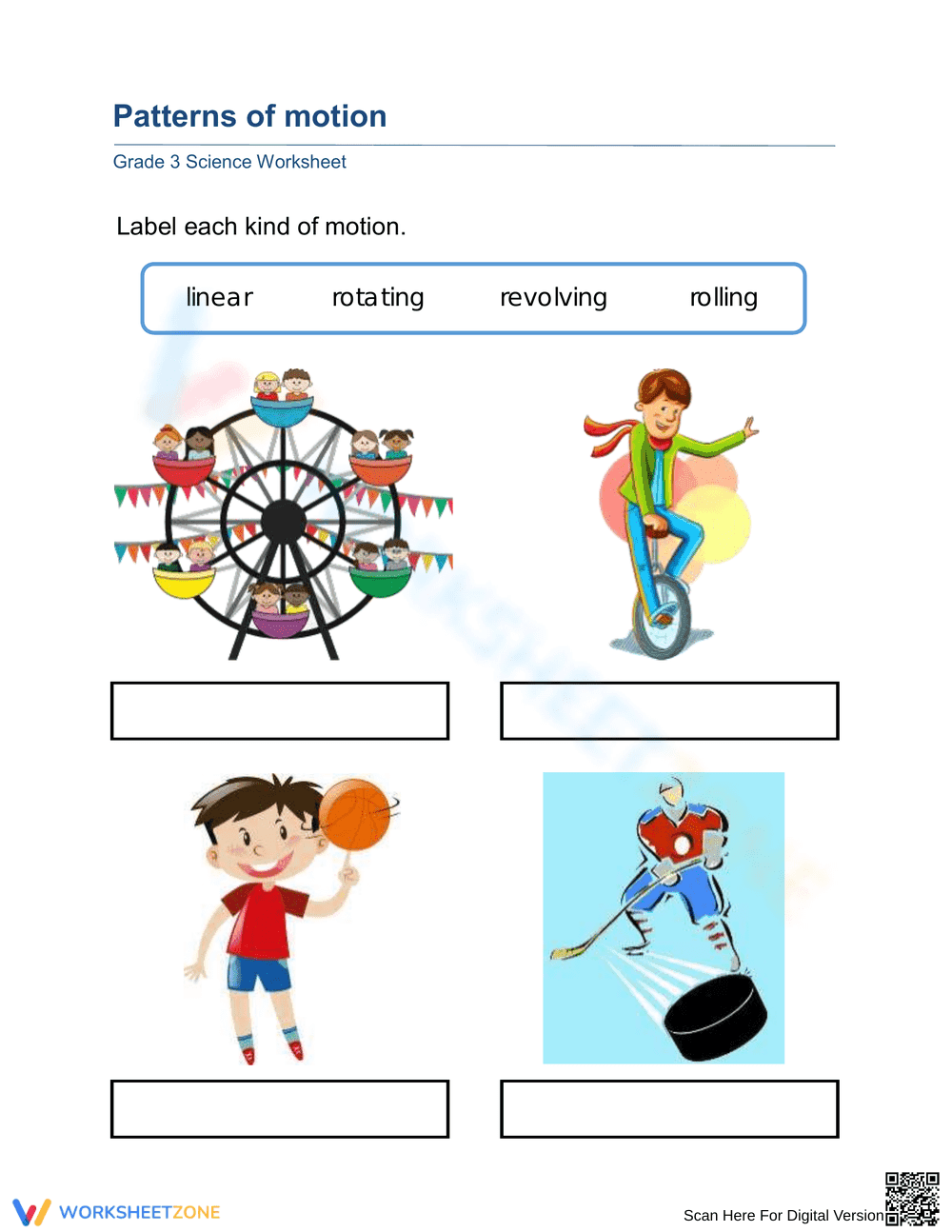
This Grade 3 patterns of motion worksheet helps students identify and classify different physical movements including linear, rotating, revolving, and rolling motion. By observing real-world examples, learners build a foundational understanding of how objects move. This resource provides immediate reinforcement of core physical science concepts through visual identification and vocabulary application.
At a Glance
- Grade: 3 · Subject: Science
- Standard:
3-PS2-2— Observe and record patterns of an object's motion to predict future movement- Skill Focus: Classifying types of motion
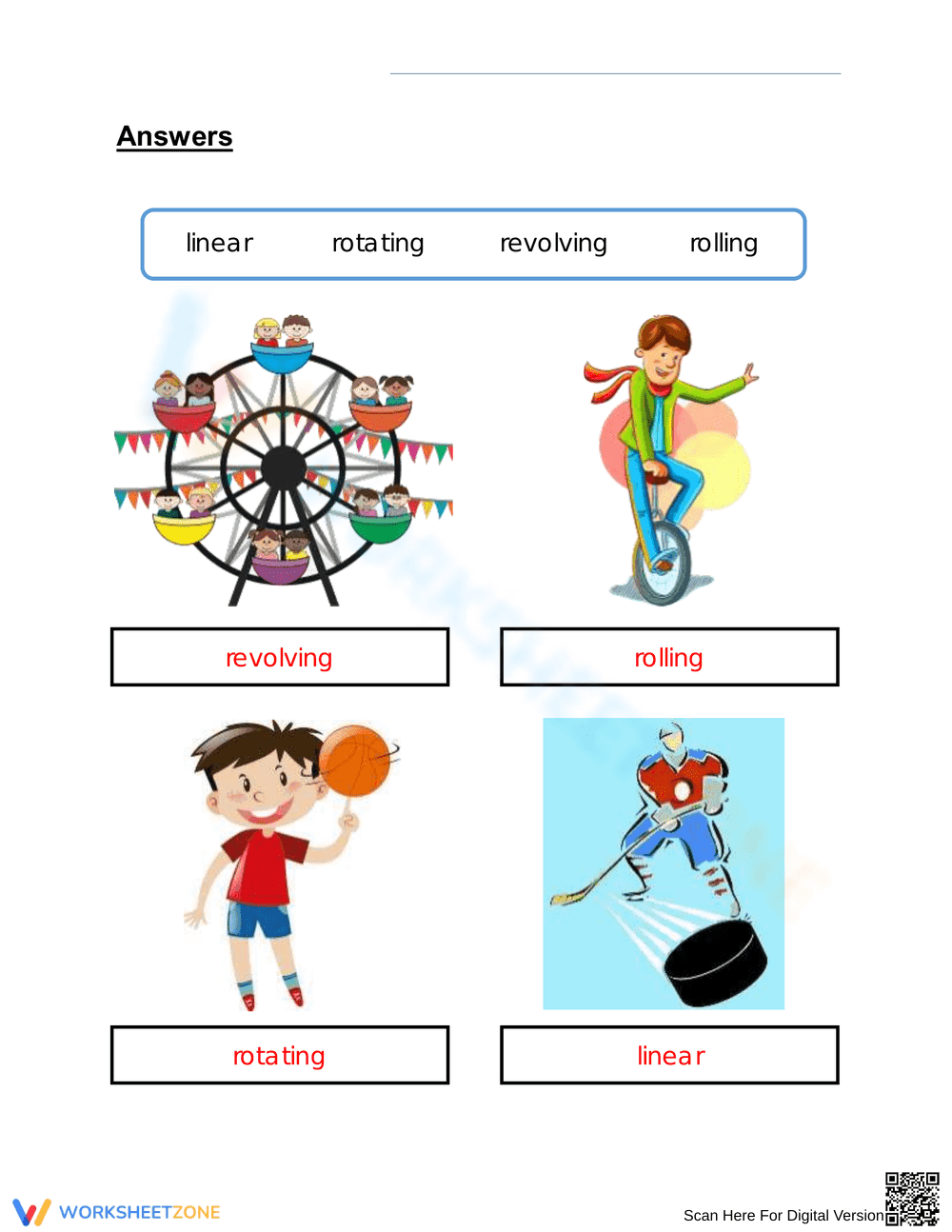
- Format: 2 pages · 4 problems · Answer key included · PDF
- Best For: Independent practice or quick formative assessment
- Time: 10–15 minutes
What's Inside
This two-page PDF includes a student worksheet and a corresponding answer key. The primary task features four distinct illustrations representing various types of movement: a Ferris wheel, a unicycle, a spinning basketball, and a hockey puck. A word bank containing key vocabulary provides support, ensuring students focus on the conceptual application of identifying motion patterns.
Zero-Prep Workflow
- Step 1: Print the single-page student worksheet and the answer key for quick reference (30 seconds).
- Step 2: Distribute to students as a transition task between science lesson segments (1 minute).
- Step 3: Review the four visual prompts as a group to discuss the evidence for each label (1 minute).
Total teacher preparation is under two minutes, perfect for busy classrooms.
Standards Alignment
This resource is aligned to 3-PS2-2, which involves making observations of an object’s motion to provide evidence that a pattern can be used to predict future motion. By identifying these four primary motion types, students recognize the predictable nature of physical systems. This standard code can be copied directly into lesson plans, IEP goals, or curriculum mapping tools.
How to Use It
Use this worksheet as a formative assessment following a lesson on force and motion. As students work, circulate and observe if they can distinguish between "rotating" and "revolving," a common point of confusion. Alternatively, use it as a science station activity where students must explain their reasoning. Expected completion time is 10 to 15 minutes.
Who It's For
This resource is designed for Grade 3 students but works well for second-grade enrichment or fourth-grade review. The visual nature makes it accessible for English Language Learners who benefit from reduced text density. It pairs naturally with a hands-on lab using tops and toy cars to demonstrate these motion types in real-time.
According to the RAND AIRS 2024 report on elementary science instruction, high-quality visual scaffolds are critical for helping young learners bridge the gap between abstract physics concepts and observable phenomena. This worksheet addresses the core requirements of the 3-PS2-2 standard by requiring students to classify four distinct patterns of motion: linear, rotating, revolving, and rolling. By isolating these specific movements, the activity provides the categorical framework necessary for students to eventually make data-driven predictions about physical systems. The inclusion of a clear answer key ensures instructional consistency, while the word bank scaffold supports vocabulary acquisition within the context of scientific inquiry. Research indicates that such focused, print-ready practice helps solidify foundational knowledge in physical science. This summary serves as a standalone reference for educators documenting standards-aligned curriculum materials within their professional portfolios or district compliance reports.


