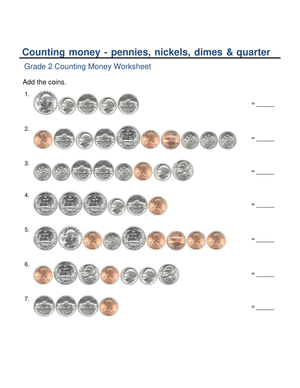
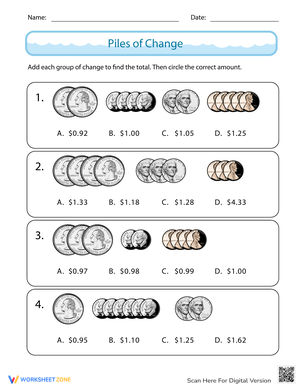
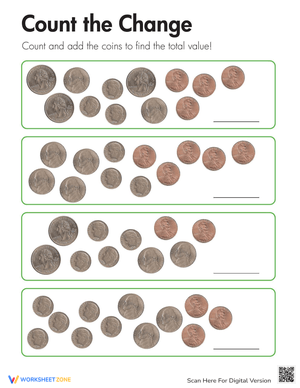
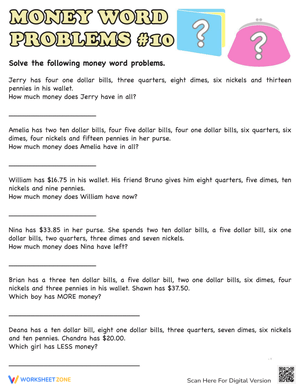
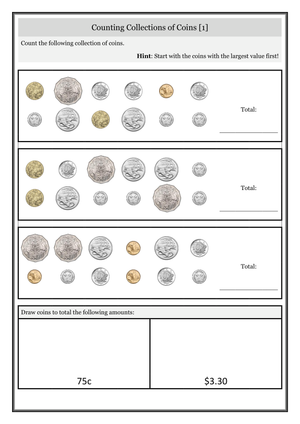
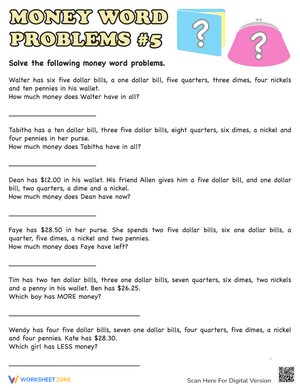
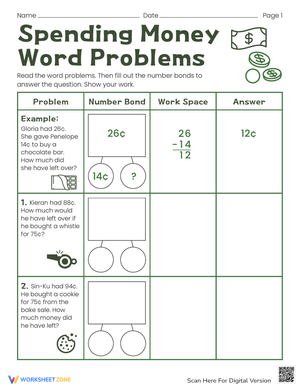
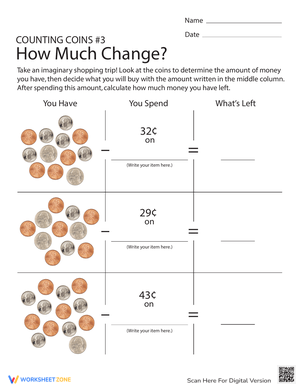
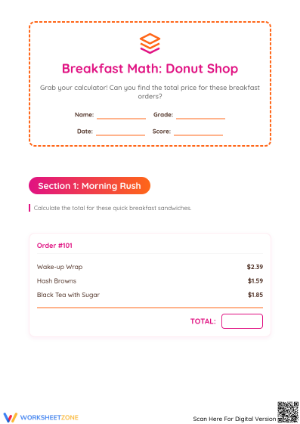
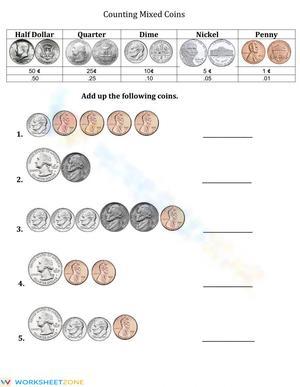
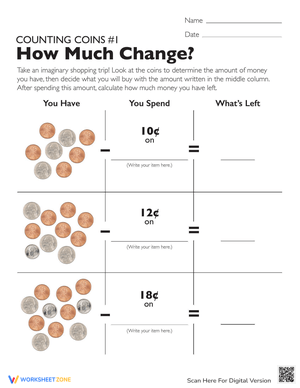
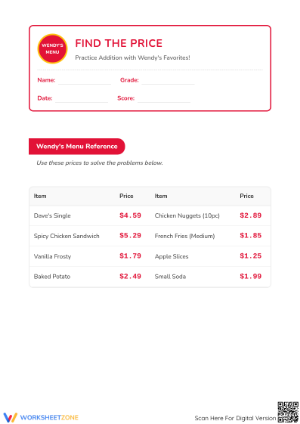
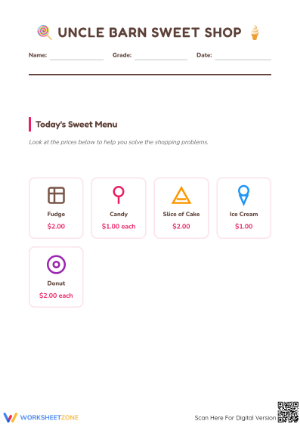
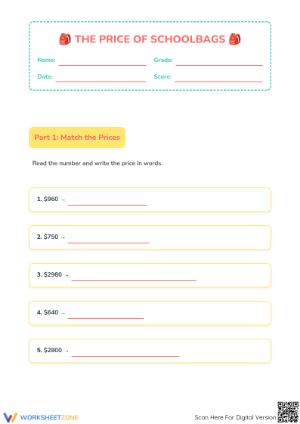
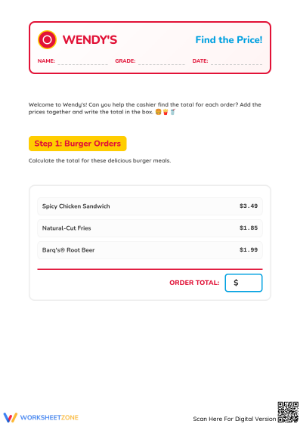
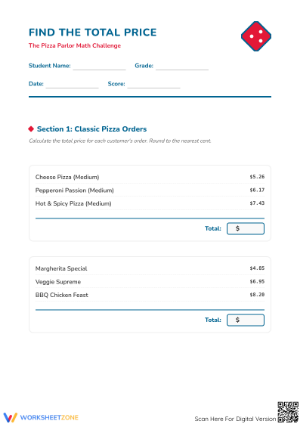
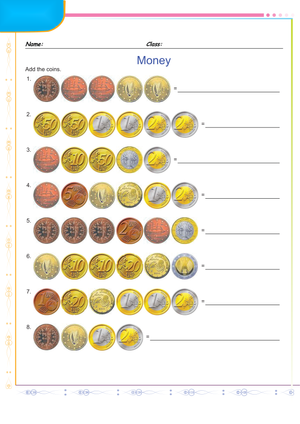
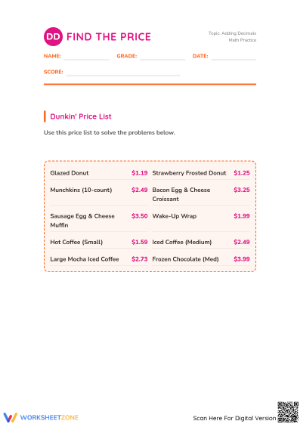
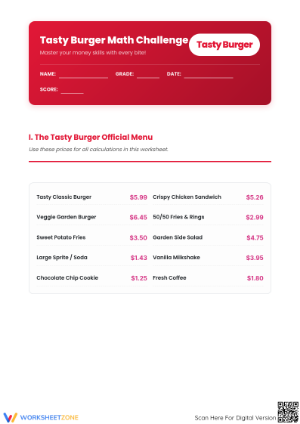
These 3rd grade operations with money printable worksheets give teachers a structured way to move students past coin identification — the second-grade baseline — into the harder work of adding and subtracting dollar-and-cent amounts, calculating exact change, and working through multi-step purchase problems written in decimal notation. The set targets amounts up to $20.00, which is enough range to force genuine regrouping without overwhelming students who are still solidifying three-digit addition.
Concepts in Each Worksheet
The resources divide into four distinct skill areas, each with problems that progress from simpler amounts to ones requiring two or more regrouping steps:
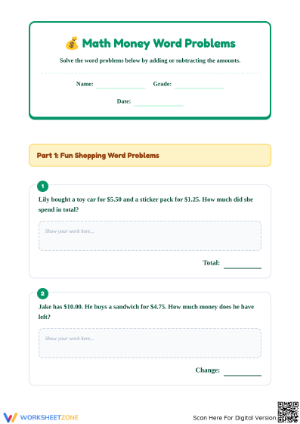
- Adding money with regrouping — problems where cents totals exceed 99 and students must carry into the dollar column
- Subtracting with borrowing — including the notoriously tricky $20.00 - $14.55 format, where students must borrow across zeros in both the tenths and hundredths columns
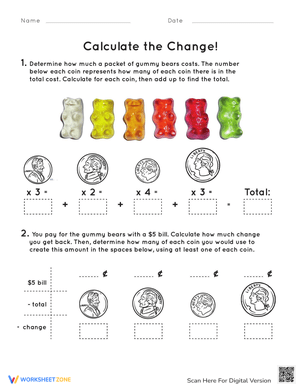
- Making change from a bill — subtracting a purchase price from $5, $10, or $20 using either the counting-up method or the standard algorithm
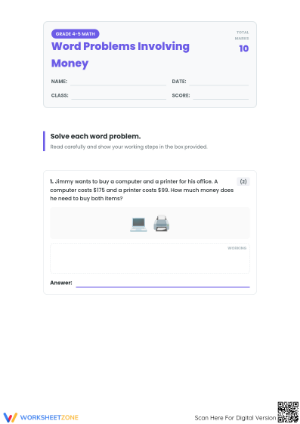
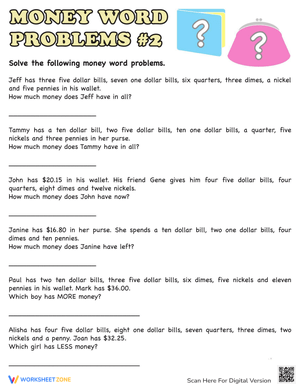
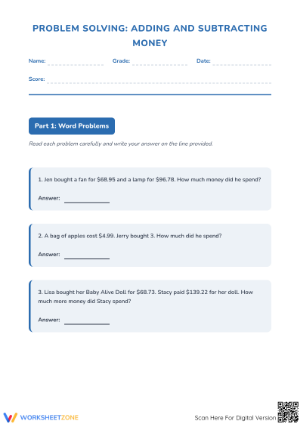
- Multi-step word problems — short shopping scenarios that require students to identify which operation to apply first before calculating anything
That last category matters more than it might initially appear. Third graders who breeze through vertical computation problems will often stall when the same numbers appear inside a sentence about buying a book and a pencil case. The gap between procedural fluency and reading comprehension applied to math shows up early and clearly in this type of problem.
Mistakes Students Make That These Worksheets Help You Catch
Decimal misalignment is the most consistent error. A student adding $8.75 and $5.50 will sometimes shift one number by a column, aligning the 5 in $5.50 with the hundredths place rather than the tenths. The resulting answer — while wrong — looks plausible enough to survive the student's own self-check. Pre-drawn vertical lines on each worksheet reduce how often this happens, but circling decimal points before starting any computation is the more reliable habit to build.
The borrow chain across zeros causes more confusion than almost any other situation third graders encounter in arithmetic. The specific error that appears most often: a student rewrites $20.00 as $19.10 instead of $19.90 during the borrowing sequence. They borrow correctly from the dollar column but then lose track of the value they just moved into the tenths place. This is not a careless mistake — it reflects a real gap in understanding how borrowing passes value from one place to the next. Catching it on a worksheet gives teachers something concrete to address, rather than marking an answer wrong and moving on without knowing why.
A smaller but recurring issue: students who carry correctly from the cents column into the dollar column will sometimes fail to add that carried 1 when the dollar column shows a zero. They see the zero, treat it as nothing, and leave it unchanged. A quick question during practice — "what did you carry, and where did it go?" — surfaces this faster than any written correction after the fact.
How to Work These Worksheets Into Your Week
The addition and change-making problems fit well into the first eight to ten minutes of math block, before direct instruction begins. Used this way, they function as formative checks rather than graded assignments — a quick scan of three problems tells you whether the class needs another whole-group session on decimal alignment or whether small-group pullout is more appropriate for the students still struggling. 3rd grade operations with money printable worksheets work particularly well for this diagnostic purpose because the errors students make are highly readable from a completed problem: a misaligned answer, a missing carry mark, a dollar sign dropped entirely from the answer line.
For partner work, pull the change-making problems specifically. Having one student play cashier while the other verifies the math on paper slows the arithmetic down just enough to reduce the impulsive mental-math errors that show up in solo work. The word-problem worksheets hold up as independent practice, but only after at least one modeled example — cold-starting students on them typically produces more guessing at which operation to use than actual computation.
Friday spiral reviews are another natural placement. Rotating through addition, subtraction, and change-making over successive weeks gives students spaced retrieval across the full skill set, which builds longer retention than running all the addition problems in a single week and then moving on.
Standard Alignment
CCSS.MATH.CONTENT.3.NBT.A.2 requires fluent addition and subtraction within 1000 using place-value strategies. Applying that standard to decimal currency is the standard instructional move at this grade level — money problems do not have a dedicated sub-standard in Grade 3 NBT, but they serve as the natural bridge between the coin-value work students completed under 2.MD.C.8 in second grade and the formal decimal fraction notation they will encounter in Grade 4. These worksheets sit at that instructional seam: students who can already regroup with three-digit whole numbers are ready to transfer that understanding to dollars and cents without relearning the underlying mechanics. Placing them mid-year, after regrouping with whole numbers is stable, gives students the cleanest path to making that transfer.
Differentiating the Set Across Student Levels
For students who are still shaky on regrouping with whole numbers, pair each worksheet with physical coins and a dollar bill. Ask them to build the amounts before recording anything, then act out the exchange between coins and bills before writing the carry notation. The extra step takes time, but it prevents the surface-level copying that happens when students write numbers they do not yet understand. Within the set, direct these students to addition problems only until regrouping feels stable — mixing addition and subtraction too early compounds the confusion rather than building on it.
Students who move through the grade-level problems quickly respond well to the multi-step word problems, and to a variation you can assign on the spot: give them a spending scenario with a fixed budget and ask them to get as close to that total as possible without going over. The task requires repeated addition, comparison, and decision-making — it holds attention in a way that single-step drill rarely does for students who are already fluent at the basic operations.
Frequently Asked Questions
How do I help students remember to align decimal points?
Have students draw a vertical line down the decimal column before writing any digits. Some teachers use graph paper for the same purpose — one digit per box, with the decimal line running between two boxes. Once students catch two or three of their own alignment errors this way, the habit tends to stick. Drawing the line first, before any numbers appear, is more effective than reminding students verbally after the problem is already set up wrong.
Which worksheet type should I introduce first?
Start with addition problems where cents total less than 100, so no carrying is required yet. Students confirm decimal placement and dollar sign formatting without having to manage regrouping at the same time. From there, move to addition with carrying from the cents column, then to subtraction with borrowing, and hold the change-making problems for last. Each step adds exactly one new complexity — that sequence reduces the number of students who freeze mid-problem because too many things are unfamiliar at once.
How should I handle a student who keeps making the same borrowing error?
Isolate the error type and give that student a worksheet focused only on that structure. Ask them to annotate each borrowing step in a different color — for example, red for borrowing from the dollar column, blue for recording that borrowed value into the tenths place. Then ask them to narrate each step aloud while writing it. The narration almost always reveals exactly where the chain breaks. 3rd grade operations with money printable worksheets that include a "show your work" column are especially useful here, because the extra space encourages step-by-step notation rather than the mental calculation that leaves nothing to examine afterward.
Can these be sent home as homework?
Yes, with one practical addition: include a worked example at the top of each worksheet and a brief note explaining which strategy you are currently using for change-making. Parents who learned only the standard subtraction algorithm will sometimes reteach it in a way that conflicts with the counting-up approach you introduced in class, which creates confusion the following morning. A single sentence — "We are currently practicing counting up from the purchase price to the bill amount" — prevents most of that friction. The 3rd grade operations with money printable worksheets in this set have clear enough layouts that students can work independently at home once the method has been modeled in class.
Do these worksheets address multi-step problems?
Several of the word-problem worksheets require two calculations — adding a total first, then subtracting from a given bill. That format mirrors what students see on most state assessments at this grade level, where a single prompt asks for the total cost and the change returned in the same question. Working through both steps with space to record the intermediate total prepares students for that format better than single-operation drill alone does.













 Interactive Worksheet Maker
 Quiz Maker
 Word Search Maker
 Crossword Puzzle Maker
 Word Scramble Generator
 Sentence Scramble Generator
 Handwriting Worksheet Generator
 Name Tracing Generator
 Fill In The Blank Generator