


























Views
Downloads




Grade 4 Money Math — Printable No-Prep Worksheet
Paste this activity's link or code into your existing LMS (Google Classroom, Canvas, Teams, Schoology, Moodle, etc.).
Students can open and work on the activity right away, with no student login required.
You'll still be able to track student progress and results from your teacher account.
Engaging, Real-World Math Practice
This practical, real-world worksheet helps students in grades 3 and 4 master essential money math skills. Using a familiar fast-food menu, learners practice adding item prices to calculate a total bill and subtracting that amount from a given total to make change. It provides concrete, engaging practice for a critical life skill.
At a Glance
- Grade: 3–4 · Subject: Math
- Standard:
CCSS.MATH.CONTENT.4.MD.A.2— Solve word problems involving money using addition and subtraction.- Skill Focus: Money Math, Adding & Subtracting Decimals
- Format: 5 pages · 20 problems · Answer key included · PDF
- Best For: Life Skills, Consumer Math Practice, Sub Plans
- Time: 25–40 minutes
What's Inside
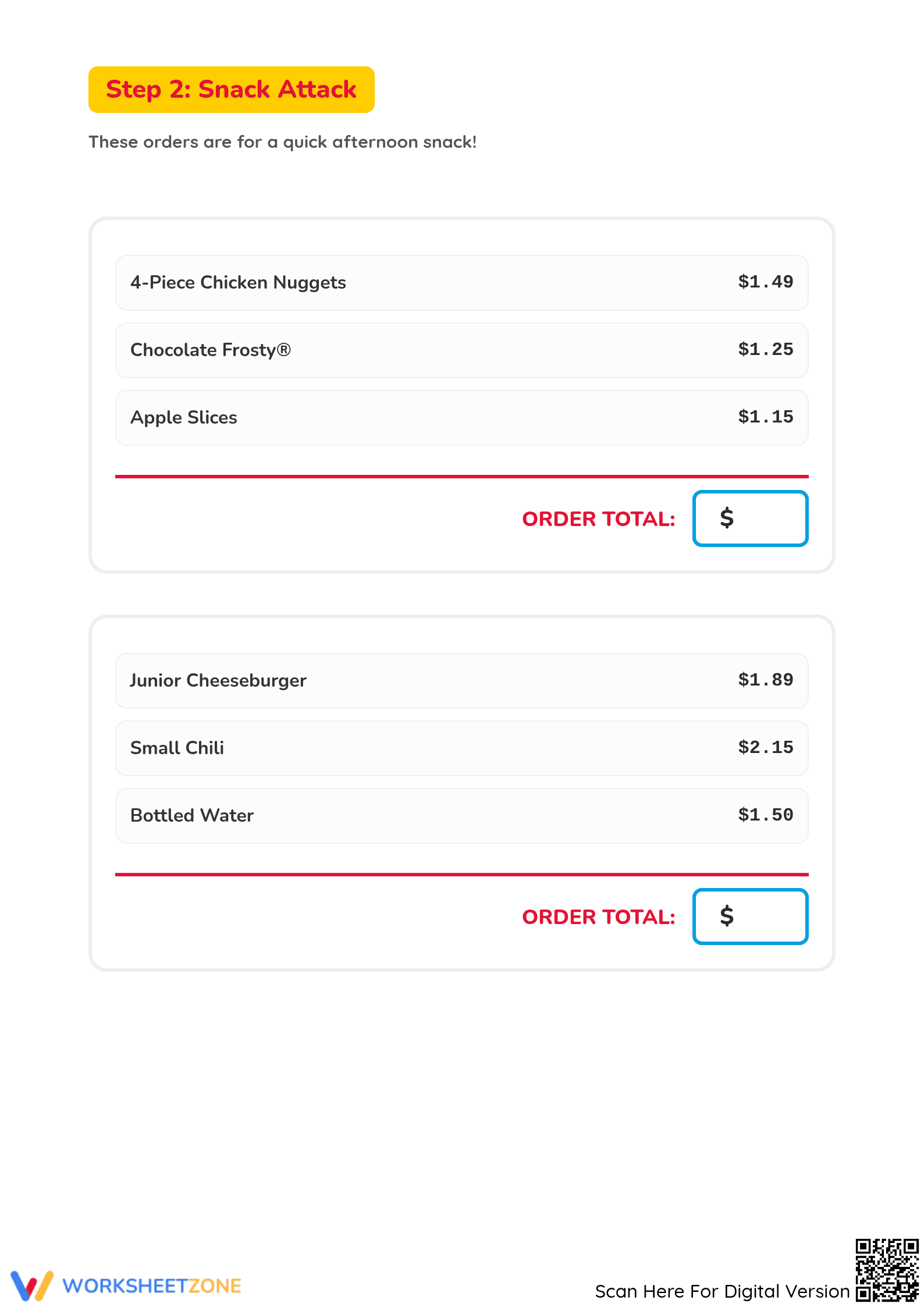
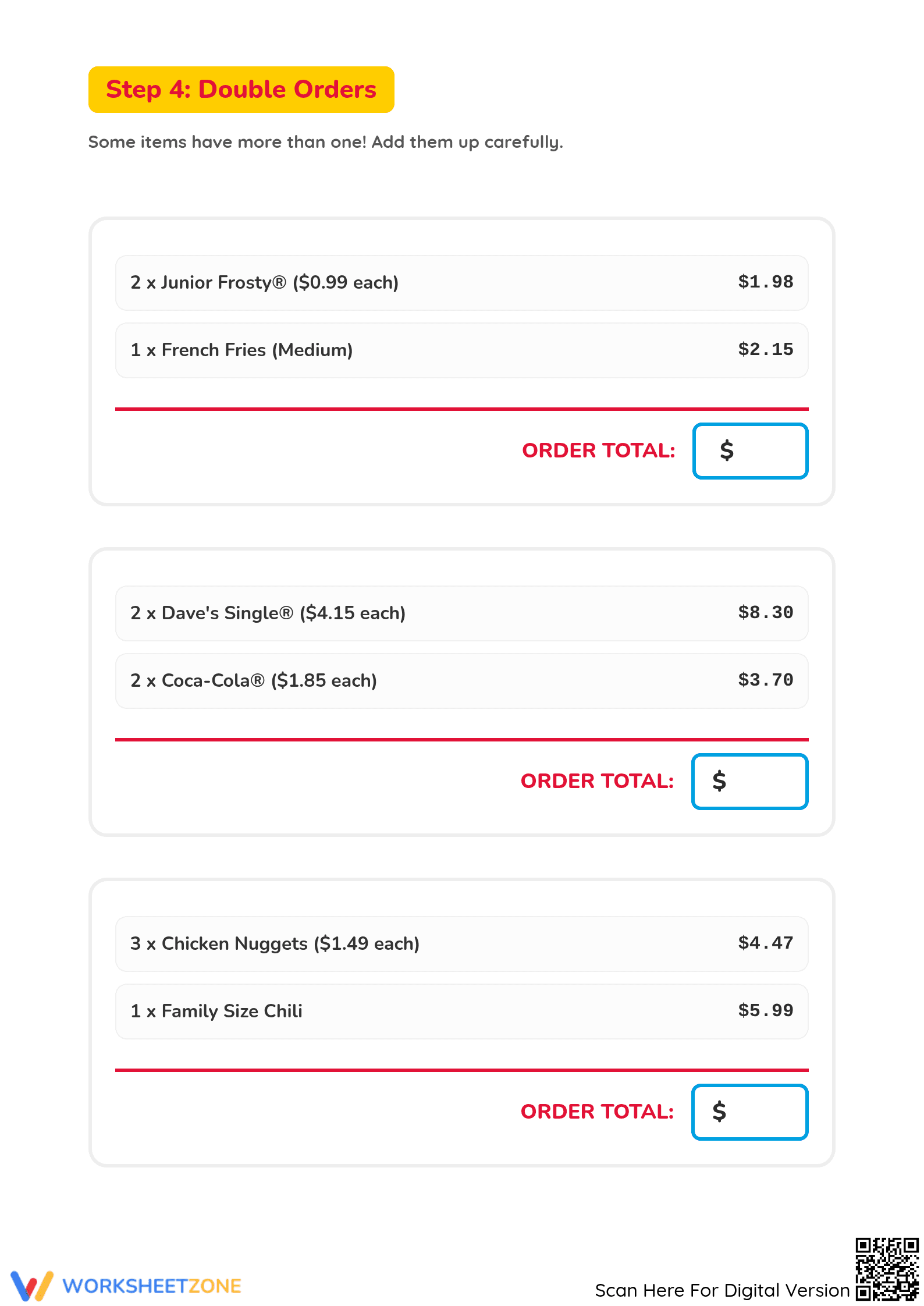
This five-page resource includes a clear, realistic menu from a popular fast-food restaurant. Across the worksheets, students will tackle 20 distinct problems organized into two types: calculating the total cost of an order and determining the correct change from a payment. A complete, easy-to-use answer key is provided for all problems.
A Seamless, No-Prep Classroom Experience
Designed for busy teachers, this activity requires virtually no preparation. Here's a typical workflow:
- Print (2 minutes): Simply print the five-page worksheet packet and the answer key. The PDF is formatted for immediate use.
- Distribute (1 minute): Hand out the worksheets. The self-contained directions allow learners to begin working independently, making it an excellent choice for a substitute teacher plan.
- Review (10 minutes): Use the provided answer key to review answers as a class or for individual grading. The clear layout makes checking work quick and efficient.
Total teacher prep time is under 5 minutes.
Connecting to Grade-Level Standards
This worksheet directly supports a key standard for elementary mathematics. The primary alignment is to CCSS.MATH.CONTENT.4.MD.A.2, which requires students to use the four operations to solve word problems involving money. This resource focuses specifically on adding and subtracting decimals in a money context. The standard code can be copied directly into lesson plans, IEP goals, or district curriculum mapping tools.
Flexible for Any Lesson Plan
This versatile resource can be used in various instructional settings. As a follow-up to a lesson on decimals, it serves as perfect independent practice. Or, use it as a pre-assessment to gauge existing consumer math skills. For a formative assessment tip, circulate while students work and observe their strategies for aligning decimal points. Most students will complete the activity in approximately 25 to 40 minutes.
Built for Real-World Learners
This worksheet is ideal for students in grades 3 and 4 learning to apply math to real-life situations. The familiar fast-food menu makes abstract decimal operations concrete and relevant. For students needing support, pair this activity with a calculator or an anchor chart showing the steps for decimal addition. It's a foundational resource for building financial literacy.
This resource provides targeted practice for standard CCSS.MATH.CONTENT.4.MD.A.2, where students learn to solve multi-step word problems with money. By embedding mathematical tasks within the authentic context of a consumer transaction, the worksheet bridges procedural skill with conceptual understanding—a practice supported by extensive research. Studies highlight the value of "anchored instruction," where learning is situated in realistic problem-solving environments. As Fisher & Frey (2014) note, applying skills to contexts that mirror students' lives increases engagement and the likelihood of knowledge transfer. This worksheet does precisely that, moving beyond rote calculation to functional application. It gives students repeated, structured practice in adding costs and making change, building a critical life skill while reinforcing the core mathematical principles of decimal operations required by elementary standards, ensuring students are prepared for both academic assessments and future financial responsibilities.


