These 3rd grade money printable worksheets resources hand teachers a focused collection of practice materials for coin counting, making change, decimal notation, and multi-step financial word problems — the specific skills that distinguish third-grade money instruction from what students practiced in second grade. Each worksheet addresses a narrow, defined task, so a teacher can pull exactly what a lesson or small group actually needs.
What the Set Covers
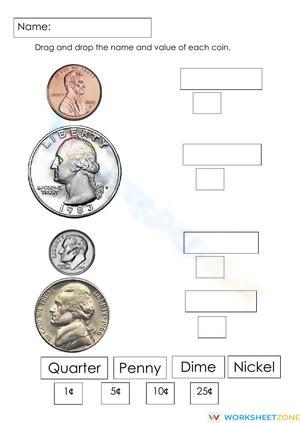
Most third graders arrive able to name coins and recall basic values. What the grade-level work actually requires is more demanding: counting a disordered mix of bills and coins, recording the total as a decimal with a dollar sign, calculating how much change comes back from a five-dollar bill, and working through problems that need two separate calculations before arriving at a final answer. Each of those skills gets its own worksheet.
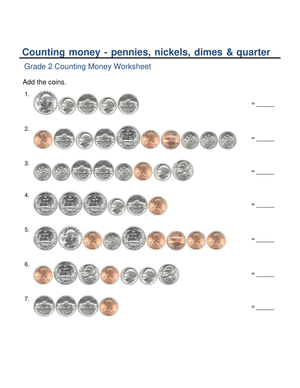
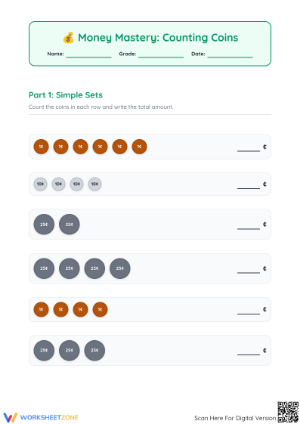
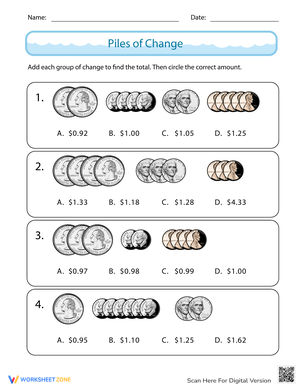
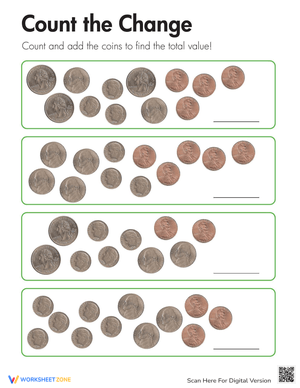
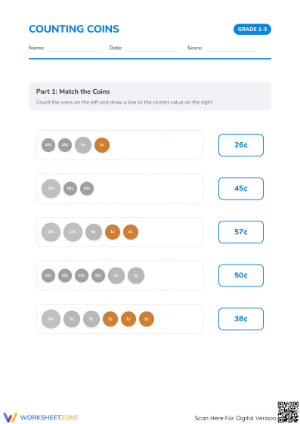
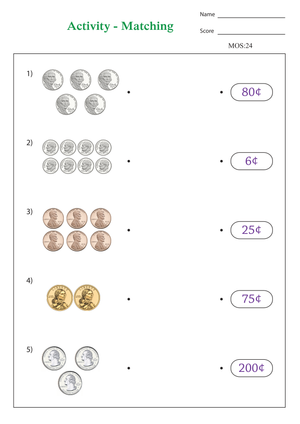
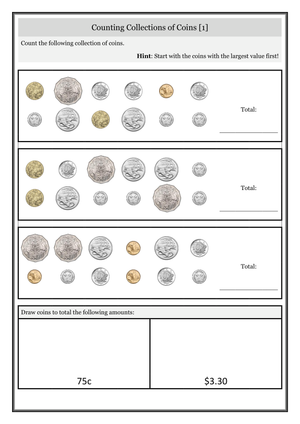
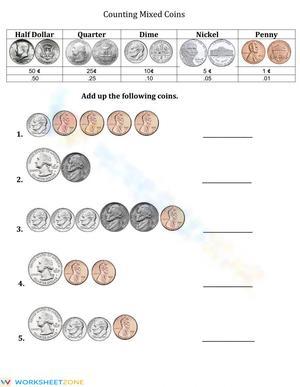
- Counting mixed collections: Students count randomly arranged pennies, nickels, dimes, quarters, and dollar bills, then write the total in decimal notation. Some worksheets in the set include half-dollars and two-dollar bills for students ready to extend beyond standard denominations.
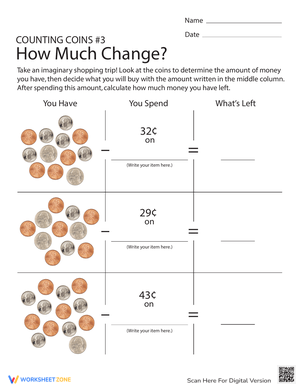
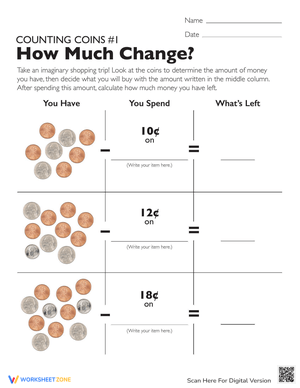
- Making change: Each worksheet presents a purchase price and an amount tendered. Students calculate the change, show their work, and on several worksheets identify which specific coins and bills make up that change.
- Comparing and ordering amounts: Students use the phrases greater than, less than, or equal to to compare two collections side by side, and on some worksheets order three or more amounts from least to greatest.
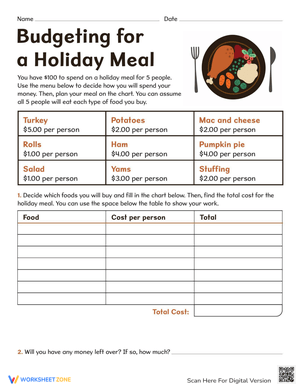
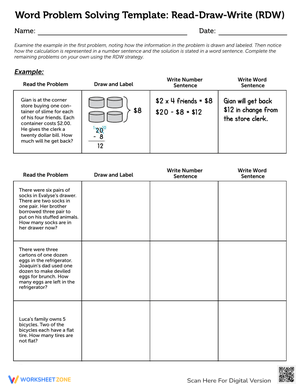
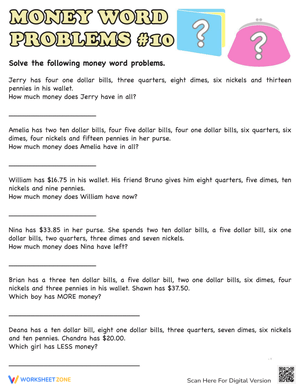
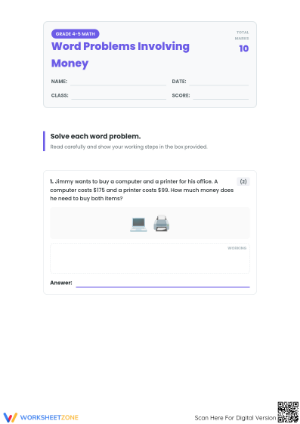
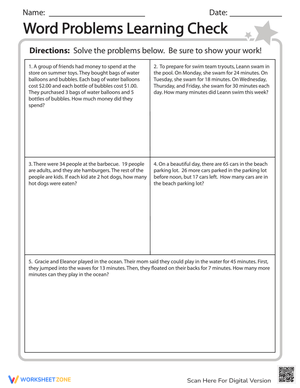
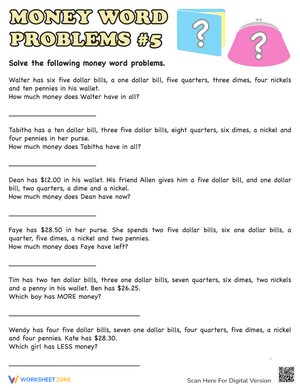
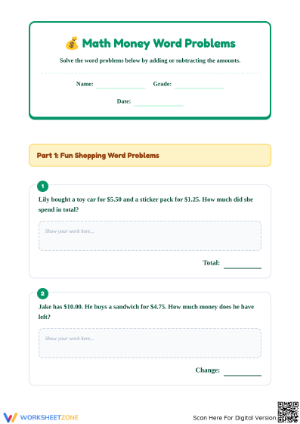
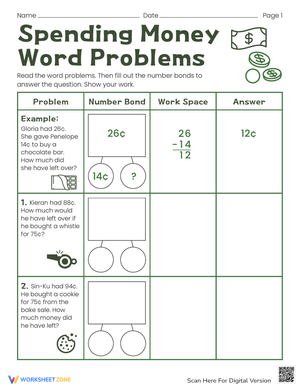
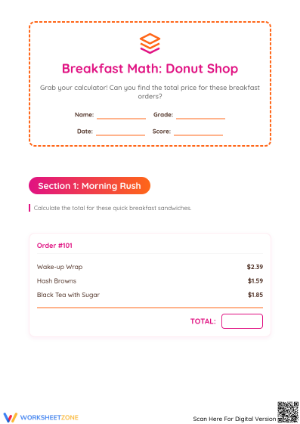
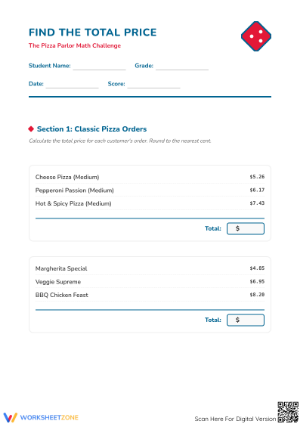
- One- and two-step word problems: Scenarios involve buying school supplies, splitting a cost between friends, or saving toward a goal. Two-step problems require finding a total first and then calculating change — the sequence mirrors the most consistent error pattern in this type of problem.
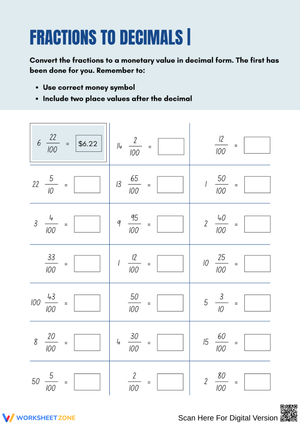
- Decimal notation conversion: Standalone worksheets have students convert between cent notation (75¢) and dollar notation ($0.75), a conversion that trips up many students who understand the value but confuse the two symbolic forms.
The set builds from recognition and counting through symbolic representation and applied problem-solving. These 3rd grade money printable worksheets materials work because each one targets a single, clear task rather than asking students to juggle four skills at once — which means teachers can isolate the exact point of breakdown when a student is struggling.
Error Patterns to Anticipate Across the Unit
The most persistent error in third-grade money work is what teachers often call the restart problem. A student counts four quarters correctly — 25, 50, 75, $1.00 — and then, when a dime appears next in the collection, resets to zero and counts only the dimes. They treat each denomination as a separate counting sequence rather than maintaining a running total. On a worksheet where coins are grouped by type, this error stays hidden. Worksheets that present coins in a random, unsorted arrangement bring it to the surface immediately, which is why those unsorted versions matter even when they look harder to grade.
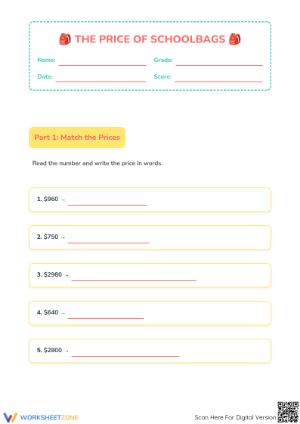
Decimal notation produces its own category of persistent mistakes. Students write $.75 instead of $0.75, or position the cent symbol incorrectly as 75.¢. Some write $75.00 when they mean 75 cents — producing totals that look as though a student bought a pencil for seventy-five dollars. These aren't careless errors; they reflect genuine confusion about what the dollar sign and the decimal point each do within the number. Running a short notation-only worksheet — no counting, just conversion between forms — before introducing word problems saves significant correction time later in the unit.
In two-step word problems, students frequently answer the first step and stop. They find the total cost of two items but never subtract from the amount paid. The problem asked for change; the student answered with a total and moved on. That pattern shows up consistently enough across grade levels that it's worth posting a visible checking prompt — "Did you answer the question the problem actually asked?" — before students turn in any word problem work.
Fitting These Worksheets Into Your Weekly Lesson Structure
The window right after morning meeting and before the first formal math block — often eight to ten minutes — is a reliable slot for a coin-counting warm-up. Running one making-change worksheet as morning work two or three times a week during the money unit does more for retention than massing the same number of problems into a single long session. Spacing the practice matters more than the total problem count, and money fluency builds exactly that way.
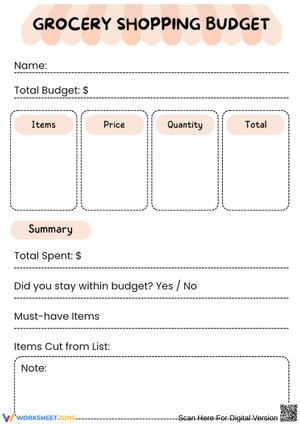
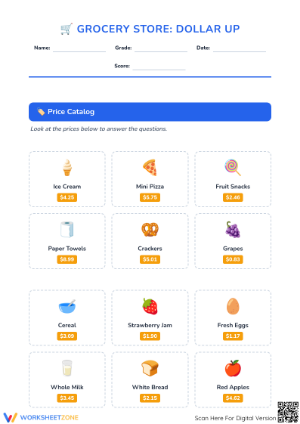
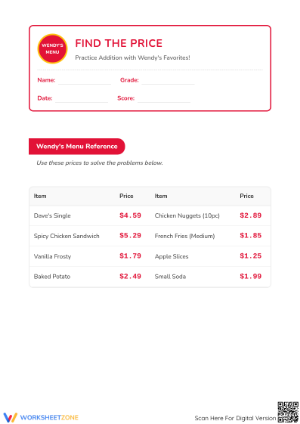
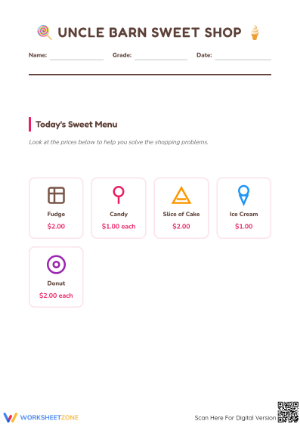
Math centers are where the word problem worksheets pay off most. Set up a buying-and-selling center with a simple printed menu or supply list, and give each student a worksheet to record selections, calculate totals, and determine change from a set amount. Students stay engaged because the task feels applied, and the teacher can circulate or pull a small group without the center losing direction.
When introducing making change for the first time, pair the printed worksheet with a handful of physical coins. Ask students to place coins on the printed coin images before writing any numbers. That one step — physical coin on printed image — eliminates most of the regrouping errors that come from students trying to hold the whole calculation in working memory simultaneously. It bridges concrete manipulation and abstract notation without adding instructional complexity, and it takes thirty seconds to explain.
These 3rd grade money printable worksheets materials also work as exit tickets at the end of a lesson: a two-problem strip tells a teacher exactly which students are ready to move to two-step problems and which need one more day with straight counting. That quick formative read changes what you plan for the following morning.
Standard Alignment
The core money standard in the Common Core State Standards sits at second grade — 2.MD.C.8, which asks students to solve word problems using dollar bills, quarters, dimes, nickels, and pennies with the dollar sign and cent symbol. Many states extend this work explicitly into third grade: Texas (TEKS 3.4C) and Virginia (VA SOL 3.7), among others, carry dedicated third-grade money standards with expanded expectations around making change and multi-step problems. In CCSS-aligned states, third-grade money practice is most accurately framed through 3.OA.D.8 — solving two-step word problems using the four operations — with financial scenarios as the vehicle. Teachers in those states are doing OA domain work even when plastic coins are sitting on the desks. That framing matters when a coach asks where money instruction fits in the pacing guide.
Tailoring the Set for Students at Different Skill Levels
Students who struggle with mixed-coin counting make the most progress when they start on worksheets where all coins of the same type are already grouped together. That single structural change — sorted versus unsorted layout — reduces the visual demands of the task and lets a student practice the counting sequence without simultaneously managing a visual search problem. Move to unsorted worksheets once the sequence is reliable, not before; pushing too soon erodes rather than builds accuracy.
For students performing above grade level, the two-step word problems can carry additional challenge without requiring different materials. Ask those students to solve each problem both ways: using the counting-up method and using subtraction, then verify that both approaches produce the same answer. This builds the kind of flexible operation reasoning the 3.OA standards are pointing toward, and it surfaces any gaps in subtraction accuracy that might otherwise stay hidden behind a correct answer reached a single way.
The visual coin images on these 3rd grade money printable worksheets resources remain genuinely useful for students with dyscalculia or weak number memory well past the point where their peers have stopped needing them. A student who counts accurately by pointing at printed images is doing the mathematical work correctly. The goal is accurate answers building toward fluency — removing visual supports before a student is ready slows progress rather than accelerating it.
Frequently Asked Questions
What's the right sequence for introducing money skills across the unit?
Start with single-denomination counting — all pennies, then all nickels, then dimes, then quarters. Once students skip-count fluently in each denomination, combine two coin types, then three, and finally all five plus dollar bills. Making change belongs after students can count mixed collections accurately and consistently. Word problems can appear in one-step form throughout the unit; two-step problems work best in the second half, when counting and basic change calculation are solid enough to carry an additional reasoning step.
How do I teach making change before students have learned subtraction with regrouping?
The counting-up strategy makes regrouping unnecessary, and most third graders find it more intuitive than subtraction anyway. Teach students to start at the purchase price and count forward to the amount paid: from $2.75, count up a quarter to $3.00, then count up two dollar bills to $5.00 — the change is $2.25. The worksheets leave space for students to record the counting-up sequence rather than just writing a final answer, which makes the method visible and checkable during teacher review.
Should students use physical coins alongside the worksheets?
Yes, particularly when first working through making change and counting unsorted collections. Handling physical coins activates processing that looking at printed images does not, and for students who count by touching each object, plastic coins prevent the skip-and-recount errors common with static images. Pull the physical coins back gradually as accuracy improves — don't wait for the student to request stopping, and don't remove them simply because peers have moved on.
How do I know when a student is ready to move from counting worksheets to word problems?
The practical benchmark is consistent accuracy on unsorted mixed-coin worksheets that include quarters — not just on sorted or single-denomination work. A student who scores well on sorted layouts but drops significantly on unsorted ones hasn't automated the counting sequence yet, and word problems will compound that difficulty rather than build on it. A quick three-problem oral check with physical coins tells you more in two minutes than a full written worksheet can when you're deciding whether to move forward.













 Interactive Worksheet Maker
 Quiz Maker
 Word Search Maker
 Crossword Puzzle Maker
 Word Scramble Generator
 Sentence Scramble Generator
 Handwriting Worksheet Generator
 Name Tracing Generator
 Fill In The Blank Generator