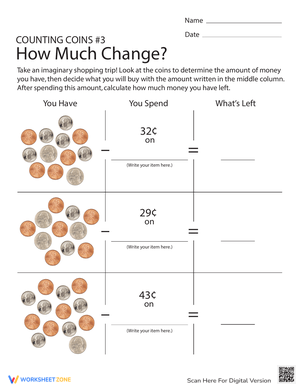
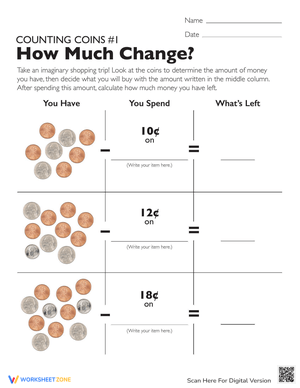
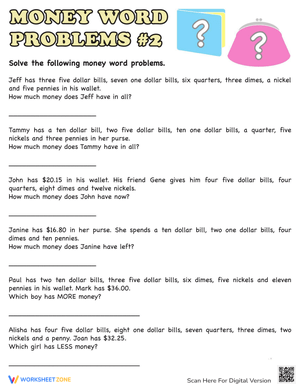
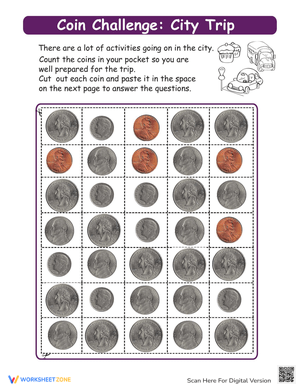
These subtracting money printable worksheets for 3rd grade target the exact moment in the year when students are expected to apply the subtraction algorithm to dollars-and-cents notation — a shift that trips up more students than teachers usually predict before they see the first round of papers. The set gives teachers ready-to-use practice at three levels of complexity: cents-only subtraction, mixed dollar-and-cent amounts, and the hardest category, subtracting from whole dollar amounts where every digit in the cents section starts at zero.
What the Worksheets Cover
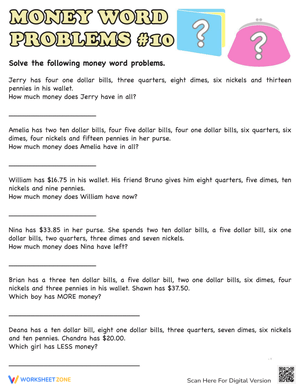
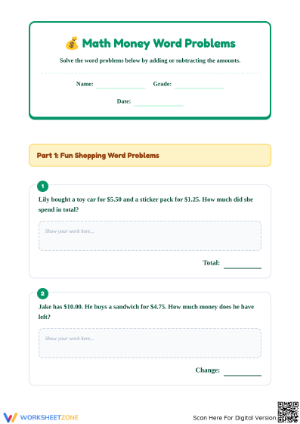
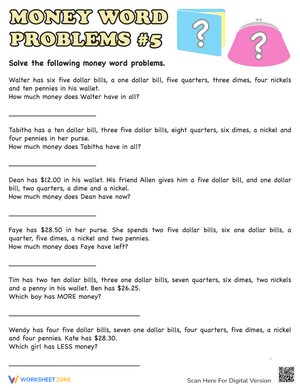
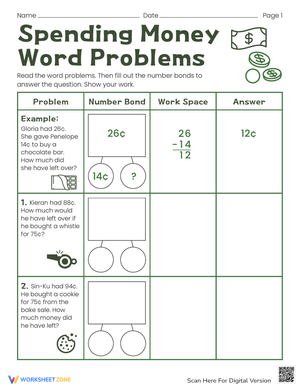
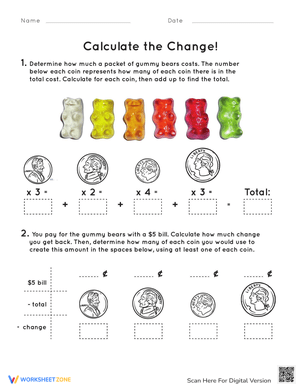
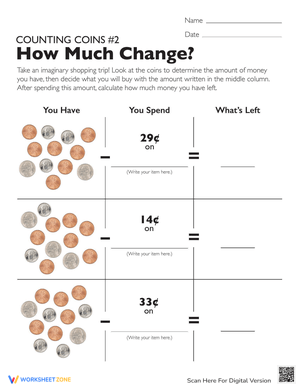
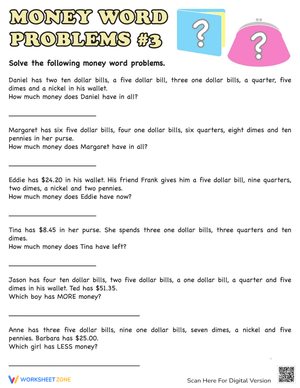
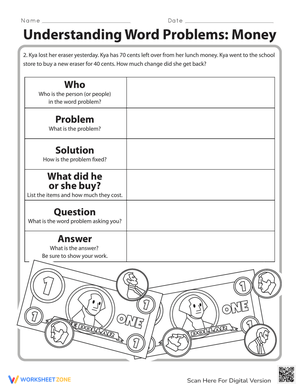
Each worksheet in the set isolates a distinct slice of money subtraction rather than mixing every problem type together. The entry-level worksheets have students subtract amounts under one dollar — $0.87 minus $0.34, for example — so they can focus on decimal placement before regrouping enters the picture. Mid-level worksheets introduce mixed dollar-and-cent amounts with regrouping confined to the cents column only. The advanced worksheets address the scenario students find hardest: subtracting from amounts like $5.00 or $10.00, where both cents columns start at zero and must be regrouped before any subtraction can happen. Word problems appear throughout, asking students to calculate change after a purchase rather than work through isolated vertical computation.
Error Patterns to Watch for in Student Work
Decimal misalignment shows up first. Students who have been performing whole-number subtraction reliably will write $4.25 above $1.70 and line up the rightmost digit rather than the decimal point — subtracting 5 from 0 in the hundredths place and producing an answer that's off by an order of magnitude. The column structure on each worksheet helps, but students still drift past the grid lines when the numbers feel more "even" a different way.
The harder pattern occurs in regroup-across-zeros problems. A student subtracting $2.45 from $5.00 knows they need to regroup but typically tries to borrow from the tenths column — which reads as zero — without understanding they must first borrow from the dollars column. The full chain is a two-step borrow: one from the dollars place to get 10 tenths, then one from the tenths to get 10 hundredths. The typical result is $3.55 or $2.55, with the dollar digit left untouched. These aren't careless slips; they reflect a genuine gap in how multi-column regrouping transfers to a decimal context. Students need to see the chain made explicit before worksheet practice can consolidate it.
A third pattern: correct regrouping, correct arithmetic, but the final answer written as 125 instead of $1.25. Building a short class norm — circle your dollar sign and decimal point before moving to the next problem — catches this before it becomes habit.
Where These Worksheets Fit in Your Day-to-Day Sequence
The strongest placement for the first worksheet is the day after initial instruction, not the day of. When money subtraction is introduced through a whole-group lesson with play coins or a projected number line, students are watching and nodding. Running subtracting money printable worksheets for 3rd grade as a day-two warm-up — even just the first four problems — shows the teacher exactly where the class landed before moving deeper into the skill.
- Math centers: Laminate one worksheet from each difficulty tier and pair it with a small tub of play coins and dollar bills. Students physically make the starting amount, remove what's being subtracted, and record the result with a dry-erase marker. The physical exchange makes regrouping visible in a way the algorithm alone does not.
- Small-group pullout: Read each word problem aloud before students begin. This removes decoding as a variable and clarifies whether a student is stuck on the language or the math — a distinction worth identifying before you intervene.
- Whole-class day two: Project one problem and annotate each regrouping step together before releasing students to work independently. A slow, narrated example at the start saves re-teaching after the fact.
- Homework: Send a brief parent note explaining the counting-up verification method so families have a checking strategy that doesn't require re-explaining the standard algorithm.
The counting-up method is worth embedding into the worksheet routine itself. After any computation problem, ask students to verify their answer by starting at the smaller amount and counting up to the total paid. If an item costs $3.75 and the customer pays $5.00: $3.75 to $4.00 is 25 cents, $4.00 to $5.00 is one dollar — total change, $1.25. When the algorithm and the count-up agree, that's genuine self-checking, not just copying from an answer key.
Standard Alignment
These worksheets address CCSS.MATH.CONTENT.2.MD.C.8, which requires students to solve word problems involving dollar bills and coins and to use the dollar and cent symbols correctly. Most third-grade teachers revisit this standard because students arrive with uneven exposure from second grade — some have had extended practice, others have not. Third grade is also where 3.NBT.A.2 (fluent subtraction within 1000) becomes the computational backbone, and money provides one of the most direct real-world application contexts for that standard. The word-problem worksheets address the "solve" language of 2.MD.C.8 while requiring the algorithmic precision that 3.NBT.A.2 demands.
Tiering the Work for Students at Different Points in the Year
For students still consolidating basic subtraction, start with the cents-only worksheets and keep manipulatives nearby. The instructional goal at that level is reliable regrouping within the cents column before the dollar place adds another layer of complexity. Pushing these students into $10.00 minus $6.42 before their regroup mechanics are solid produces frustration and copying rather than learning. Holding them at the right level for a few extra days is more efficient than accelerating and then reteaching.
Students who move through the standard set quickly can be directed toward the subtracting money printable worksheets for 3rd grade featuring multi-step word problems, where they first find the total cost of two items and then subtract that total from a given bill. This requires a shift from single-operation thinking to two-operation planning — closer to how money actually works in a purchasing situation. A useful extension beyond that: ask these students to write their own word problems using prices from a classroom menu and trade with a partner. Constructing a solvable problem forces them to identify which values are given, which is unknown, and whether their chosen numbers will produce a result that makes sense.
Frequently Asked Questions
My students subtract whole numbers reliably but fall apart with money. What's actually different?
Two things change simultaneously: the decimal point introduces a new positional anchor, and cent values require students to work with hundredths — a place value not formalized in whole-number subtraction. Students who have been lining up problems by the rightmost digit now need to anchor to the decimal instead. That switch, combined with multi-column regrouping, is what causes the breakdown. The subtracting money printable worksheets for 3rd grade in this set address both by leading with decimal alignment tasks before introducing regrouping across zeros.
What do I do when a student regroups correctly but still gets the wrong answer?
Have the student talk through each step aloud while you watch their pencil. The most common culprit: the student completes the regroup in the cents columns but forgets to reduce the dollar digit, leaving it unchanged — producing an answer exactly one dollar too high. A brief one-on-one conversation identifies which error type you're dealing with and tells you what to address directly before assigning more practice.
Can parents support this work at home without much explanation?
The computation worksheets are clear enough for most parents to follow. The regrouping-across-zeros problems may create friction if families use different language around borrowing or aren't sure how to help when a student gets stuck mid-problem. Sending home a short note explaining the counting-up verification method gives parents a concrete tool that doesn't require re-teaching the algorithm — and gives students a way to check their own work before calling anyone over.













 Interactive Worksheet Maker
 Quiz Maker
 Word Search Maker
 Crossword Puzzle Maker
 Word Scramble Generator
 Sentence Scramble Generator
 Handwriting Worksheet Generator
 Name Tracing Generator
 Fill In The Blank Generator