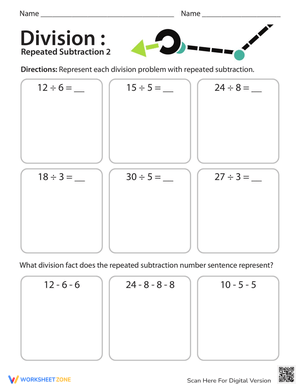
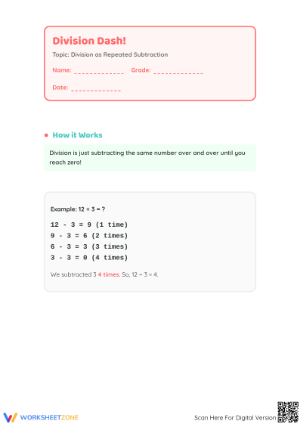
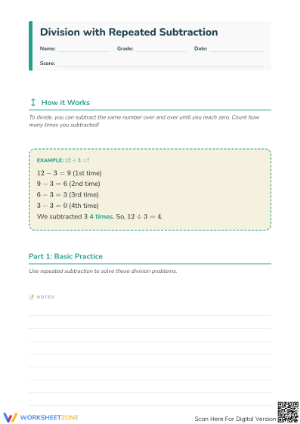
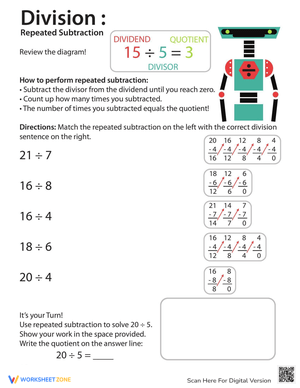
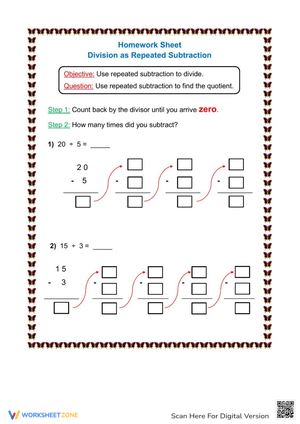
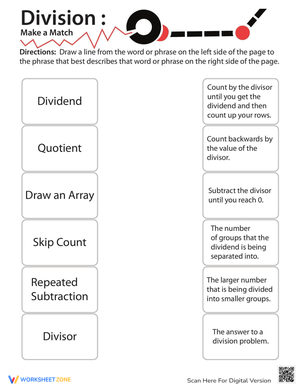
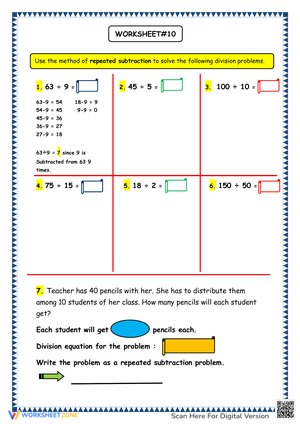
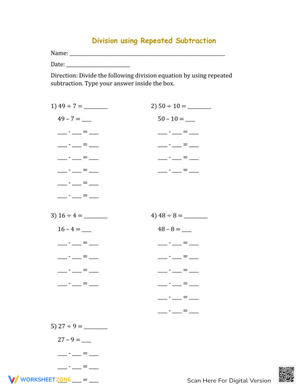
These 3rd grade division as repeated subtraction printable worksheets resources give teachers a concrete entry point into division before multiplication facts are fully memorized. Each worksheet moves through a deliberate arc: a visual model students can mark up, a chain of written subtraction sentences, and a final division equation. That structure matters because third graders who trace the quotient back through equal groups they removed can explain what the number means — something rarely true when division appears as a symbol students are simply told to process.
What Each Worksheet in the Set Builds
Each worksheet in this 3rd grade division as repeated subtraction printable worksheets set is organized around the same three-stage move: see it, record it, name it. That repetition is intentional. Students who work through the same pattern across different numbers begin to notice that the strategy holds — the process for 12 ÷ 3 is structurally identical to the process for 24 ÷ 6, and recognizing that is an early form of algebraic thinking.
The specific skills across the set include:
- Crossing out equal groups in a picture and counting how many times they subtracted
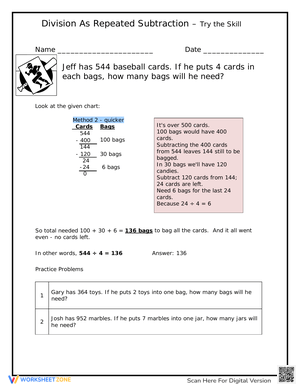
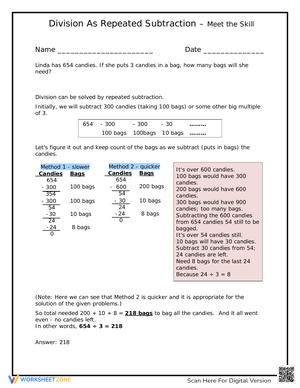
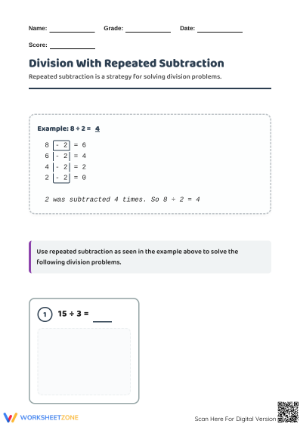
- Writing a chain of subtraction sentences that tracks each removal step by step
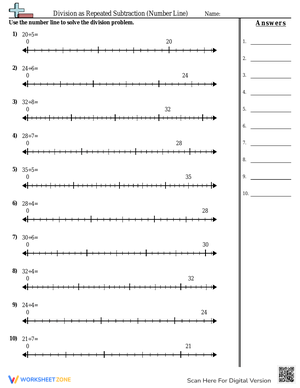
- Making equal backward jumps on a number line and marking each jump
- Recording the final division equation alongside the matching multiplication check
- Identifying the remainder when the subtraction stops before reaching zero
- Applying the strategy to word problems with simple sharing or grouping contexts
The number-line worksheets deserve particular attention. Students who find crossed-out groups hard to track often click with the jump format immediately, because movement along a line connects to skip-counting patterns they already know. Offering both visual formats within the same set means teachers can assign based on what a student has already shown comfort with rather than moving every student through the same sequence.
Frequent Student Errors Worth Catching Early
The most consistent error in this strategy is a counting problem, not a subtraction problem. A student working through 18 ÷ 3 will write the subtraction chain correctly — 18, 15, 12, 9, 6, 3, 0 — and then count the numerals on the page rather than the number of subtractions. They land on 7 instead of 6 because seven numbers appear in that sequence. Asking students to point to each subtraction step and say the count aloud ("that's one, that's two...") while keeping attention on the operation rather than the result fixes this within a few problems.
A second pattern surfaces early: students confuse which number to subtract each time. In 20 ÷ 4, some students subtract 5 from the start because they already have a partial sense of the answer. Worksheets that include a labeled space — "I am subtracting ___ each time" — require students to name the divisor before they begin, which makes the error visible before it runs through an entire problem.
Remainders bring their own complication. Students working through 13 ÷ 4 sometimes subtract past zero, writing a negative result rather than stopping and naming the leftover. The rule that ends the process — you cannot remove a full group when what remains is less than the divisor — needs explicit class discussion before students encounter remainder problems independently. A brief teacher-modeled example of "stopping before zero" is far clearer than any written worksheet instruction can be on its own.
Building These Worksheets Into Your Lesson Sequence
The most productive placement for this set is the three to five days immediately after students have worked with physical counters but before they move to fact memorization. That transition window is where the strategy has the most instructional value — students can still see what the division operation means, and the worksheets help them record and stabilize that understanding in written form.
On the first day, use a visual worksheet as guided practice right after a whole-class model with counters. One worksheet per pair, worked together, with the teacher moving between tables for roughly eight minutes of conferencing. Students who finish early can write a word problem to match the equation they just solved — this keeps the thinking active without moving to a different topic or format.
Days two and three work well for small-group rotation. The number-line format is a natural teacher-led group activity because the common error — counting tick marks instead of jumps — is easy to spot and easy to correct in real time when a teacher is present. The independent group working on the subtraction-chain worksheet produces written work that functions as a quick formative check: a class set can be read through in five minutes, and the written steps make it immediately clear who understands what each subtraction represents and who is going through the motions.
These 3rd grade division as repeated subtraction printable worksheets resources also hold up well as Monday morning warm-up practice after a weekend break. The visual format re-anchors the strategy quickly, and two or three problems take under ten minutes — enough to refresh the concept before a lesson moves forward without eating into new instruction time.
Standard Alignment
CCSS 3.OA.A.2 is the primary standard: interpret whole-number quotients of whole numbers. The standard describes two distinct interpretations of division — fair sharing and equal grouping — and repeated subtraction addresses the second one directly. Students who subtract equal groups from a total and count the removals are practicing the "how many groups of this size fit into this total?" reading of division, which many students find less intuitive than sharing equally and which this strategy makes explicit through written steps.
CCSS 3.OA.A.3 (use multiplication and division within 100 to solve word problems) is addressed by the word-problem worksheets in the set, particularly those where students must identify the total, the group size, and the number of groups before writing any equations.
The multiplication-check step built into each equation worksheet directly supports CCSS 3.OA.B.6 — understanding division as an unknown-factor problem. When students confirm 15 ÷ 5 = 3 by writing 3 × 5 = 15, they are practicing the inverse-operation reasoning that extends into fraction work and algebraic thinking in later grades. Treating the check as a required step, not an optional one, is what makes this connection stick.
Adjusting the Set for Different Student Needs
Students who are still building subtraction fluency need worksheets with dividends below 20 and divisors of 2 or 5, where the arithmetic stays within automatic range. The goal for these students is not speed — it is internalizing the structure of the strategy: select the divisor, subtract it, record the step, count the subtractions. Worksheets with labeled boxes for each step ("subtract ___, now I have ___") reduce the working-memory load enough that the conceptual work stays in focus instead of being crowded out by computation.
On-level students work through the standard progression — visual models, number lines, equation chains, multiplication checks — at roughly one worksheet type per day. The multiplication-check step is especially worth reinforcing at this level because it is the earliest formal introduction to the idea that division and multiplication undo each other, a relationship that appears explicitly in fourth-grade fraction standards.
Students who move through the set quickly are ready for two-digit dividends with single-digit divisors, missing-quotient problems where the subtraction steps are not provided, and word problems where the remainder carries meaning in context. A problem asking how many full teams of 4 can be formed from 22 students requires students to explain that the 2 remaining students do not constitute a team — a different cognitive move than simply writing "R2." That interpretation step separates surface fluency from genuine understanding of what division produces.
One honest limitation worth noting: the strategy becomes inefficient as dividends grow. Students solving 72 ÷ 8 by subtracting 8 nine times will finish correctly, but they will feel the tedium — which is actually a useful instructional moment. Students who notice the repeated subtraction taking a long time are signaling readiness to move toward fact practice. The 3rd grade division as repeated subtraction printable worksheets set is built for the number range where the strategy is genuinely instructive, keeping dividends within 100 and divisors at single-digit values, which is where the method teaches rather than just slows students down.
Frequently Asked Questions
Which division facts work best for introducing this strategy?
Start with divisors of 2 and 5, with dividends below 20. Students can subtract those amounts automatically, which means their attention stays on the structure of the strategy rather than on the arithmetic. Once students can write the subtraction chain and the division equation without prompting, move to divisors of 3 and 4.
How is the number-line format different from the written subtraction-chain format?
Both represent the same operation through different visual tools. The subtraction chain records each removal as a written equation. The number line shows each removal as a backward jump of equal size. Both end with a count of how many times the divisor was removed. Some students connect with one format before the other, and offering both within the set lets teachers assign by student need rather than by topic sequence.
Should every student complete every worksheet in the set?
Not necessarily. The visual and number-line worksheets are most useful for students who are new to the strategy or who still need to connect division to something they can picture. Students who move to equation-only practice quickly can condense or skip the earlier formats. The word-problem and remainder worksheets are worth completing for all students, since those formats appear on third-grade assessments and require students to interpret the quotient in context, not just calculate it.
What do I do when a student keeps writing the wrong quotient even after subtracting correctly?
Have the student point to each subtraction line and say a number aloud before writing the final answer — "that's one, that's two, that's three." Most of the time the error is counting the numerals in the chain rather than the number of removals. Speaking the count while pointing to each step, rather than scanning the whole list at the end, resolves this within a handful of practice problems.













 Interactive Worksheet Maker
 Quiz Maker
 Word Search Maker
 Crossword Puzzle Maker
 Word Scramble Generator
 Sentence Scramble Generator
 Handwriting Worksheet Generator
 Name Tracing Generator
 Fill In The Blank Generator