


























Views
Downloads


Printable Division with Repeated Subtraction | Grade 3 Math
Paste this activity's link or code into your existing LMS (Google Classroom, Canvas, Teams, Schoology, Moodle, etc.).
Students can open and work on the activity right away, with no student login required.
You'll still be able to track student progress and results from your teacher account.
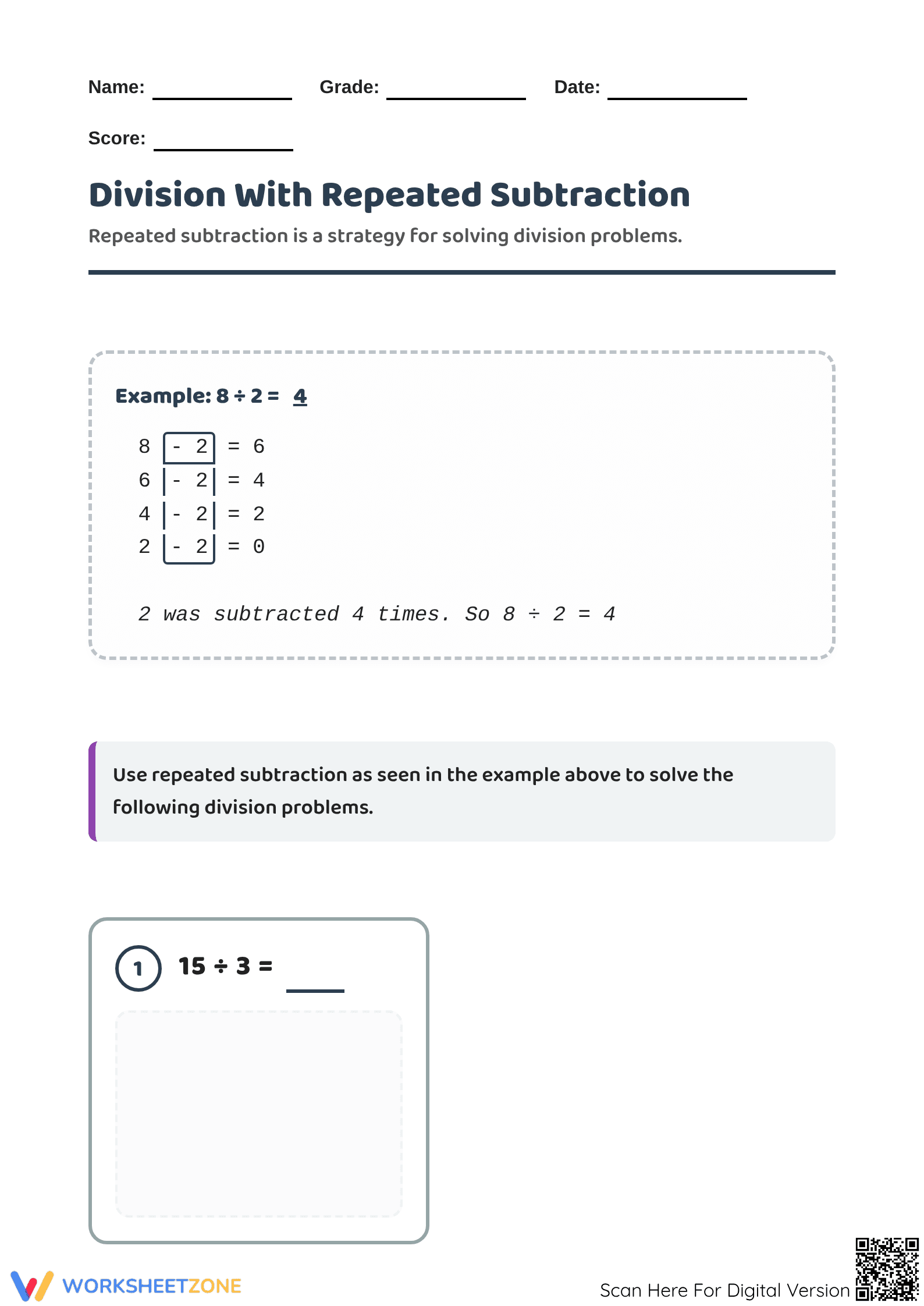
This Grade 3 division worksheet helps students master the foundational concept of division by relating it to repeated subtraction. Students learn to subtract the divisor from the dividend until they reach zero, counting the total number of subtractions to find the quotient. This visual and procedural approach ensures deep conceptual understanding and mathematical fluency.
At a Glance
- Grade: 3 · Subject: Math
- Standard:
CCSS.MATH.CONTENT.3.OA.A.2— Interpret whole-number quotients of whole numbers as the number of objects in each share- Skill Focus: Division via Repeated Subtraction
- Format: 4 pages · 8 problems · Answer key included · PDF
- Best For: Independent practice or introductory lessons
- Time: 20–30 minutes
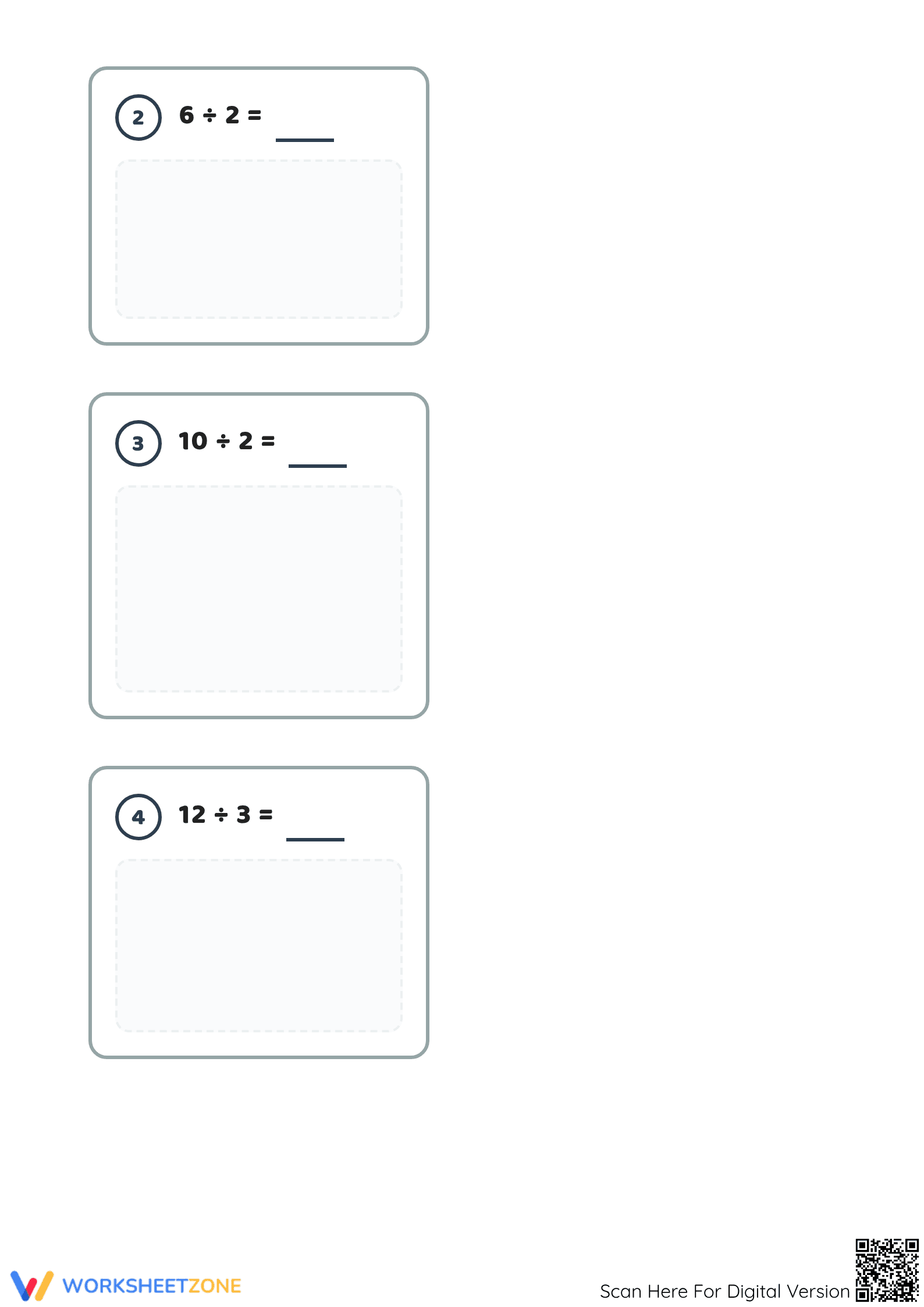
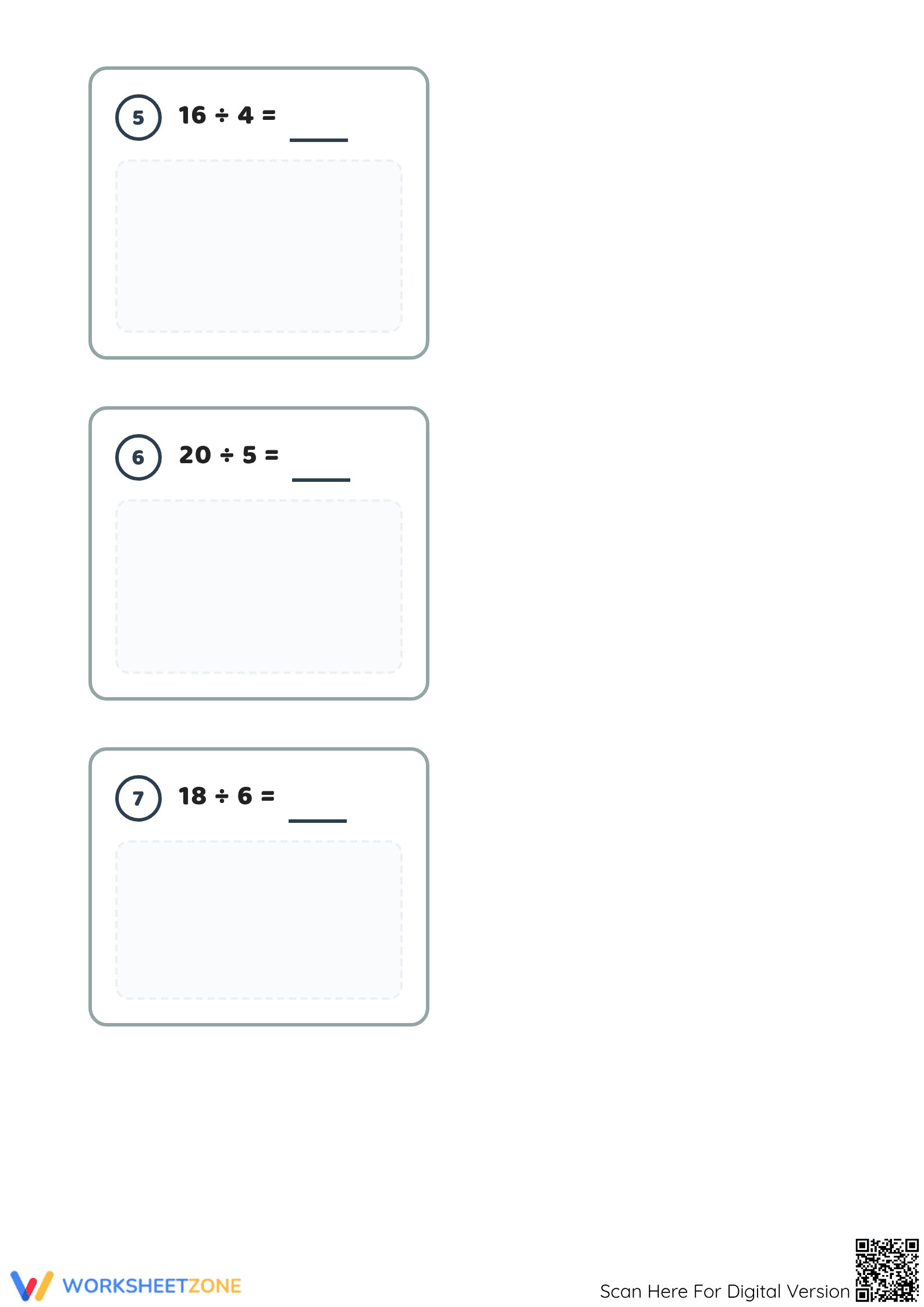
This resource consists of a comprehensive four-page PDF. The first page features a clear, step-by-step worked example showing how to solve 8 ÷ 2 = 4 using four separate subtraction steps. The following pages provide eight structured practice problems, each with a dedicated workspace box to encourage students to show their subtraction strings. A full answer key is included for rapid grading.
Skill Progression
- Guided Practice: The opening example provides a visual model of the repeated subtraction process, reducing cognitive load.
- Supported Practice: Problems 1 to 4 use smaller dividends, allowing students to focus on the subtraction steps.
- Independent Practice: Problems 5 through 8 increase in complexity, requiring students to organize multiple operations within the workspaces.
This gradual-release model ensures students build confidence before tackling problems solo.
Standards Alignment
This resource is aligned to `CCSS.MATH.CONTENT.3.OA.A.2`, which requires students to interpret whole-number quotients. Specifically, it addresses the conceptual link between division and subtraction. It also supports `CCSS.MATH.CONTENT.3.OA.A.3` by preparing students to solve more complex word problems using varied strategies. Both standard codes can be copied directly into lesson plans, IEP goals, or district curriculum mapping tools.
How to Use It
Use this worksheet during a direct instruction phase as a "We Do" activity where the teacher models the first problem on a whiteboard while students follow along. Alternatively, assign it as a formative assessment after the initial division unit to identify students who struggle with the conceptual relationship between operations. Expect students to take approximately 25 minutes to complete the full eight-problem set.
Who It's For
This worksheet is ideal for third-grade students beginning their division journey, as well as fourth-grade learners who need a concrete refresher on why division works. It serves as an excellent differentiation tool for students who struggle with abstract division symbols but excel at procedural subtraction. Pair this with a division passage or an anchor chart showing multiple strategies for maximum impact.
The use of repeated subtraction to teach division is a proven pedagogical strategy for developing operational fluency in elementary mathematics. By grounding division in the more familiar territory of subtraction, educators provide a bridge for students to transition from additive to multiplicative thinking. This approach aligns with research from Fisher & Frey (2014) regarding the importance of scaffolding conceptual understanding through multiple representations. Specifically, it targets `CCSS.MATH.CONTENT.3.OA.A.2` by requiring students to count "how many times" a divisor can be subtracted, which directly maps to the quotient. This printable 4-page worksheet offers 8 problems that reinforce this connection through guided workspaces. According to the RAND AIRS 2024 analysis, such explicit procedural scaffolds significantly improve retention for learners who demonstrate gaps in basic arithmetic recall. This worksheet provides the structured practice necessary for long-term mastery.


