


























Views
Downloads



Printable Division Models Worksheet | Grade 3 Math
Paste this activity's link or code into your existing LMS (Google Classroom, Canvas, Teams, Schoology, Moodle, etc.).
Students can open and work on the activity right away, with no student login required.
You'll still be able to track student progress and results from your teacher account.
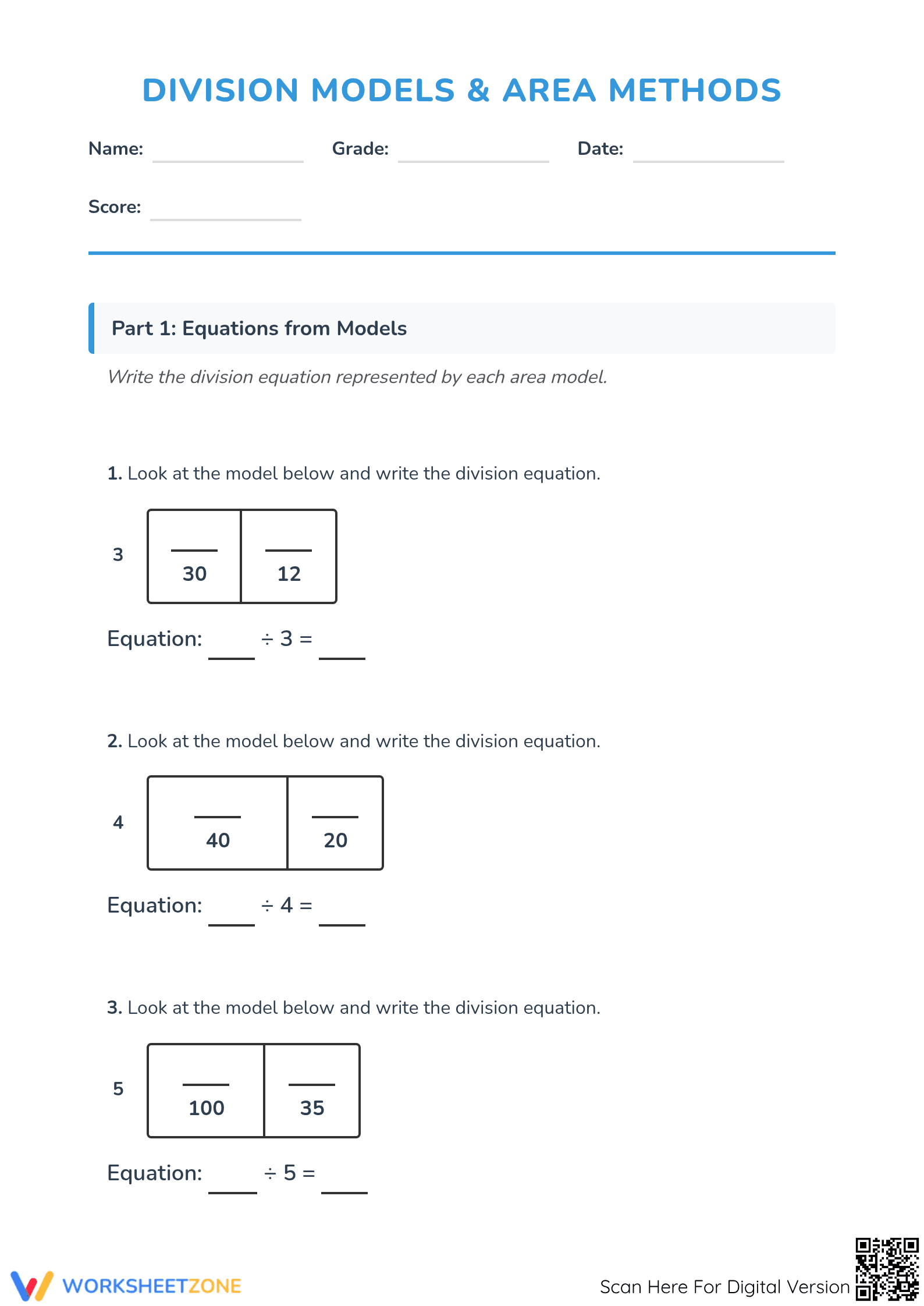
This worksheet provides focused practice on division models for third-grade students. Learners strengthen their understanding of division by partitioning objects into equal shares and writing the corresponding equation. This directly connects visual representations to abstract math, building a solid foundation for more complex division problems.
At a Glance
- Grade: 3 · Subject: Math
- Standard:
CCSS.MATH.CONTENT.3.OA.A.2— Interpret whole-number quotients of whole numbers.- Skill Focus: Division Models, Equal Groups
- Format: 5 pages · 16 problems · Answer key included · PDF
- Best For: Guided practice, concept reinforcement
- Time: 15–25 minutes
What's Inside
This five-page PDF contains 16 problems across four pages. Students draw items in equal groups and write the matching division equation. The final page provides a complete answer key showing the correct groupings and equations for efficient grading, making it a ready-to-use resource.
A Clear Path to Understanding
The worksheet follows a logical progression to build student skill through a gradual-release model.
- Guided Practice: The first few problems can be completed together as a class, with the teacher modeling how to draw equal shares.
- Supported Practice: Students can then work on the next set of problems with a partner or with teacher support to reinforce the concept.
- Independent Practice: The final problems allow students to show their independent mastery of the concept.
Standards-Aligned for Your Classroom
This worksheet directly aligns with Common Core standard CCSS.MATH.CONTENT.3.OA.A.2, which requires students to interpret whole-number quotients. The tasks provide concrete practice for this skill. The standard code can be copied directly into lesson plans, IEP goals, or curriculum maps.
Putting It Into Practice
Use this resource during a core math lesson after introducing division. For formative assessment, observe how students partition the items to spot misconceptions. It also works well for homework or as a math station activity for reinforcement. Most students will complete the worksheet in about 15-25 minutes.
Designed for Every Learner
This worksheet is for third-grade students starting their division unit. The visual tasks also make it an effective review tool for fourth graders needing support with foundational concepts. It pairs well with a classroom anchor chart defining key terms like 'dividend,' 'divisor,' and 'quotient' as a reference.
This practice worksheet provides a direct application of principles for building mathematical understanding. Aligned with CCSS.MATH.CONTENT.3.OA.A.2, it tasks students with interpreting whole-number quotients by creating visual models of equal groups. This approach, moving from concrete representation to abstract equations, is a cornerstone of effective mathematics instruction. Research consistently shows that students who can flexibly use different representations for mathematical ideas develop a more robust and durable understanding. According to the RAND AIRS (2024) report on elementary math instruction, providing students with opportunities to visualize and manipulate quantities is critical for developing number sense and operational fluency. This resource gives students precisely that opportunity, connecting the visual act of partitioning with the formal structure of a division sentence, which is a key predictor of future success in mathematics.


