These addition strategies worksheets for 3rd grade cover four distinct methods — partial sums, open number lines, decomposition, and compensation — each on its own worksheet so teachers can sequence instruction one strategy at a time rather than presenting all approaches at once. The set targets three-digit addition and keeps every exercise anchored in place value reasoning, which is where grade 3 work on this standard has to begin.
The Four Strategies and What Each Worksheet Targets
Each worksheet isolates one strategy and gives students enough focused repetition to build genuine familiarity before moving on to the next method.
- Partial sums — Students add hundreds, then tens, then ones separately, then combine the three partial totals. A graphic organizer built into the worksheet keeps columns aligned — useful because spatial disorganization on the page is often the actual source of an arithmetic error, not a conceptual gap.
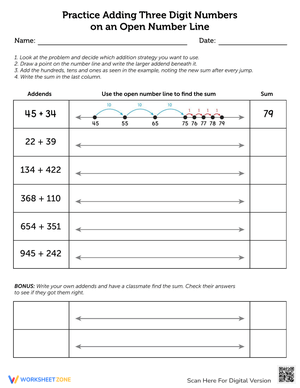
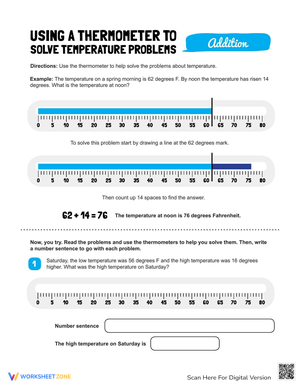
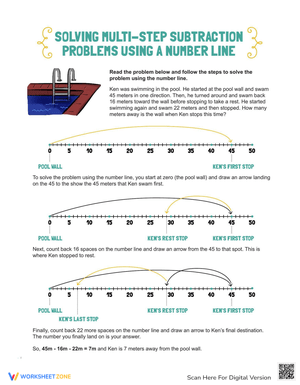
- Open number lines — Students start at one addend and make labeled jumps to reach the sum. The worksheet provides the starting value and the problem; students decide how many jumps and how large. Where students place their jumps reveals a great deal about how they are thinking about number magnitude.
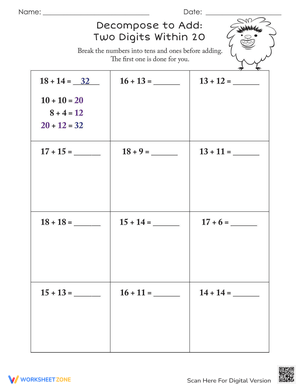
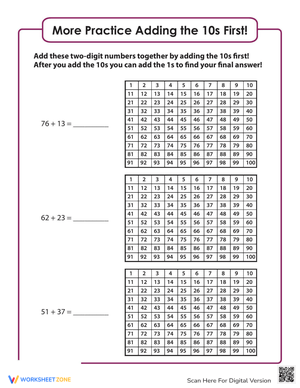
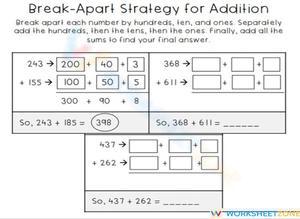
- Decomposition (break-apart) — Students expand each addend into its place value components, group like values, and add column by column. This worksheet runs horizontally, which is a deliberate contrast to the vertical format of partial sums — same logic, different layout.
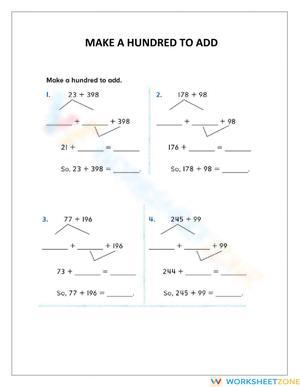
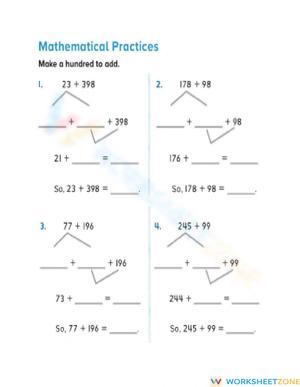
- Compensation — Students round one addend to the nearest friendly number, add, then adjust the total. This is the most demanding worksheet in the set and works best after students are accurate with partial sums and decomposition.
Student Errors Teachers Should Watch For and Correct
Compensation produces the most predictable mistake in the set: students add the rounding adjustment instead of subtracting it. Solving 198 + 253, a student rounds 198 to 200, correctly adds to get 453, then writes 455 as the final answer — adding the 2 back rather than subtracting it. This is a procedural confusion, not a place value gap, and it surfaces consistently even after whole-class modeling. Naming the error explicitly before students work independently — "watch the direction of your adjustment" — prevents most of it.
On the number line worksheet, a common source of wrong answers is miscounting jumps of 10 when adding the tens digit. Solving 350 + 120, a student makes a correct jump of 100 to land on 450, then draws three arcs of 10 instead of two, landing on 480. This almost always happens when students draw the arcs first and add the labels after — they lose count mid-drawing. Asking students to write the label on each arc before lifting the pencil to draw the next one cuts this error significantly.
Partial sums generates a different pattern among students who have already seen the standard algorithm. They add eight ones and six ones, write 4 in the ones column, carry a 1 into the tens — then stall because the partial sums format expects a 14, not a regrouped value. These students are not confused about the arithmetic; they have imported a different procedure into the wrong format. A brief comparison — "in partial sums, we write the whole number" — resolves it for most students in a single conversation.
Fitting These Worksheets Into Your Instructional Week
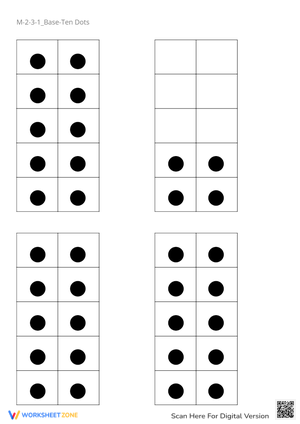
One strategy per focused instructional period is the right pace — not necessarily one per calendar day, but one per lesson block. Introduce a strategy with base-ten blocks, move to the worksheet once students have a concrete image in mind, then return to the same worksheet two or three days later as a short review before moving to the next method. That gap between first and second practice produces noticeably stronger retention than doing both in the same lesson — spaced retrieval applies here just as it does in other content areas.
Math centers are a natural home for this set. Each station holds one worksheet type, and students rotate every 12 to 15 minutes. The center format lowers the resistance students show during whole-class instruction — a student who shuts down during a teacher-led number line lesson will often try the same work independently at a station. The compensation worksheet is the exception: it works better as a teacher-led station than as an independent rotation until students have built some comfort with the adjustment step.
As the strategies unit wraps up, pairing two completed worksheets — one partial sums, one decomposition — and asking students to find where the same numbers appear in both formats generates some of the sharpest mathematical conversations of the unit. Addition strategies worksheets for 3rd grade serve that comparison work well because each worksheet uses a consistent format, so students can track the math across methods without the layout getting in the way.
Standard Alignment
These worksheets address CCSS.MATH.CONTENT.3.NBT.A.2, which requires students to fluently add and subtract within 1,000 using strategies and algorithms based on place value and properties of operations. The standard lists "strategies" before "algorithms" — that ordering is intentional and matters for instruction. Students who work through partial sums and decomposition before the standard algorithm have a concrete referent for regrouping: they already know that ten ones become one ten because they have written it out in a partial sum. The algorithm stops being a rule to memorize and becomes a description of something they have already done by hand.
Adapting This Set for Different Levels of Student Readiness
Students still solidifying two-digit addition find partial sums and decomposition accessible because the column-by-column structure does the organizational work for them — they add within one place value at a time rather than tracking the entire problem simultaneously. The compensation worksheet should come last in the sequence for everyone, and for students still building accuracy with the other three methods, it can wait entirely. Pulling it from the rotation is a reasonable instructional decision, not a shortcut.
For students who are already accurate with three-digit addition, addition strategies worksheets for 3rd grade become a vehicle for written explanation. Ask them to annotate each step: why they chose a particular jump size on the number line, or which place value they added first in partial sums and why. That annotation work surfaces whether their fluency rests on genuine understanding or just procedural speed — students who can explain the math in writing have the kind of number sense that holds up when problems get more complex.
Frequently Asked Questions
When should students move to the standard algorithm?
Once a student solves a three-digit addition problem accurately using at least two different strategies and can explain what each step represents, they are ready. The algorithm makes more sense to students who already understand regrouping as a real action — ten ones becoming one ten — rather than as an abstract rule about writing a small digit above a column. The partial sums and decomposition worksheets build that understanding directly.
Can these worksheets be used with students who already know the standard algorithm?
Yes, and it is often worth doing. Students who learned the algorithm first sometimes find open number lines disorienting because they are accustomed to a vertical, column-by-column process rather than a left-to-right spatial one. Working through addition strategies worksheets for 3rd grade in order — partial sums through compensation — helps those students build the conceptual layer that was skipped, and it frequently improves their algorithm accuracy by clarifying what regrouping actually does to the number's value.
How long does each worksheet take during a typical class period?
Partial sums and decomposition worksheets take most students 10 to 15 minutes during independent work time. The number line worksheet runs longer — closer to 15 to 20 minutes — because students construct the representation rather than fill in a given structure. Compensation is the most variable: some students finish in 12 minutes, others need closer to 25. If you are running stations, build extra time into the compensation rotation or plan it as the teacher-led stop rather than an independent one.













 Interactive Worksheet Maker
 Quiz Maker
 Word Search Maker
 Crossword Puzzle Maker
 Word Scramble Generator
 Sentence Scramble Generator
 Handwriting Worksheet Generator
 Name Tracing Generator
 Fill In The Blank Generator