


























Views
Downloads



Essential Grade 3 Math Worksheet: Marbles & Addition
Paste this activity's link or code into your existing LMS (Google Classroom, Canvas, Teams, Schoology, Moodle, etc.).
Students can open and work on the activity right away, with no student login required.
You'll still be able to track student progress and results from your teacher account.
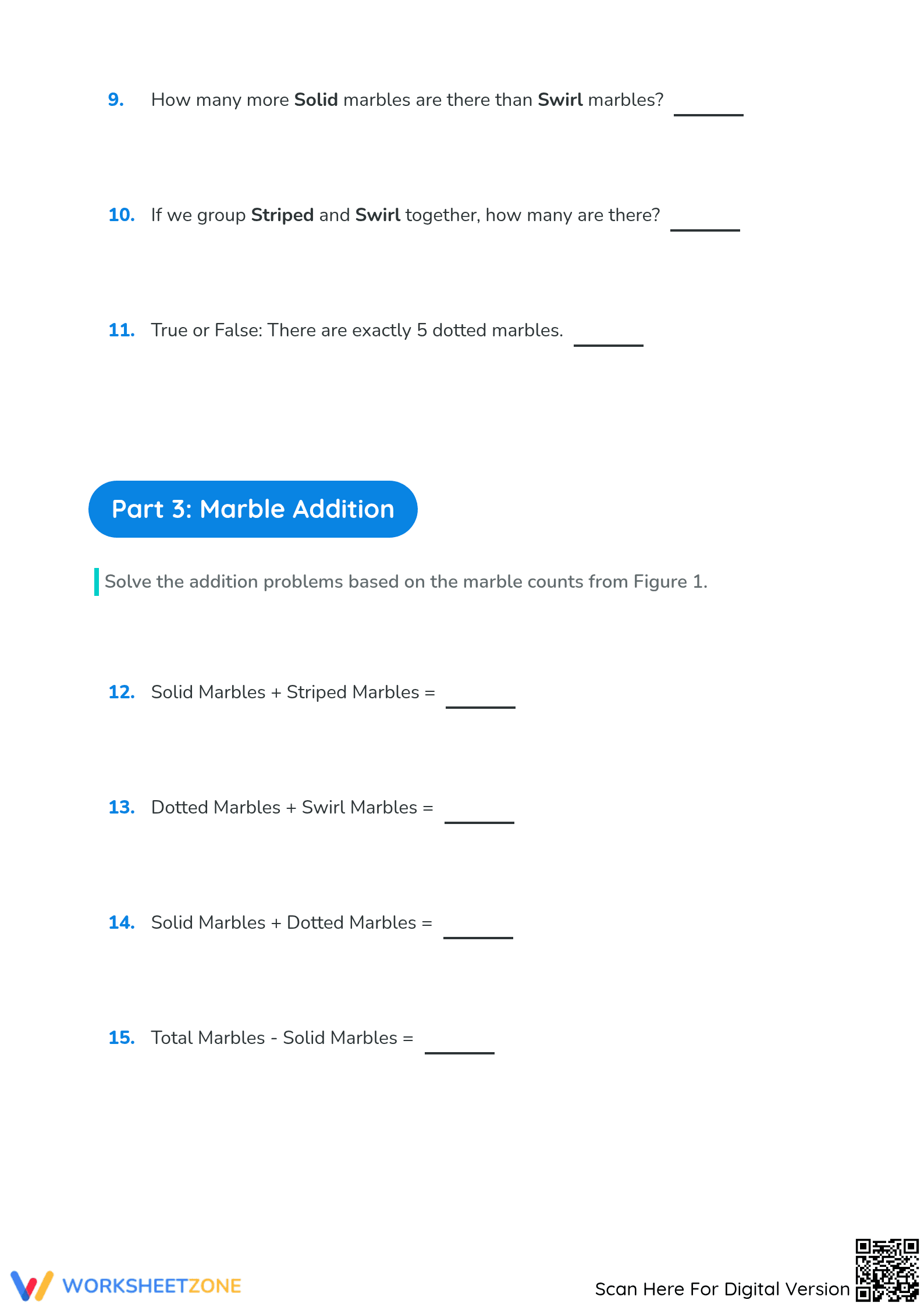
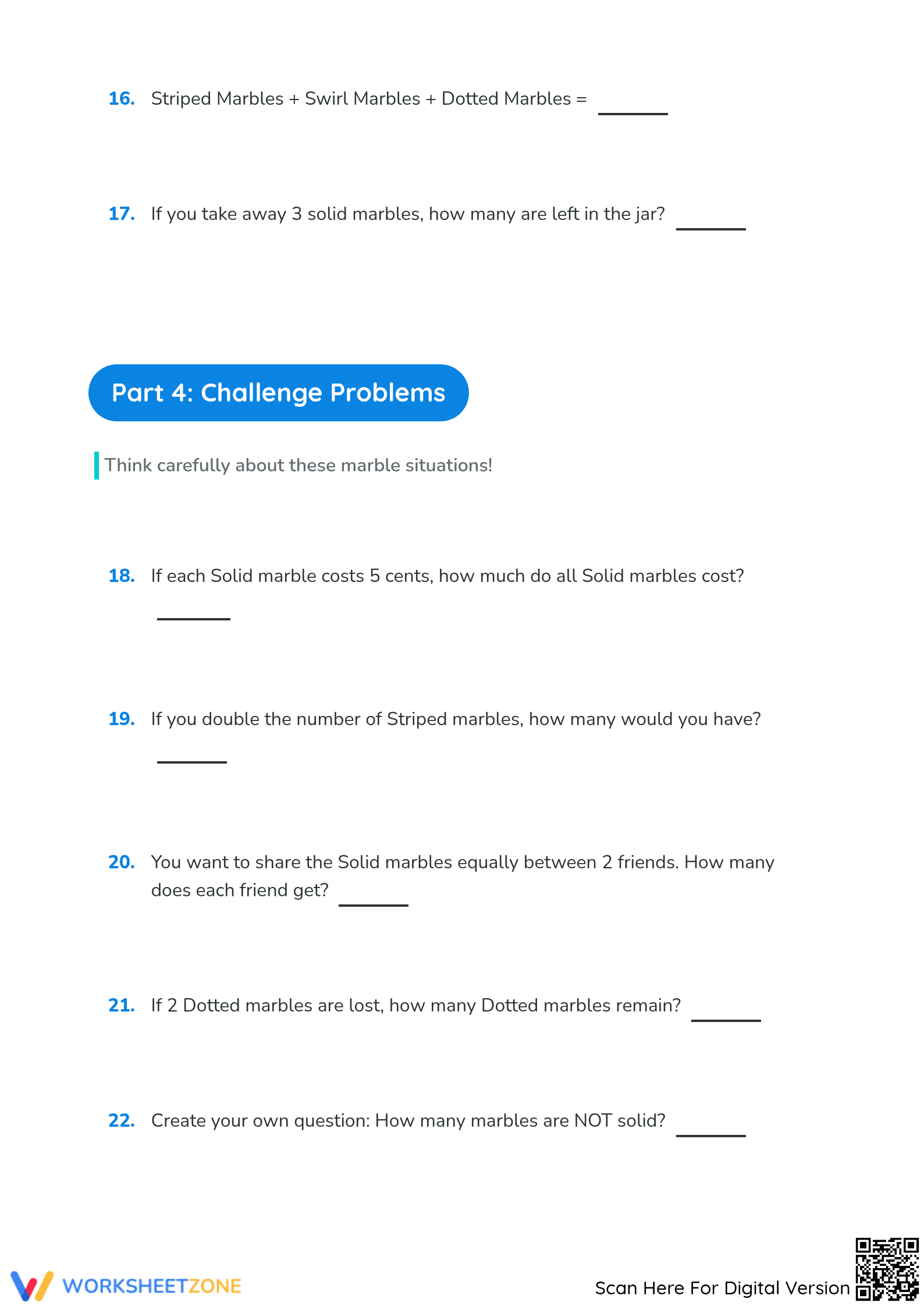
This Grade 3 math worksheet uses a marble-themed dataset to help students master counting, categorizing, and multi-step addition. By analyzing a visual jar of 18 marbles, learners solve 24 structured problems that progress from simple identification to complex logic and basic multiplication through repeated addition. This resource ensures students can translate visual information into numerical data and perform accurate operations.
At a Glance
- Grade: 3 · Subject: Math
- Standard:
CCSS.MATH.CONTENT.3.OA.A.3— Use multiplication and division within 100 to solve word problems in situations involving equal groups- Skill Focus: Data Categorization & Addition
- Format: 5 pages · 24 problems · Answer key included · PDF
- Best For: Small group data analysis practice
- Time: 25–35 minutes
Inside this comprehensive 5-page packet, teachers will find a highly visual primary figure featuring 18 distinct marbles. The worksheet is organized into four logical parts: The Marble Jar (Counting), Comparison & Logic, Marble Addition, and Challenge Problems. It includes task types ranging from simple counts to multi-group addition and cost calculations, supported by a full answer key for rapid grading.
Skill Progression
- Guided Practice: Tasks 1-5 focus on identifying and counting marbles by physical attributes (stripes, dots, solids) to establish a baseline dataset.
- Supported Practice: Tasks 6-11 introduce comparison logic and true/false verification, requiring students to interpret their collected data against specific claims.
- Independent Practice: Tasks 12-24 challenge students with addition equations, word problems involving money, and division of groups, moving toward higher-order application.
This structure follows a gradual-release model, ensuring students build confidence with the data before tackling complex operations.
Aligned to CCSS.MATH.CONTENT.3.OA.A.3, students use the marble groups to solve word problems involving equal groups and arrays. The worksheet also supports measurement and data standards by requiring students to categorize and represent a dataset with multiple categories. This standard code can be copied directly into lesson plans, IEP goals, or district curriculum mapping tools.
Use this worksheet as a mid-unit formative assessment after students have learned basic categorization but before moving into complex multiplication. During instruction, observe how students track their counts—students who check off marbles in the jar while counting demonstrate stronger organizational skills. Expect a completion time of 30 minutes for most Grade 3 learners.
This resource is designed for Grade 3 students but provides excellent remediation for Grade 4 learners or an extension for advanced Grade 2 students. It pairs naturally with an anchor chart on "Types of Word Problems" or a hands-on activity using physical manipulatives to mirror the digital jar.
According to research by Fisher & Frey (2014) on the gradual release of responsibility, structured practice that transitions from simple observation to complex problem-solving is critical for mathematical retention. This worksheet aligns with CCSS.MATH.CONTENT.3.OA.A.3 by providing a concrete visual model that bridges the gap between basic counting and abstract operations. By requiring students to categorize 18 unique objects before performing operations, the resource reinforces the fundamental link between data representation and algebraic thinking. The inclusion of challenge problems involving cost and equal sharing ensures that learners are prepared for real-world applications of these mathematical concepts. This systematic approach to data-driven math ensures that Grade 3 students meet or exceed NAEP proficiency benchmarks for mathematical reasoning and operations.


