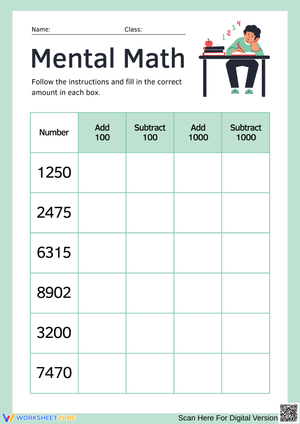
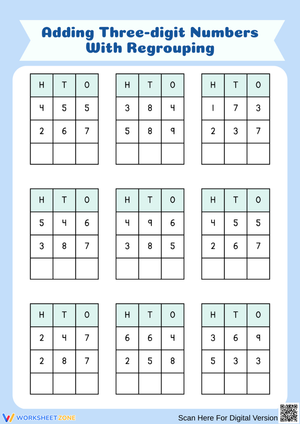
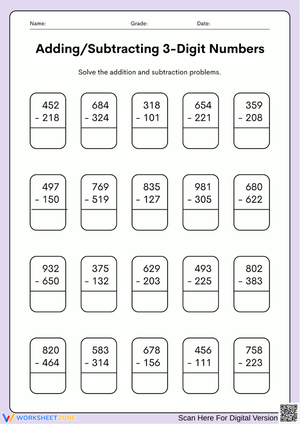
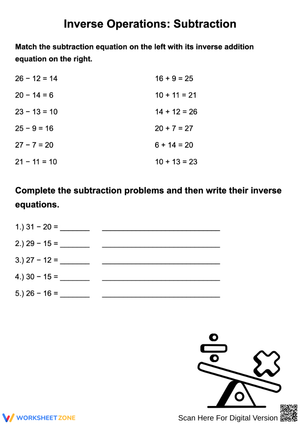
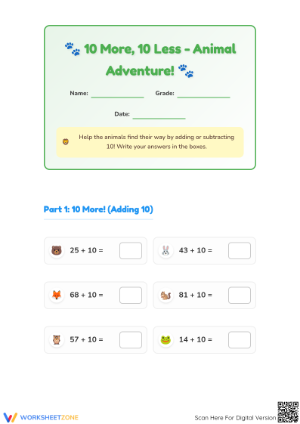
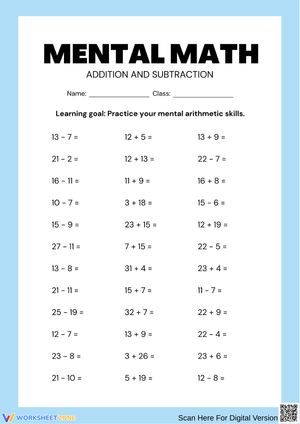
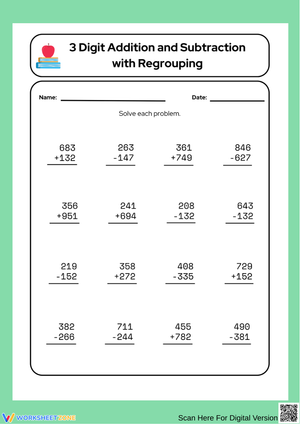
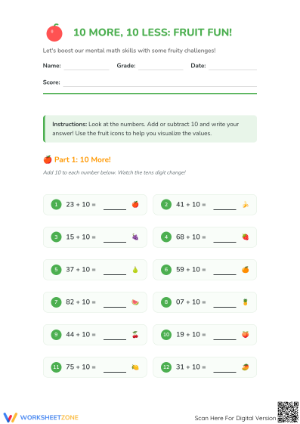
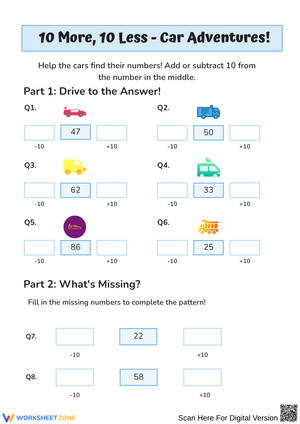
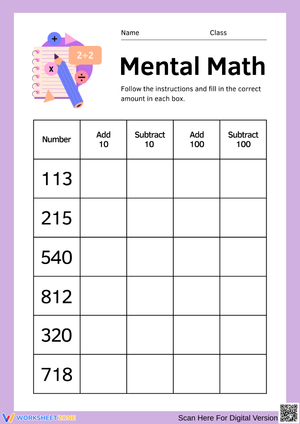
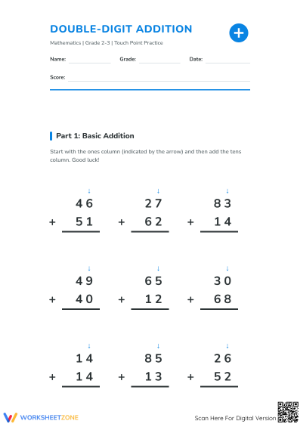
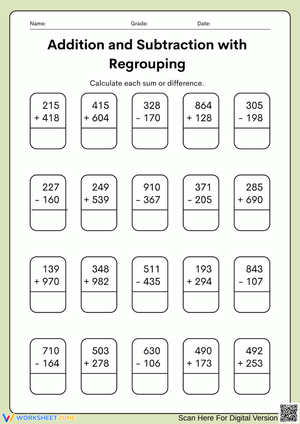
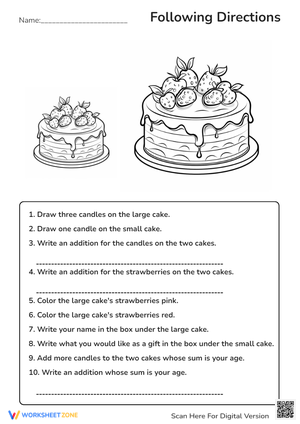
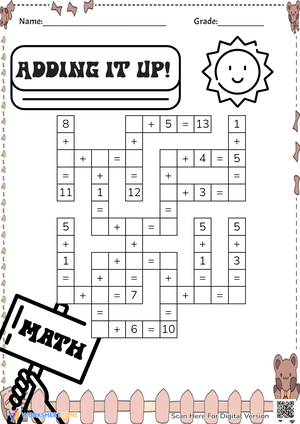
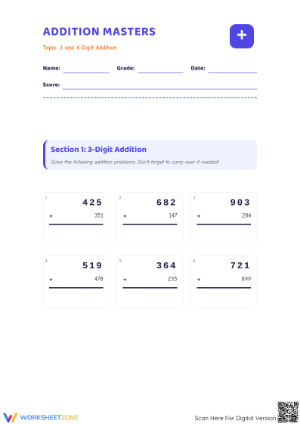
These addition printable worksheets for 3rd grade give teachers computation and problem-solving practice across the full Grade 3 addition sequence — from fact fluency and 2-digit work through 3-digit regrouping and word problems. Each worksheet prints cleanly in black and white, uses generous number spacing, and carries directions students can follow independently so a teacher can assign and circulate without re-explaining the task.
Grade 3 is the year addition shifts from primarily fact recall to place value reasoning. Students who answer 7 + 8 without hesitation still make errors when those same facts appear inside a column of three-digit numbers with carries stacking up. That shift — from isolated fact to embedded computation — is what the resources in this set address.
The Specific Skills Each Worksheet Targets
Among the addition printable worksheets for 3rd grade, each worksheet focuses on one skill area so teachers can match the practice to a lesson objective rather than assigning broad review and hoping it fits. The set covers:
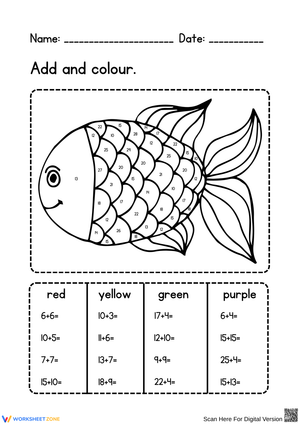
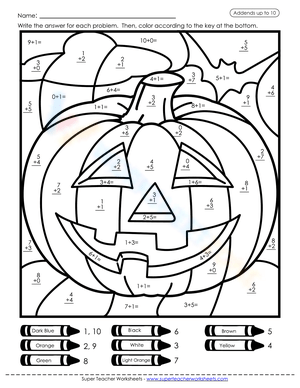
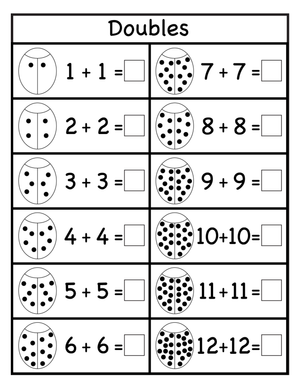
- Addition fact review: short fluency sets for warm-ups and intervention groups, covering sums within 20
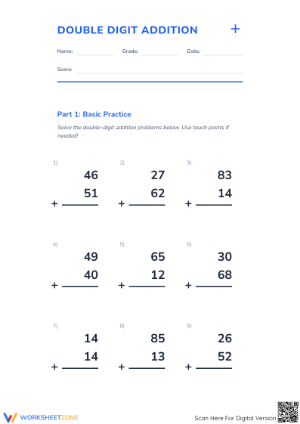
- 2-digit addition without regrouping: builds procedural confidence before carrying enters the work
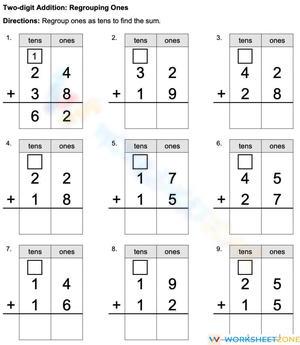
- 2-digit addition with regrouping: targets carrying from the ones column, the step where most Grade 3 errors cluster
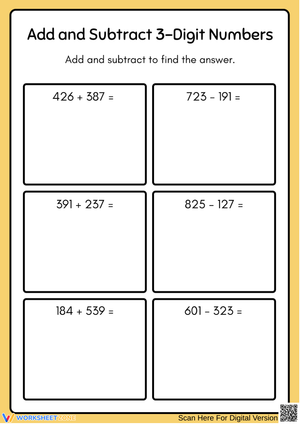
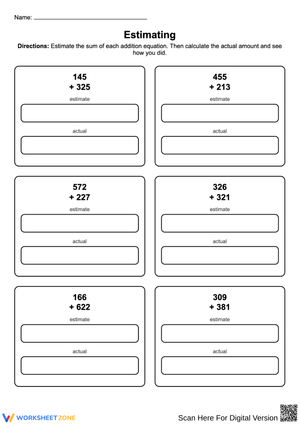
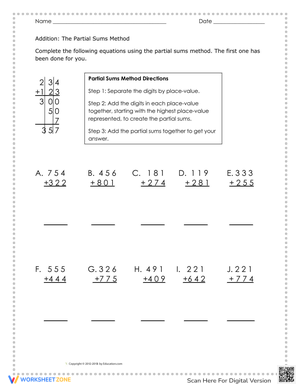
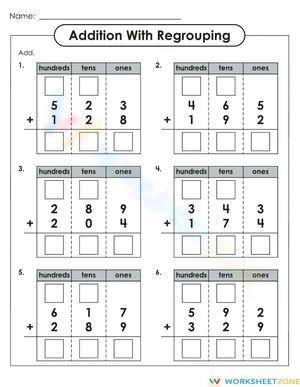
- 3-digit addition: extends place value work across hundreds, tens, and ones, both with and without regrouping
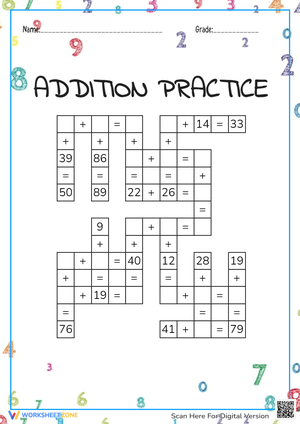
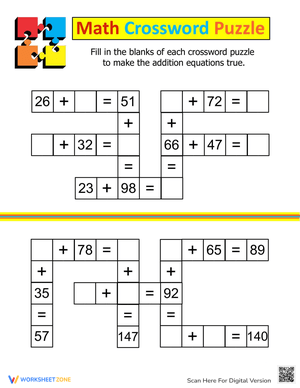
- Missing addends: asks students to reason about part-whole relationships rather than follow a set procedure
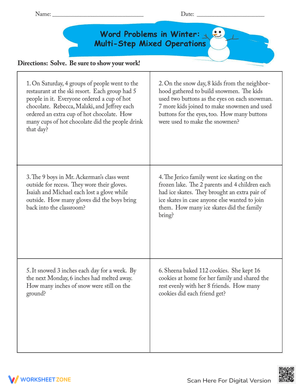
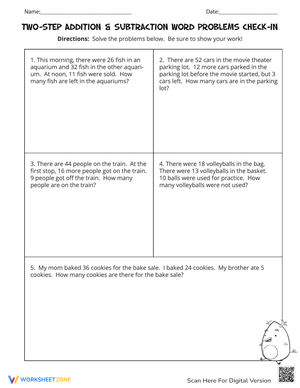
- Addition word problems: short scenarios requiring students to identify the correct operation and show their reasoning
- Mixed review: combines several skill types on one worksheet, useful for unit wrap-up or informal assessment
The word problem worksheets deserve a separate note. Students at this level often recognize "how many in all" as an addition cue but freeze when a problem presents three quantities and asks for a total — suddenly the structure doesn't match their mental template for addition. These worksheets include those less obvious problem types alongside the familiar ones, so students encounter realistic variety before an assessment does the revealing.
Frequent Student Errors Worth Watching For
The most common regrouping error at Grade 3 is not that students forget to carry — it's that they carry the wrong digit in multi-regroup problems. A student adding 268 + 475 will often handle the ones column correctly, carrying 1 into the tens. But when the tens column sum also requires regrouping, students either lose track of the first carry or write the entire two-digit tens sum above the hundreds column instead of just the regrouped ten. In actual student work, you see "12" penciled above the hundreds column where only a "1" belongs. That's a sign the student understands regrouping conceptually but hasn't automated which digit moves and which stays — an important distinction for how you reteach it.
Place value alignment is a separate problem. Even students who know the algorithm will drift when working in open space: ones lining up with tens, columns offset by a position, answers that look procedurally correct but aren't. The vertical format built into the computation worksheets removes that variable, letting a teacher isolate whether an error comes from misalignment or from computation. Those require different instructional responses.
Word problems surface a third pattern: students add every number in a scenario regardless of what the question asks. A problem where a character collects 24 objects, loses 9, then finds 15 more will be answered as 24 + 9 + 15 = 48 by students who scan for numbers without reading for meaning. Including problems with that structure — before a standardized assessment surfaces the habit — gives teachers a chance to address it directly.
Working These Worksheets Into Your Weekly Plan
Sorting printed copies into three labeled folders at the start of a unit — fluency, regrouping, application — makes small-group rotation faster. When a student stalls during a guided group, you reach for a folder rather than flipping through a stack. That setup takes about five minutes once a week and saves real time during the moments when a targeted worksheet is needed and the lesson is already running.
Shorter fact-review worksheets work well during the first four to five minutes of math block — enough repetition to be useful, brief enough to move into new instruction before attention drifts. Regrouping and 3-digit worksheets fit better immediately after direct instruction, used as independent practice while the modeled examples are still on the board. Word problem worksheets operate differently: they hold up as partner tasks or as the closing ten minutes of class, when students are ready to transfer computation skill into applied reasoning. Matching each worksheet type to the right moment in a lesson structure is what makes the practice stick.
For substitute plans and intervention folders, pre-sorting by skill means another adult can run a focused math block without improvising. A note reading "students are on regrouping with 2-digit numbers — use the R-2 folder" gives a substitute or paraprofessional exactly what they need without requiring a full written lesson plan.
Adjusting the Set for Different Readiness Levels
For students still building confidence with multi-digit addition, the worksheets at the lower range of the set — 2-digit problems without regrouping, fact sets within 20 — give enough structure to make success realistic. Assigning fewer problems from the same worksheet rather than switching to an entirely different resource keeps a student working at the same conceptual level as the class. Vertical format and generous spacing reduce visual clutter for students who process print slowly, without simplifying the math itself.
Students who move through Grade 3 computation quickly need tasks that press past fluency into reasoning. Missing addend worksheets serve that function: the sum is given and the unknown is an addend, so students reason backward in a way that builds early algebraic thinking at a level Grade 3 can handle. You can also ask early finishers to write a word problem that matches a number sentence they just solved — that turns a computation worksheet into a math-writing connection without needing a separate assignment.
For English learners or students with reading challenges, the computation worksheets — facts, vertical addition, regrouping — carry the lightest language load. Word problem worksheets work better when paired with vocabulary front-loading or strategic partnering, so teachers have a clear way to sequence the set for those students rather than skipping the application work entirely.
Standard Alignment
The computation worksheets address CCSS.MATH.CONTENT.3.NBT.A.2, which requires students to fluently add and subtract within 1,000 using strategies grounded in place value and properties of operations. In classroom terms, this standard arrives after students have worked with 2-digit addition in Grade 2 — the expectation in Grade 3 is extension to three-digit numbers and demonstrated accuracy, not just procedural familiarity. Teachers searching for addition printable worksheets for 3rd grade that map to specific CCSS codes will find this set aligns directly to the 3.NBT cluster for computation and to CCSS.MATH.CONTENT.3.OA.D.8 for the word problem worksheets, which ask students to solve two-step problems using the four operations. Using both worksheet types within the same unit addresses the computation standard and the applied-reasoning standard without requiring separate planning blocks.
Frequently Asked Questions
How is the set organized, and how many worksheets does it include?
The set includes worksheets across seven skill areas: fact review, 2-digit addition without regrouping, 2-digit addition with regrouping, 3-digit addition, missing addends, word problems, and mixed review. Each worksheet targets one skill focus, which makes it easy to select the right practice for a given lesson without working through the set in a fixed order.
When in a unit should I introduce the regrouping worksheets?
After at least two days of direct instruction using concrete or visual models — base-ten blocks, place value charts, or drawn representations. Students who move to algorithm practice before they understand what carrying represents often memorize steps without grounding them in place value, and those errors are harder to undo later. The regrouping worksheets function as consolidation practice, not as an introduction to the concept.
Do the worksheets include answer keys?
Yes. Answer keys come with every worksheet in the set. That matters most when managing multiple small groups, running centers simultaneously, or setting up a substitute day. A quick check against the key also shows where errors are concentrating before you plan the next day's instruction.
Can I use these with students who are working below grade level?
The set includes worksheets at the lower end of Grade 3 expectations — 2-digit addition without regrouping and fact practice within 20 — that fit students still building foundational skills. These addition printable worksheets for 3rd grade work best for below-level students when paired with a short hands-on or visual component before pencil-and-paper practice, so the work connects to something concrete rather than standing as abstract algorithm steps.













 Interactive Worksheet Maker
 Quiz Maker
 Word Search Maker
 Crossword Puzzle Maker
 Word Scramble Generator
 Sentence Scramble Generator
 Handwriting Worksheet Generator
 Name Tracing Generator
 Fill In The Blank Generator