Repeated Addition worksheets for 3rd Grade
These repeated addition worksheets for 3rd grade give teachers a concrete entry point into multiplication — one that builds meaning before it builds memorization. The set covers equal groups, arrays, number line jumps, and written equation translation, all ready to print and drop into whatever lesson structure you're already running.
The Specific Skills Targeted
Each worksheet works a different facet of the equal-groups concept. Students who move through the full set will:
- Write repeated addition sentences from pictures of grouped objects — three bags with five marbles each, not just "fifteen things"
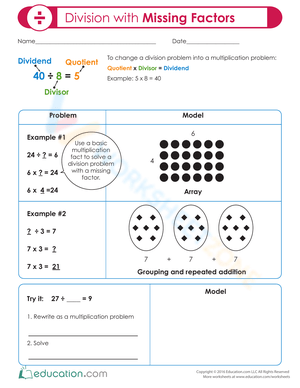
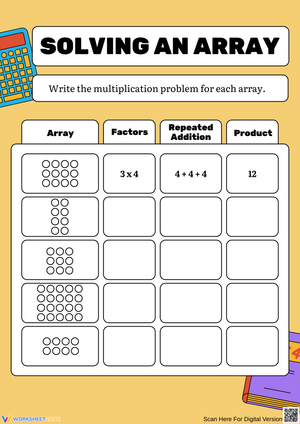
- Translate rows-and-columns arrays into an addition string, then rewrite that string as a multiplication equation
- Mark equal jumps on a number line and record both the repeated addition and multiplication notation below it
- Match a long addition string — such as 6+6+6+6 — to its corresponding multiplication fact
- Solve word problems that require identifying group size and group count before constructing any equation
That last skill — separating "how many groups" from "how many in each group" — is where the conceptual work actually happens. Getting an answer right doesn't mean a student has that distinction down. Watching what they write first tells you a lot.
Mistakes Students Make That These Worksheets Help You Catch
The most consistent error shows up on array worksheets. A student sees a 4-row, 3-column grid and writes 3+3+3+3, then crosses it out and writes 4+4+4 instead — because when they recount, they shift to reading columns rather than rows. Both totals are twelve, so the answer looks right either way. These worksheets require students to label which number represents the group size and which represents the number of groups, which makes the switch visible even when the final answer is correct. Without that labeling step, a teacher has no window into whether the student understands what the equation actually describes.
Number line worksheets surface a different issue. When students make four equal jumps of three — landing on 3, 6, 9, and 12 — they frequently count the total marks they've touched, including zero as the starting position. That gives them five positions rather than four groups, so they record the wrong number of groups in their equation. The error is spatial rather than conceptual: students haven't yet linked "one group" to "one jump" rather than "one landing mark." Asking them to draw arrows between the marks, rather than circling the marks, makes each jump visible as a distinct unit — and the confusion usually clears from there.
How to Build These Worksheets Into Your Lesson Plans
The equal-groups and array worksheets fit best in the days immediately before students encounter formal multiplication notation — not after. Using them during that window means the multiplication symbol lands as shorthand for something students already understand, not as a new rule to memorize. Introduce one worksheet format per day over three or four sessions, then cycle back to earlier formats as warm-ups in the week that follows. That spaced return, even just eight or ten minutes at the start of class, does more for retention than a single dense practice block.
For math centers, the equation-matching worksheet runs cleanly as a partner task. One student reads the addition string aloud, the other identifies the multiplication fact — then they swap. Reading the equation out loud slows students down enough that they catch their own misreads. The word problem worksheet works better as independent practice followed by a brief whole-group debrief where two or three students share how they identified the group structure before solving. That debrief is where the repeated addition worksheets for 3rd grade format pays off most: the structure stays visible on the worksheet while the conceptual reasoning surfaces out loud.
Standard Alignment
3.OA.A.1 asks students to interpret products of whole numbers as the total number of objects in equal groups — describing a product like 5×7 as five groups of seven objects each. That is exactly what the visual equal-groups and array worksheets require students to do, repeatedly, with different number combinations. The word problem section also engages 3.OA.A.3, where students use multiplication within 100 to solve contextual problems involving equal groups. Because both standards appear in the first multiplication unit of most third-grade programs, this set fits naturally into the instructional sequence before times tables practice begins.
Adjusting the Set for a Range of Learners
For students who are still shaky on addition itself, the repeated addition worksheets for 3rd grade format that uses pictures with countable objects — rather than numbers already written into the equation — gives them a slower entry. They count objects to find each addend before writing any addition string. Removing the visual entirely for more advanced students, and giving them only the multiplication fact to reverse-engineer into a repeated addition sentence, works the other direction: it forces them to construct the structure rather than read it off an image.
Students who grasp equal groups quickly often stall on the commutative property. They see 3×4 and 4×3 as different problems rather than the same product viewed from a different angle. The array worksheets are the right tool for that conversation. Have those students physically rotate one worksheet 90 degrees and rewrite the equation for the new orientation. Three rows of four becomes four rows of three. That single physical action tends to settle the concept faster than any verbal explanation.
Frequently Asked Questions
When should students move from repeated addition to straight multiplication?
The transition makes sense when a student can look at a visual model and write the correct repeated addition sentence without counting individual objects — when they see the groups rather than the items inside them. That's the signal that the structure has landed. Pushing into multiplication notation before that point means students memorize a symbol without a referent, which creates gaps when they encounter an unfamiliar problem type later in the year.
Are these worksheets still useful once students have started memorizing multiplication facts?
Yes, specifically for students who have a memorized fact but lose confidence when an answer doesn't come quickly. Knowing they can reconstruct 7×4 by writing 7+7+7+7 gives them a reliable fallback during assessments. The repeated addition worksheets for 3rd grade format also keeps the conceptual model active while rote memorization is being built — so the two processes reinforce each other rather than compete.
How do the word problems differ from standard computation practice?
Standard computation practice gives students the equation and asks for the total. These word problems require students to build the equation first — identifying group size and group count from context before writing anything. A problem about six tricycles asks whether a student understands that each tricycle contributes three wheels, not just whether they can add three six times. Students who struggle with this format typically need more time with the visual equal-groups worksheets before working in a purely written context.
Clear All