


























Views
Downloads

Grade 2 Double-Digit Addition — Printable No-Prep Worksheet
Paste this activity's link or code into your existing LMS (Google Classroom, Canvas, Teams, Schoology, Moodle, etc.).
Students can open and work on the activity right away, with no student login required.
You'll still be able to track student progress and results from your teacher account.
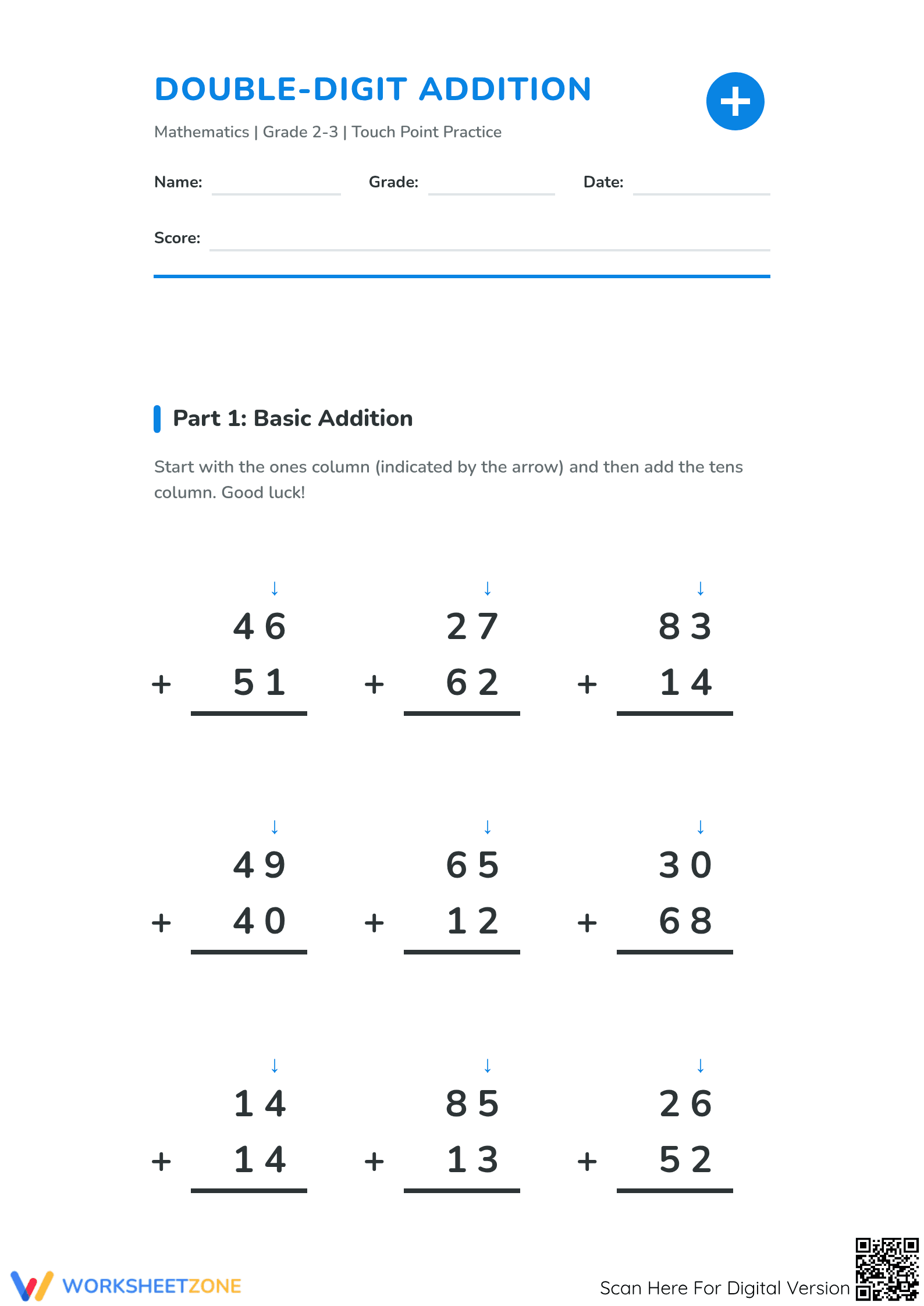
This Grade 2 double-digit addition worksheet provides structured practice for students mastering place value addition without regrouping. Students follow guided visual cues to solve problems by adding ones and then tens, ensuring a strong foundation in computational fluency. This resource is designed to build confidence through repetitive, high-success practice.
At a Glance
- Grade: 2 · Subject: Math
- Standard:
CCSS.MATH.CONTENT.2.NBT.B.5— Fluently add and subtract within 100 using place value strategies- Skill Focus: Double-digit addition without regrouping
- Format: 2 pages · 21 problems · Answer key included · PDF
- Best For: Daily warm-ups or independent seatwork
- Time: 15–20 minutes
What's Inside
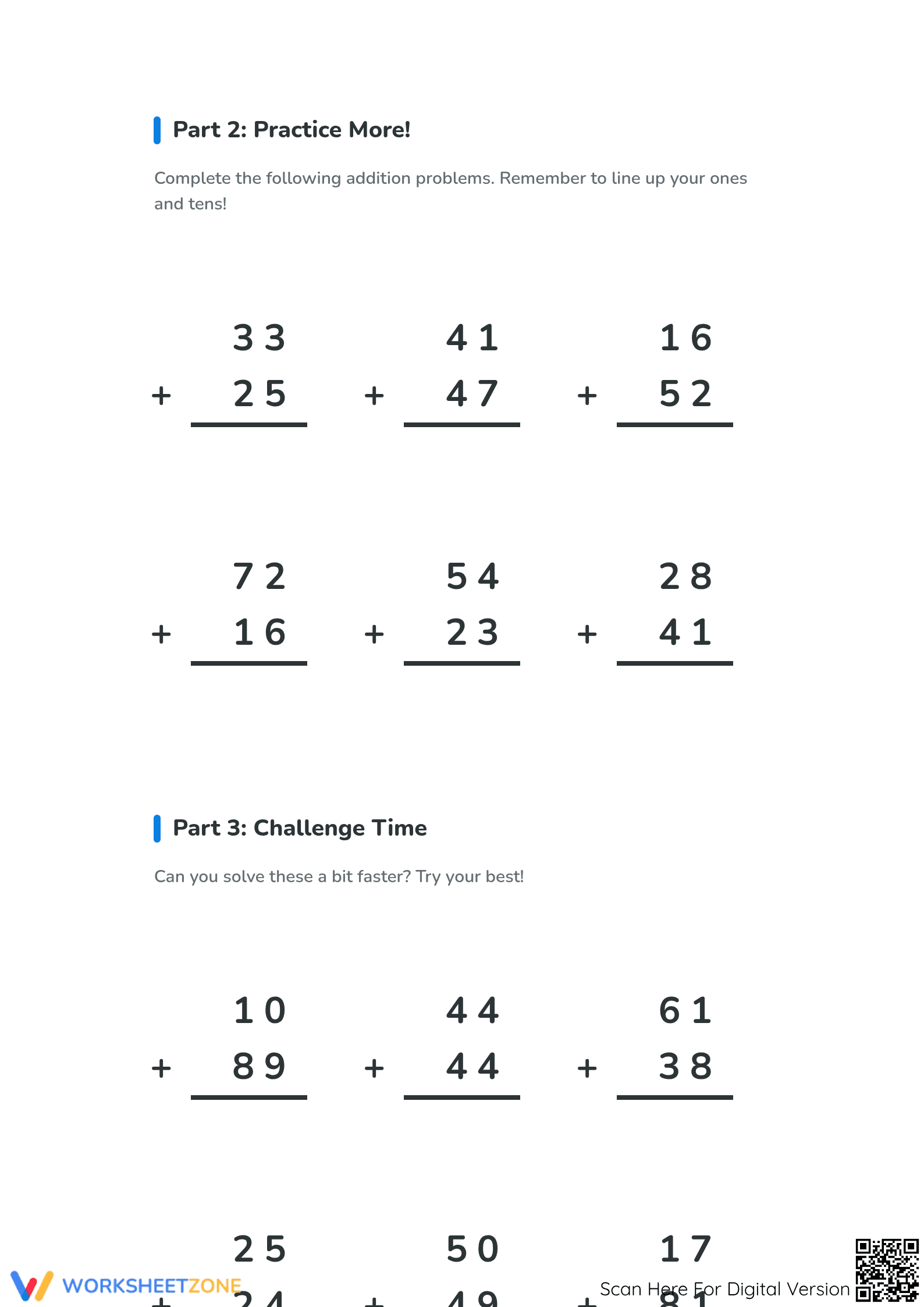
This comprehensive two-page PDF features 21 vertically aligned addition problems organized into three distinct sections. Page one introduces basic double-digit problems with helpful visual arrows to guide column addition. Page two expands into "Practice More" and "Challenge Time" segments to increase student stamina. A full answer key is provided for rapid grading or student self-correction.
Zero-Prep Workflow
The zero-prep design allows teachers to implement this activity in exactly two minutes. Step one: Print the double-sided PDF (30 seconds). Step two: Distribute to students for independent work during math centers or as a bell-ringer (30 seconds). Step three: Use the included answer key for immediate verbal feedback or a quick check-for-understanding as students complete their tasks (1 minute). This streamlined workflow makes it an ideal choice for substitute teacher packets.
Standards Alignment
The primary focus is CCSS.MATH.CONTENT.2.NBT.B.5, which requires students to fluently add within 100 using strategies based on place value. By isolating addition without regrouping, this worksheet reinforces the procedural reliability needed for later complex operations. The vertical format aligns with standard algorithmic practice found in common core state assessments. Both standard codes can be copied directly into lesson plans, IEP goals, or district curriculum mapping tools.
How to Use It
Use this worksheet as a formative assessment immediately following a lesson on place value addition. Observe students as they work through "Part 1" to ensure they are consistently starting in the ones column rather than the tens. For a second use case, assign the "Challenge Time" section as a timed "Mad Minute" style activity to encourage mental math recall and computational speed.
Who It's For
This resource is tailored for second and third-grade students who require extra reinforcement with vertical addition. It is particularly effective for learners who benefit from visual scaffolding, such as the column-start arrows and touch-point style cues. Pair this worksheet with an anchor chart showing the "Ones First" rule or place value blocks to provide a concrete model alongside the abstract numbers.
Mastering double-digit addition is a critical milestone in elementary mathematics, serving as the gateway to multi-step arithmetic and algebraic reasoning. According to research analyzed in the RAND AIRS 2024 report, providing students with high-frequency, low-stakes practice opportunities significantly improves long-term retention of place value strategies. This worksheet adheres to the CCSS.MATH.CONTENT.2.NBT.B.5 standard by focusing on computational fluency within 100, which is essential for meeting end-of-year grade-level expectations. The use of visual scaffolds, such as the arrows on page one, aligns with the gradual release of responsibility model, which has been shown by Fisher & Frey (2014) to enhance learner autonomy in mathematics. By isolating the addition operation from regrouping complexities, students can concentrate on the procedural sequence of vertical math, building the necessary cognitive muscle memory for more advanced mathematical domains in subsequent grades.


