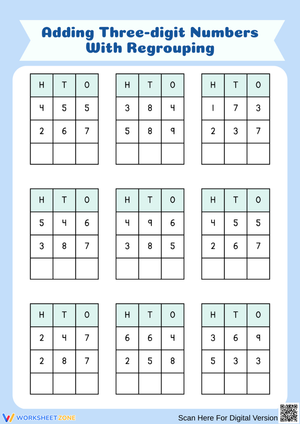
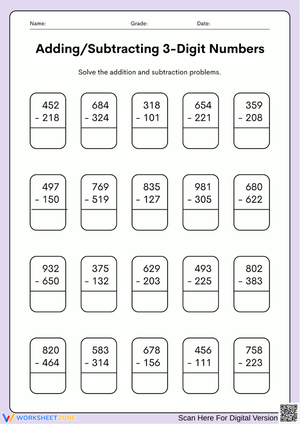
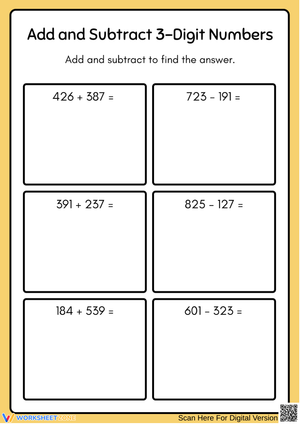
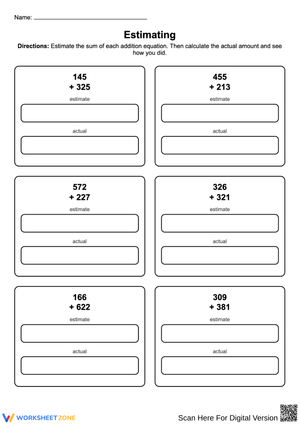
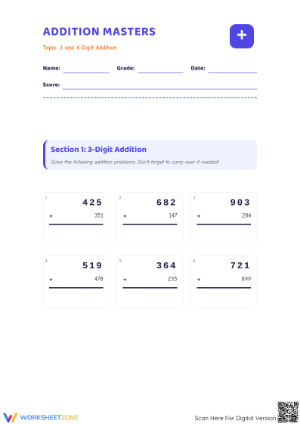
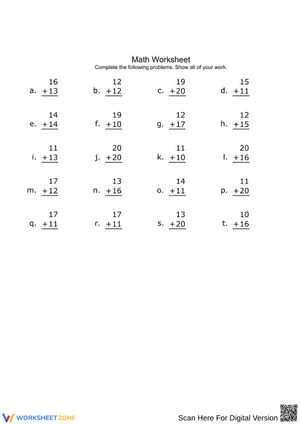
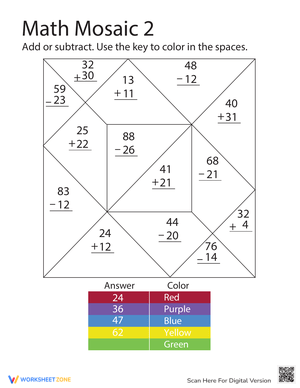
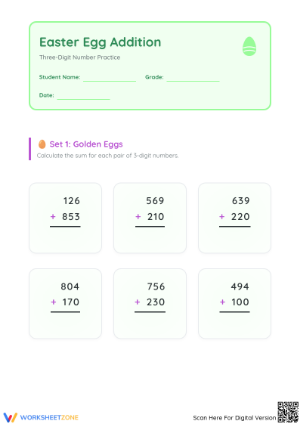
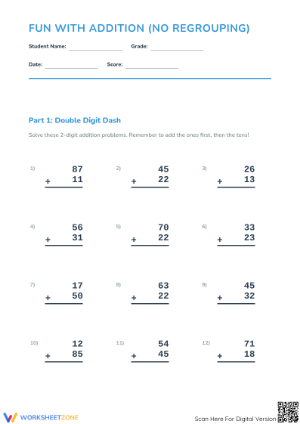
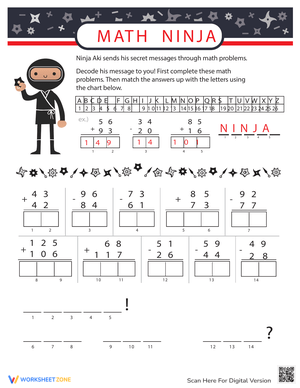
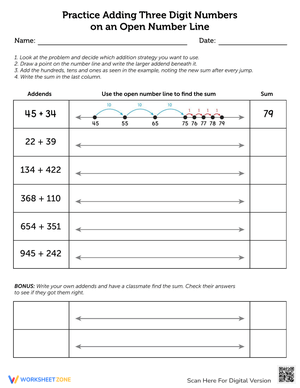
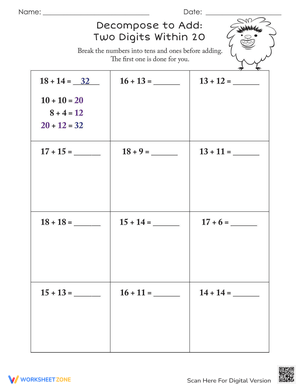
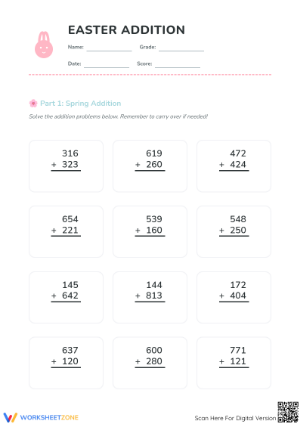
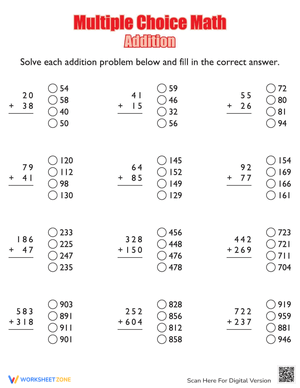
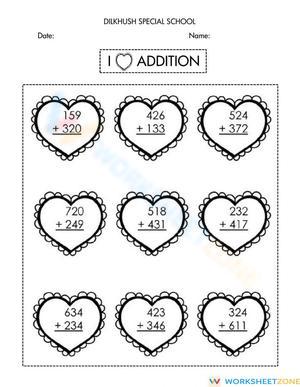
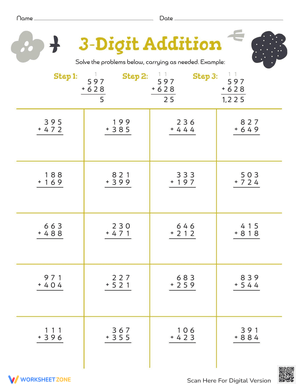
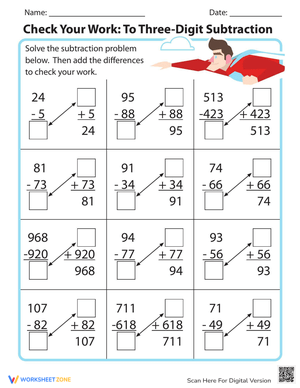
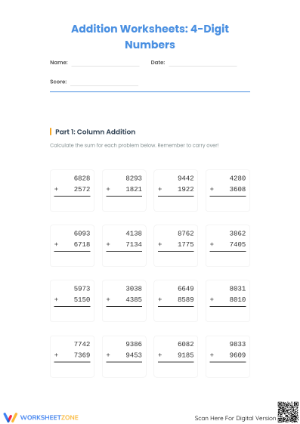
These multi digit addition printable worksheets for 3rd grade give teachers a ready set of practice resources covering addition within 1000 — from straightforward 2-digit problems without regrouping all the way to 3-digit equations that require carrying across both the ones and tens columns. The set targets the skill that sits at the center of third-grade math instruction: building procedural fluency with the standard addition algorithm while keeping place value understanding intact.
What Students Work Through
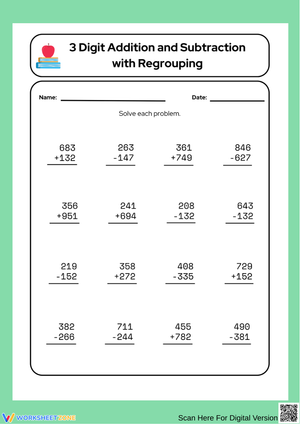
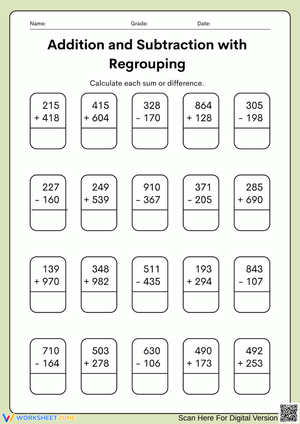
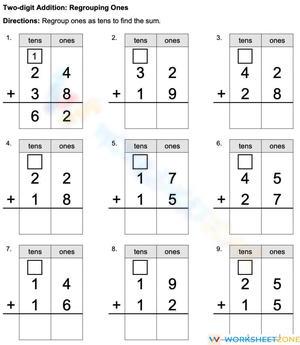
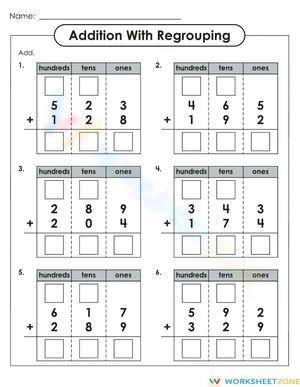
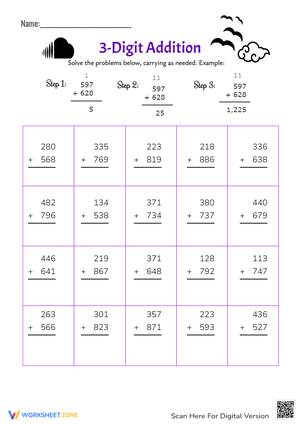
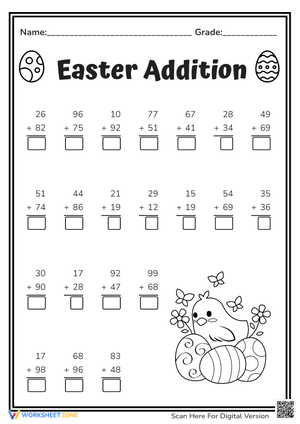
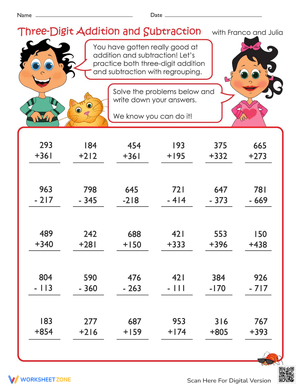
Each worksheet targets a distinct stage of multi-digit addition development. The progression moves from problems where students add 2-digit numbers without regrouping — building alignment habits and speed — to problems requiring a single regroup in the ones column, then double regrouping across both columns. Students practice:
- Adding 2-digit and 3-digit numbers in vertical format with grid-aligned columns
- Identifying when regrouping is necessary before beginning to compute
- Writing and tracking carried digits accurately through multi-step problems
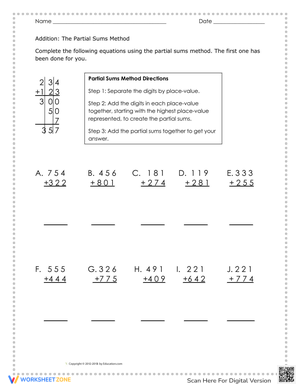
- Applying partial sums — adding hundreds, tens, and ones separately before combining — as a conceptual bridge toward the standard algorithm
- Estimating with rounded values as a self-checking strategy
The partial sums work deserves specific mention. Students who move directly to the standard algorithm without this intermediate step often treat digits as isolated symbols rather than as representations of value. A student adding 347 and 285 might execute the carrying steps correctly and still have no sense of whether the answer should be near 600 or near 6,000. Spending time adding 300 + 200, then 40 + 80, then 7 + 5 builds the magnitude awareness that makes the algorithm meaningful rather than purely mechanical.
Mistakes Students Make That These Worksheets Help You Catch
The most persistent error in this skill isn't misaligning columns — it's what might be called the phantom carry. A student writes the regrouped 1 above the tens column, then when adding that column simply forgets to include it. The digit sits there, visually present, but functionally ignored. What makes this particularly difficult to catch is that students who do it often execute carries correctly on earlier, simpler problems; the error spikes under time pressure or when regrouping is required in two consecutive columns. Having students physically cross out a carry digit once they've added it — not just write it, but actively mark it done — drops this error rate noticeably in actual classroom use.
A second pattern surfaces when students add a 3-digit number to a 2-digit number without grid lines. Left-justified alignment is their default from reading and writing, so 324 + 58 sometimes becomes 324 + 580 in the student's mental arrangement. Students who place the shorter number flush left rather than flush right produce answers off by a factor of ten and often can't identify why. Worksheets with pre-drawn column boxes address this directly, without requiring the teacher to monitor every student individually during independent work.
Standard Alignment
These worksheets align to CCSS.MATH.CONTENT.3.NBT.A.2, which asks students to fluently add and subtract within 1,000 using strategies based on place value, properties of operations, and the relationship between addition and subtraction. In classroom terms, that standard expects more than computational correctness — it expects students to understand why the algorithm works. The partial sums problems directly address that expectation by making place value decomposition visible before the efficiency of the standard algorithm takes over. A student who can explain that the carried 1 above the tens column represents ten — not one — is demonstrating the understanding 3.NBT.A.2 actually requires.
Within a typical third-grade scope and sequence, 3.NBT.A.2 is introduced early in the year, revisited in the context of multi-step word problems mid-year, and assessed for full fluency by spring benchmarking. These multi digit addition printable worksheets for 3rd grade map to all three of those instructional windows — early structured practice with simpler problems, mid-year application, and fluency-building for the spring assessment.
Fitting These Worksheets Into Your Week
Three classroom slots work especially well for this set. The Monday warm-up after morning meeting is the first: two or three problems from a no-regrouping worksheet reactivate prior learning before new instruction starts and run under five minutes. The second is the guided practice phase of a lesson introducing double regrouping for the first time — projecting a worksheet problem and solving it alongside students while they fill in their own copies keeps every student writing and reduces passive watching. The third is the eight minutes before afternoon dismissal, when a focused set of three problems produces a quick formative snapshot of where the class landed that day.
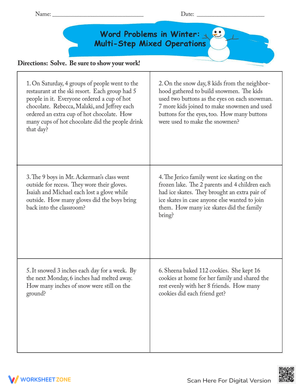
For math center rotations, pairing a computation worksheet at one station with a matching word problem set at another creates natural movement between the abstract and applied versions of the same skill. It also gives a clearer picture of which students can execute the algorithm but struggle to set up a problem from context — a distinction that matters when planning the next day's instruction.
Adapting the Set for Different Learners
Students who aren't yet fluent with single-digit addition facts will find multi-digit regrouping problems genuinely difficult — not because the concept is confusing, but because fact retrieval consumes working memory that should be tracking the carry. For those students, allowing a fact reference card during worksheet practice separates the two skills, so you're assessing understanding of the algorithm specifically rather than measuring fact fluency again. Once fact retrieval becomes more automatic, the reference card comes away without disrupting conceptual progress.
Students who have the standard algorithm solid can work through the partial sums problems as a challenge in reverse: solve first with the algorithm, then show the same work decomposed into partial sums, and verify both methods match. That extension doesn't require new materials — it uses the same worksheet differently. For students operating above grade level, adding a self-checking column where they estimate each answer before computing, then flag any result that differs from the estimate by more than 50, builds the number sense habits that pay real dividends when fourth-grade problems involve four-digit numbers and multi-step operations.
Frequently Asked Questions
What do I do when a student consistently forgets to add the carried digit?
The cross-out strategy is the most reliable classroom fix: once a student adds the carry to the next column, they draw a line through the written carry digit to mark it used. This turns the carried number from a passive annotation into an active checkpoint. Students who drop carry digits aren't usually skipping them intentionally — they lose track because the small superscript sits outside their normal left-to-right reading path. The physical cross-out re-routes their attention to it at exactly the right moment in the calculation.
Should partial sums come before or after the standard algorithm?
Before — and mid-year assessment data consistently supports the reasoning. Students who move straight to the standard algorithm without partial sums practice often produce correct answers but cannot explain what the carried digit represents. When they make an error, they have no decomposition strategy to check against, and no estimate of what a reasonable answer looks like. Starting with partial sums gives them a reference framework so that when a standard algorithm result looks wrong, they have a tool to audit it.
Are these worksheets appropriate for students still unsteady with 2-digit addition?
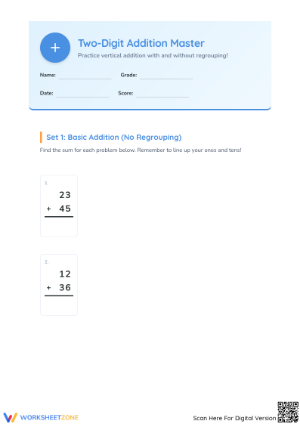
Yes. The set opens with 2-digit problems without regrouping, which gives students who need more time at that level a place to build fluency before moving to 3-digit work. The multi digit addition printable worksheets for 3rd grade are ordered by complexity, so assigning the earlier ones in the set keeps those students doing on-grade-level work without pushing them prematurely into double regrouping.
How useful are these worksheets for formative assessment?
Useful, but with one important caveat: a completed worksheet tells you whether the answer is right, not why it's wrong. Scanning completed work specifically for carry errors versus alignment errors versus fact errors produces three entirely different instructional responses. Holding onto completed worksheets for a few days and comparing the problem types where a student consistently errors — rather than simply counting total incorrect — turns these multi digit addition printable worksheets for 3rd grade into genuinely diagnostic records rather than just accuracy scores.













 Interactive Worksheet Maker
 Quiz Maker
 Word Search Maker
 Crossword Puzzle Maker
 Word Scramble Generator
 Sentence Scramble Generator
 Handwriting Worksheet Generator
 Name Tracing Generator
 Fill In The Blank Generator