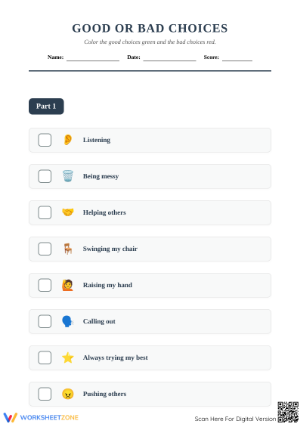
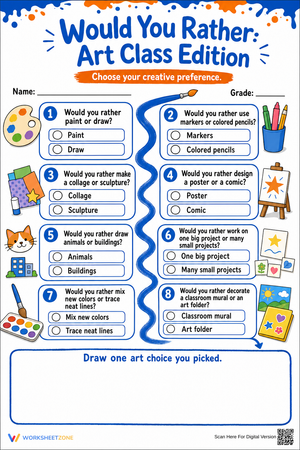
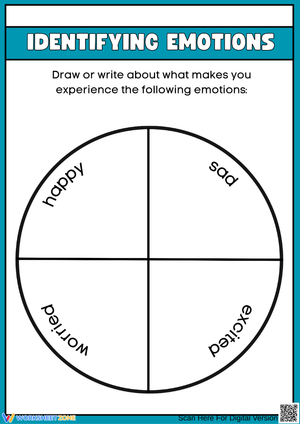
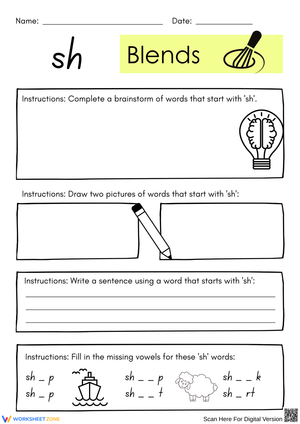
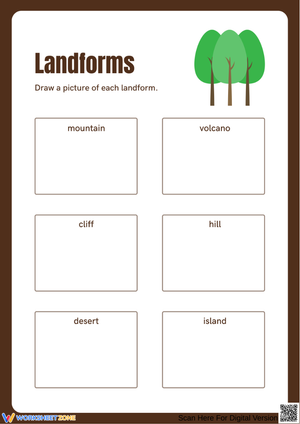
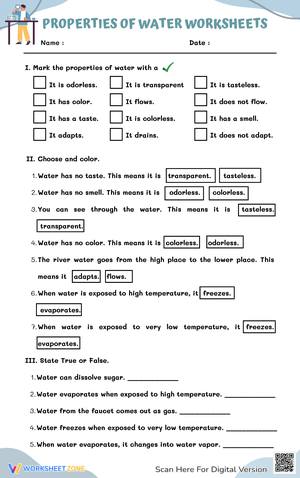
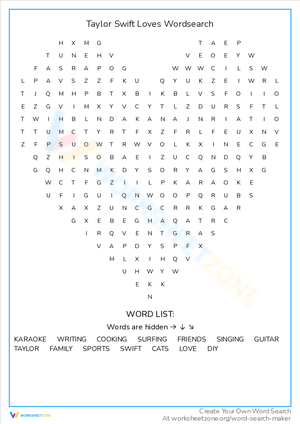
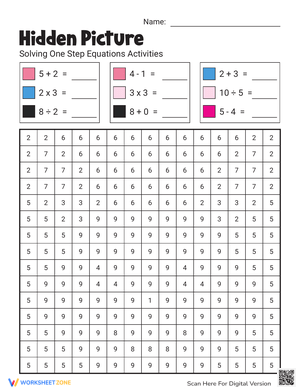
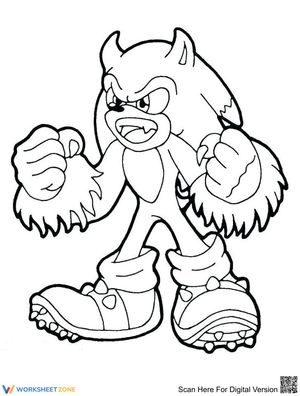
These 3rd grade art worksheets pdf resources give teachers printable practice organized around the visual art elements and design principles most central to Grade 3 instruction. At this level, students are ready to move beyond naming colors and shapes — they can analyze why a composition feels balanced, describe texture with growing precision, and apply vocabulary like foreground, value, and complementary without constant prompting. Each worksheet in this collection targets one of those skills directly, with enough structure for independent work and enough open space for student thinking to show.
The Specific Skills Targeted
Grade 3 is the point where art vocabulary shifts from exposure to application. Students have encountered "line" and "texture" in earlier grades, but third graders can now use those terms to describe their own decisions — "I used jagged lines to show energy" rather than just pointing at a mark. Every worksheet in this 3rd grade art worksheets pdf collection reflects that developmental shift, asking students to draw, label, compare, or explain rather than circle or match alone.
- Line and shape: Students sort, draw, and combine contour lines, gestural marks, geometric forms, and organic shapes. Several worksheets ask students to fill a composition using only two or three line types, which pushes deliberate decision-making instead of random mark-making.
- Color relationships: Warm and cool identification, complementary pair recognition, and basic color mixing prediction. One worksheet asks students to predict the result of mixing two given colors before they blend — a step that surfaces a lot of assumptions about how color actually works.
- Real and implied texture: Students draw both a tactile texture and a visual texture, then label which is which and explain the technique used to create each effect. That two-step task builds observation and descriptive language at the same time.
- Composition and space: Worksheets address foreground, middle ground, and background placement; filling the page; and creating visual balance through repeated shapes or distributed color.
- Symmetry and basic shading: Radial and bilateral symmetry completion tasks, plus value practice using hatching and cross-hatching — techniques that transfer directly into studio projects.
- Art vocabulary in context: Terms appear inside drawing and analysis tasks, not as isolated word lists, so students use language the same way they would when discussing actual artwork.
Mistakes Students Make That These Worksheets Help You Catch
The most consistent color error at this grade is not about hue — it is about value. Students who correctly say "red and blue make purple" will still describe adding white to a color as "making it darker." They conflate tint and shade until they see the visual difference side by side. A worksheet that places a color chip next to its tint and asks students to label it forces that distinction in a way verbal explanation alone rarely achieves.
Composition tasks surface a second predictable habit: the baseline. When asked to place objects in foreground and background, many third graders default to lining everything up along an invisible ground line at the bottom of the page. Providing a faint horizon line reference on the worksheet helps, but the habit requires several rounds of deliberate practice before students stop reaching for it automatically.
Symmetry worksheets reveal a third pattern. Students complete the mirror half accurately but leave a visible gap at the center axis because they stopped drawing just short of it. Building in a self-check step — "run your pencil along the fold line and make sure your lines connect" — catches this almost every time and turns a recurring error into a proofreading habit.
How to Build These Worksheets Into Your Lesson Plans
The most productive structure is to use each worksheet as the middle layer of a short three-part sequence. Open with a 5-minute visual model — a textile photograph for texture, a reproduction for composition analysis — then move to the worksheet for 10 to 15 minutes of focused practice, then close with a 2-minute share where each student names one choice they made and explains why. Used this way, a 3rd grade art worksheets pdf collection integrates into both art specialist schedules and homeroom morning blocks without displacing hands-on studio time.
Sub plans are where this format consistently earns its place. When a worksheet includes a visual example at the top and requires only pencils or crayons, a substitute can run the activity without art content knowledge. The key is selecting worksheets that have a clear finish state — students know the task is done because every drawing box is filled and every label is written — rather than open-ended tasks that stall without a knowledgeable teacher nearby.
Two additional slots work well in practice: morning warm-up during the week before a studio project begins, using the worksheet to build vocabulary or spatial awareness students will apply when making starts; and a 10-minute cooldown after a project wraps, using a reflection worksheet to have students label techniques they used or identify one change they would make. That second use produces a lightweight portfolio entry without any additional planning.
Differentiating the Set Across Ability Levels
For students still building fine motor control, the drawing spaces are large enough to accommodate a wider pencil grip and less precise marks — the conceptual goal is what matters, not the precision of the line. That said, some students in this range will resist a drawing task if they believe their work will not look "right." Pairing those students with a classmate for a brief 2-minute shared-thinking step before independent work reduces the freeze response without changing the task itself.
Students who finish early can extend any drawing worksheet by adding a written explanation for every visual choice — naming the element, the technique, and the intended effect. That expectation is easy to communicate before distributing the worksheets and turns a 10-minute task into a 20-minute one with richer output.
For English language learners, the vocabulary sections benefit from a bilingual reference card attached alongside the worksheet. The drawing and observation tasks remain accessible without language modification, but labeling prompts require enough language production that a small word bank — even a handwritten sticky note — prevents the task from stalling on vocabulary rather than on the art concept itself.
Standard Alignment
These worksheets connect to two National Core Arts Standards at the Grade 3 level. VA:Cr2.1.3 asks students to "create personally satisfying artwork using a variety of artistic processes and materials." The composition, texture, and drawing worksheets give students structured rehearsal with process decisions before and during studio work — which is exactly what this standard expects when it calls for intentional, personally motivated choices rather than copied outcomes. Teachers can position these worksheets in the creating phase of a unit and point to completed student work as evidence of process thinking.
VA:Re7.1.3 asks students to "speculate about processes an artist uses to create a work of art." The visual analysis prompts embedded in color and composition worksheets address this directly: students describe what they observe in a reference image, identify the elements at work, and explain the effect produced. Using a worksheet like this after viewing a reproduction — before studio time begins — gives teachers documented evidence of responding-phase thinking without adding a separate formal assessment.
Frequently Asked Questions
What art concepts do these Grade 3 worksheets address?
The collection covers line, shape, color relationships, real and implied texture, composition and space, symmetry, basic value shading using hatching, and art vocabulary in context. Each worksheet focuses on one primary visual element or principle so students are not splitting attention across multiple concepts at once.
How do these worksheets fit into a lesson that is primarily hands-on?
They work best as the focused practice layer between a teacher model and hands-on studio time, or as a structured reflection after a project is complete. The worksheets are not substitutes for making — they sharpen the conceptual understanding students bring to the materials.
Can a homeroom teacher use these without a background in visual art?
Yes. Most worksheets require only pencils or crayons and include a visual example so the task is self-explanatory. Teachers who use the 3rd grade art worksheets pdf set during morning work or centers do not need specialized art training — the format provides enough direction for students to work independently.
Do these worksheets print clearly in black and white?
The drawing tasks are student-generated rather than dependent on pre-printed color fields, so the worksheets reproduce cleanly without color ink. Where a color-theory worksheet includes reference chips, each chip is labeled with the color name so students can work from a basic crayon set without needing a full-color printout.