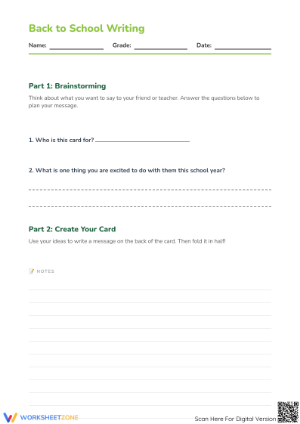
Brainstorming printable worksheets for 3rd grade address the single most common writing-block moment at this level: the student who sits down with a pencil and produces nothing because they can't figure out where to start. This set gives teachers a range of organizers matched to Grade 3's three main writing types — personal narrative, opinion, and informative — so students have a concrete place to collect ideas before drafting begins. Each worksheet works as a standalone prewriting tool, meant to be completed in one sitting and kept beside the student during the drafting period.
Formats in the Set and What Each One Does
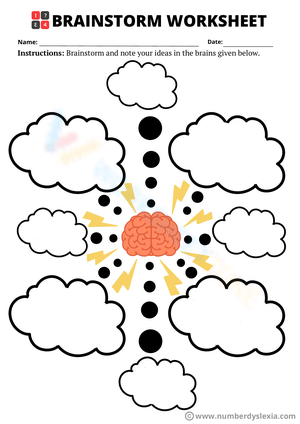
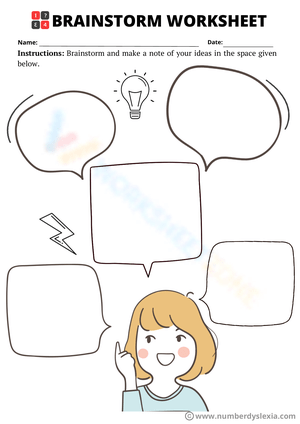
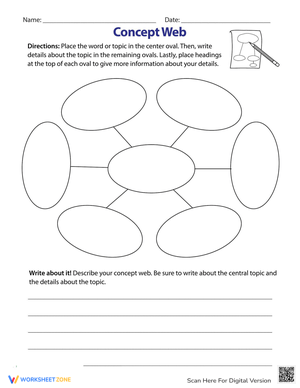
The set includes five distinct organizer formats, each suited to a different planning need. A bubble map places the main topic in a center circle with surrounding spaces for details, examples, or related ideas — a strong choice for informative writing or early topic exploration when students need to see how many ideas they actually have before narrowing. A list organizer gives students an open column for rapid idea collection: story events, opinion reasons, or facts they already know. The story map walks narrative writers through character, setting, problem, key events, and resolution before a word of the draft is written. An opinion planner holds the claim at the top and provides three reason slots with space for a supporting example under each. A topic-and-detail organizer divides the worksheet into a main topic box and separate category sections, keeping informative facts grouped rather than scattered.
Each worksheet uses short, direct labels — "My Opinion," "Reason 1," "What Happened First" — rather than lengthy instruction. At Grade 3, directions on a prewriting worksheet compete with the mental work of generating ideas, and keeping labels brief leaves more cognitive space for actual thinking. This matters especially at this grade level, where students are transitioning from the mostly oral composition common in K–2 to sustained written production — the simultaneous demand of generating ideas and forming sentences is genuinely high.
Frequent Student Errors Worth Watching For
The error pattern that shows up most often with Grade 3 opinion writing is circular reasoning in miniature: a student writes "My opinion is that dogs are better pets" and then fills every reason slot with a variation of "because dogs are good." The opinion planner in this set prompts for an example under each reason, which pushes students past repetition. When a student can't produce an example, that's the teaching moment — not after they've drafted three paragraphs built on the same unsupported claim.
In narrative writing, the most consistent issue isn't weak ideas — it's scope. Third graders routinely try to write about an entire vacation instead of one afternoon at the beach. The story map here includes a "big moment" prompt alongside the standard beginning-middle-end sections. That single field asks the student to name the most important part of the story, which naturally tightens the focus before drafting starts. Teachers who catch a student writing "my whole trip to Florida" in that box already know the conference conversation before it begins.
For informative writing, students often confuse opinions with facts or pile unrelated details under one category heading. A completed topic-and-detail worksheet makes this visible immediately. If a student's "Animal Adaptations" worksheet shows "polar bears are cute" filed under the same heading as "polar bears have thick fur to stay warm," the sorting error is right there — fixable in a two-minute conversation before the draft begins.
How to Work These Worksheets Into Your Lesson Plans
The most reliable entry point is a five-minute whole-group model at the start of writing workshop. Pick one organizer, write your own topic in front of the class, and think aloud as you add ideas — including a moment where you cross something out or move it to a different section. That visible revision tells students the worksheet is a thinking space, not a document to be filled in neatly. Then release them to work with their own topics on the same format.
Writing conferences become more focused when students bring their completed worksheet to the table. Instead of opening with a general question, a teacher can point to specific sections and ask targeted questions based on what they actually see:
- On a story map: "You have four events here — which one is the big moment your whole story is building toward?"
- On an opinion planner: "Your third reason doesn't have an example yet. What's one time you actually saw this happen?"
- On a topic-detail organizer: "These two facts are in different categories, but they seem to be about the same idea — should they be together?"
That kind of question moves the conference from retrieval to decision-making, which is where real writing growth happens. For the 10 or 12 minutes left before a transition or pickup, a partially completed worksheet is actually the right task — students can add one more idea, circle their strongest reason, or sketch the main event without being pushed into full drafting mode mid-period.
Adjusting the Set for a Range of Learners
Brainstorming printable worksheets for 3rd grade can be adjusted at the point of use without modifying the file. For students who need more support, pair the worksheet with oral rehearsal first — have the student tell a partner their story or opinion before writing anything. The fields then function as a capture tool for ideas the student already knows they have, rather than a blank prompt they're staring at with nothing coming. For students who fill every box quickly but with thin content, add a verbal challenge after they finish: "Pick your strongest reason and tell me three examples, not just one." That conversation extends thinking without requiring a different worksheet entirely.
Emergent writers often do better starting with a quick sketch. Students who draw their main event, label the characters, and circle the key moment have completed real planning work even if the written fields hold only a word or two per box. Letting that count as a finished brainstorm — then using a brief dictation conversation to name what the words should say — gets the planning done without making the prewriting step feel longer than the drafting step itself.
Standard Alignment
Brainstorming printable worksheets for 3rd grade align directly to CCSS W.3.5, which calls for students to develop and strengthen writing through planning, revision, and editing with guidance from peers and adults. In classroom terms, W.3.5 is the standard that makes prewriting instruction explicitly required rather than optional — a completed organizer is direct evidence of that planning step in a writing portfolio or conference binder. The format-specific worksheets also support W.3.1 (opinion), W.3.2 (informative), and W.3.3 (narrative) by giving students a structured way to organize thinking before they produce the text those standards assess. Most Grade 3 teachers introduce these planning routines in the fall and return to each format at the start of a new writing unit.
Frequently Asked Questions
Do these worksheets cover all three Grade 3 writing types?
Yes. The set includes organizers matched specifically to personal narrative, opinion, and informative writing. The formats are different because the planning needs are different — a story map doesn't help an opinion writer, and a reasons planner doesn't help a student planning a narrative. Each worksheet is labeled by writing type so teachers can pull the right format without explanation.
How should I introduce these to students who have never used an organizer?
Model one worksheet with your own topic before students use it independently. The first time, complete it together as a class, talking through each section. The second use, release students after the first section is done together. By the third time, most students can work independently. The goal is for students to internalize what each field is asking so they stop needing to re-read directions at the start of every writing period.
Can these worksheets serve as a formative assessment tool?
Brainstorming printable worksheets for 3rd grade tell you whether a student's difficulty with a final draft started at the planning stage. A student with a strong, detailed organizer who still produces a weak draft likely needs help with sentence construction or paragraph organization. A student with a mostly blank organizer needs more work on idea generation before drafting begins at all. The worksheet separates those two problems, which is the first step in addressing them effectively.
What if students finish quickly and all their ideas are thin?
Speed usually isn't the problem — topic choice is. Students who pick a topic they know only in general terms ("my favorite sport") tend to produce general ideas. Students who anchor to a specific memory or experience ("the time I missed the bus on picture day") tend to fill the organizer with usable detail. When weak brainstorming shows up, asking the student to swap to a more specific topic and start again takes less time than trying to develop thin material further.












 Interactive Worksheet Maker
 Quiz Maker
 Word Search Maker
 Crossword Puzzle Maker
 Word Scramble Generator
 Sentence Scramble Generator
 Handwriting Worksheet Generator
 Name Tracing Generator
 Fill In The Blank Generator