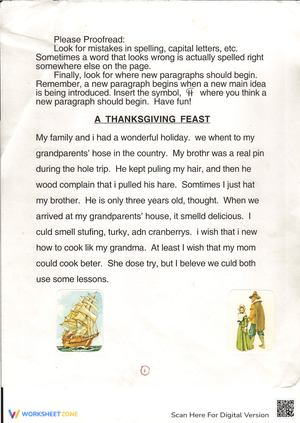
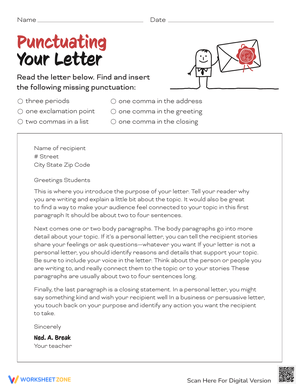
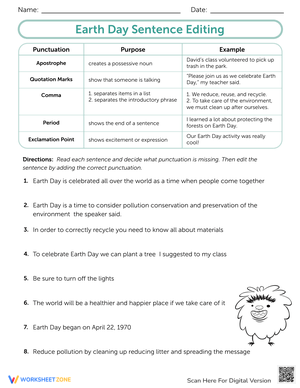
These editing worksheets for 3rd grade give students structured practice catching mechanical errors in pre-written text — a fundamentally different task than correcting their own stories, and one that builds the careful reader's eye third graders need before self-correction becomes reliable. The set targets capitalization, usage, punctuation, and spelling — the four CUPS categories many grade 3 teachers already use as a classroom editing routine.
Skills Built Across the Set
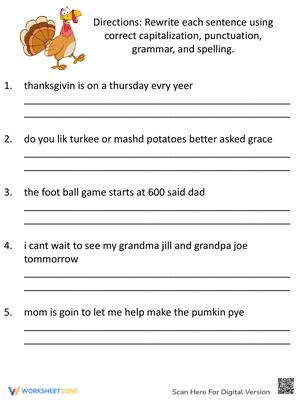
Each worksheet works through the CUPS framework in a way that matches what third graders are actually expected to do. Capitalization work goes beyond sentence beginnings: students mark proper nouns, correct the pronoun I, and fix titles. Punctuation exercises cover end marks, commas in addresses and dialogue, and apostrophes in possessives. Usage tasks ask students to find subject-verb mismatches and pronoun errors — the kind of mistake that sounds fine when read aloud but looks wrong in print. Spelling exercises center on grade-level homophones, silent-letter words, and consonant-doubling patterns that 8- and 9-year-olds consistently confuse.
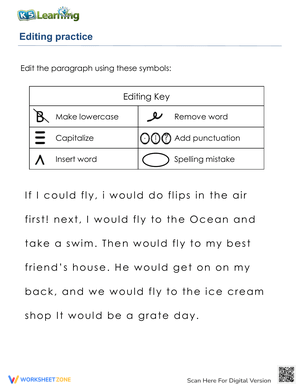
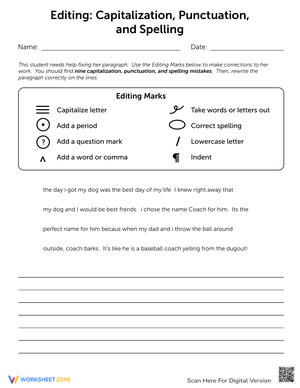
Several worksheets in the set introduce a simplified proofreading mark system: triple underline for capitalization, a caret for a missing word, a circled dot for a missing period. Giving students a visual vocabulary for corrections separates the act of finding an error from the act of describing it. They mark first, fix second, and that two-step rhythm slows them down in exactly the right way.
Common Student Errors Worth Anticipating and Correcting
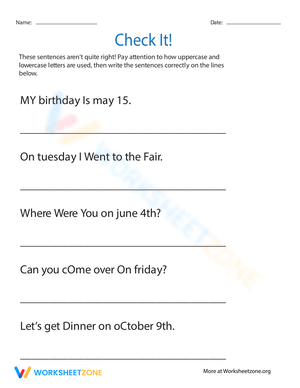
The most persistent capitalization problem at this grade level is inconsistency with proper nouns mid-sentence. A student who writes Springfield correctly in one sentence will write maple street in the next. The category rule — all proper nouns, regardless of position — has not yet generalized; students are still operating name-by-name. Worksheets that string several proper nouns across different sentence positions, not just sentence-initial capitals, are what build that wider generalization.
Apostrophe confusion takes a specific form in third grade: students add an apostrophe to nearly every word ending in s. If a sentence contains the girl's hat and three dogs on the same line, expect a large share of students to write dog's. The plural-versus-possessive distinction is abstract until students have seen it corrected in concrete examples enough times for the difference to settle. Homophones — particularly their/there/they're and your/you're — appear as spelling errors on the surface but are usage errors underneath, and they require a different correction move than standard misspellings do. Worth flagging both issues explicitly when going over work as a class.
Fitting These Worksheets Into Your Planning
The Daily Fix-It routine is where most grade 3 teachers see the steadiest growth. Two sentences with planted errors on the board at the start of class, five to eight minutes of individual marking, then class discussion. The routine works not because of any single session but because of repetition across weeks — the rules stop feeling arbitrary after students have encountered them in thirty low-stakes practice moments.
The single-lens pass is worth introducing once students have the basics under control. Give them four colored pens and send them through each editing worksheets for 3rd grade task four separate times — one CUPS category per pass. Blue pen for capitalization only, red for punctuation only, and so on. What this does in practice is reduce the number of decisions a student has to hold simultaneously: most third graders who miss errors do so not because they lack the rule but because they are tracking too many things at once. Four deliberate passes catch more than one rushed scan. It also gives teachers readable diagnostic data — if a student's red pass is nearly clean on a worksheet with eight punctuation errors, that tells you something specific about what needs direct instruction.
Themed passages — a paragraph about the solar system during a science unit, a passage about a historical figure during social studies — generate more careful reading than generic content. When students are actually interested in the text, the editing gets more attention.
Standard Alignment
These worksheets address L.3.2, the Language standard requiring third graders to demonstrate command of capitalization, punctuation, and spelling conventions. The sub-standards that map most directly to the set are L.3.2b (forming and using possessives), L.3.2c (commas and quotation marks in dialogue), and L.3.2d (commas in addresses). Spelling exercises align with L.3.2e and L.3.2g, targeting grade-appropriate patterns and reference-consultation habits. In classroom terms, L.3.2 is an editing standard — it is assessed inside writing products, not in isolation — which means repeated practice on pre-written text is a direct and appropriate path toward meeting it.
Adapting the Set for Different Learners
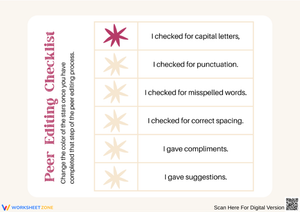
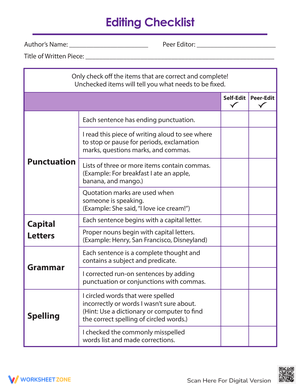
For students who are not yet solid on basic end punctuation and sentence-initial capitalization, pull the worksheets that isolate those two features and hold the possessives and dialogue tasks for later. Distributing attention across all four CUPS categories before the fundamentals are secure produces scattered work. These students also benefit from having the CUPS checklist visible on their desk while they work — not as a test tool but as a prompt for where to look next.
Students who find errors accurately and quickly are ready for two additional challenges. First, ask them to write a sentence explaining why each correction is necessary, not just mark the error. Second, give them a clean paragraph and ask them to plant exactly three errors before trading with a partner. Constructing deliberate mistakes requires a deeper grasp of the rule than correcting them does. The editing worksheets for 3rd grade in this set serve as useful models for what well-constructed error-planting looks like — students can study the error types before they try to reproduce them.
Frequently Asked Questions
What is the practical difference between editing and revising at this grade level?
Revision addresses content — adding a detail, cutting a repeated line, reordering events. Editing addresses mechanics — capitalization, punctuation, spelling, usage. Third graders frequently conflate the two, partly because teachers often use both words interchangeably when rushing through the writing process. The distinction matters in practice because editing requires a different kind of attention: slower, mark-by-mark reading rather than reading for meaning. These worksheets build editing habits specifically; revision tasks require separate work.
Which punctuation skills does L.3.2 actually add at grade 3, beyond what students learned earlier?
Beyond the end marks students learned in grades 1 and 2, L.3.2 adds commas in addresses, commas and quotation marks in dialogue, and apostrophes in possessives. The apostrophe work is genuinely new for most students — they have encountered possessives in reading but have not applied the apostrophe rule systematically in their own writing. These skills take the most time in the editing worksheets for 3rd grade tasks, and teachers should plan to revisit them across multiple sessions before student writing shows consistent accuracy.
Can these PDFs be used for digital annotation instead of printing?
Yes. Uploading to a platform that supports annotation — Kami, Seesaw, or Google Classroom with the right extension — lets students mark corrections with digital tools rather than a pen. The proofreading mark system transfers cleanly to stylus or text-box annotations. For whole-class use, projecting the worksheet and working through it together on an interactive display functions well as a discussion format alongside individual practice.












 Interactive Worksheet Maker
 Quiz Maker
 Word Search Maker
 Crossword Puzzle Maker
 Word Scramble Generator
 Sentence Scramble Generator
 Handwriting Worksheet Generator
 Name Tracing Generator
 Fill In The Blank Generator