


























Views
Downloads
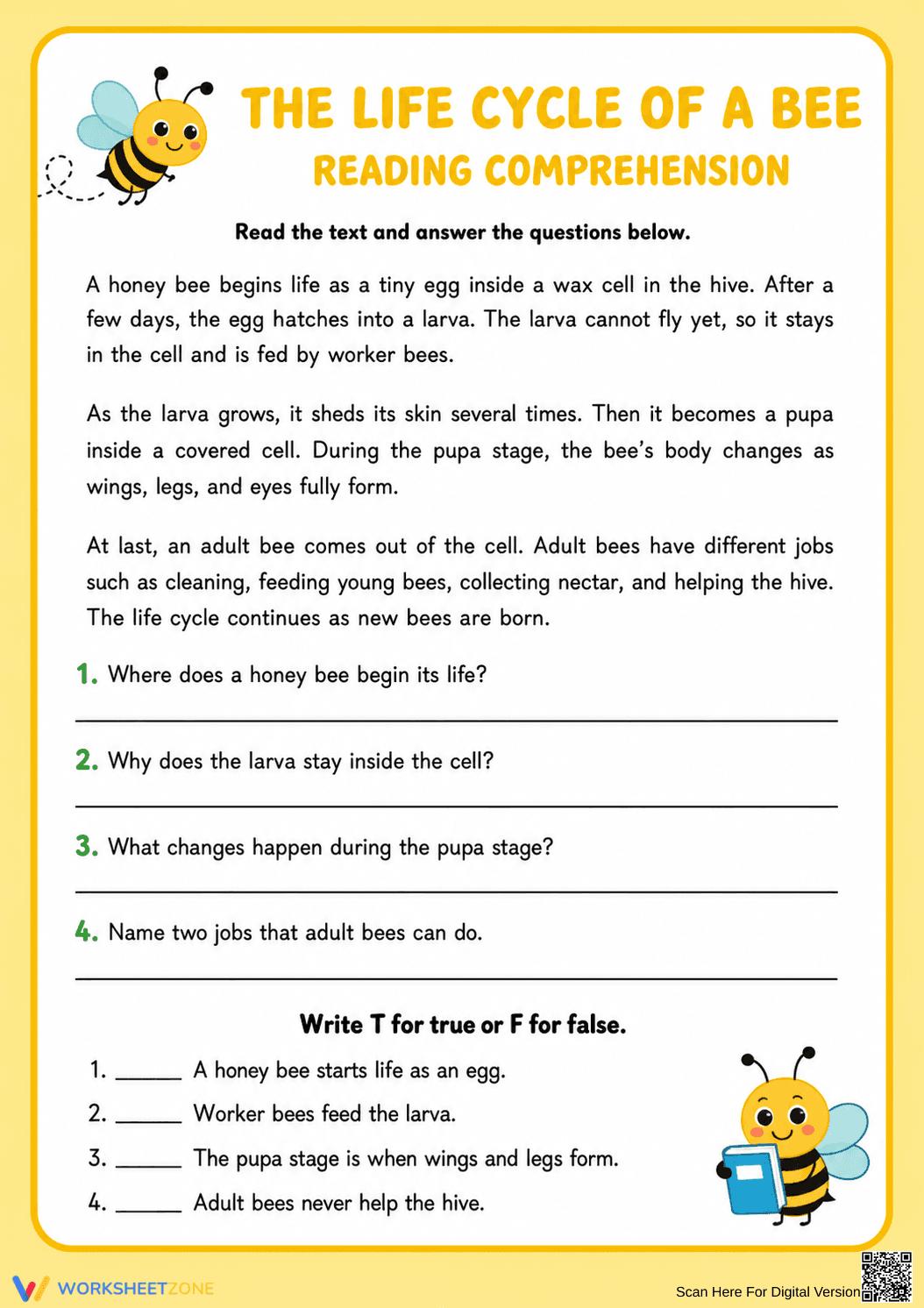

Grade 3 Bee Life Cycle — Printable No-Prep Worksheet
Paste this activity's link or code into your existing LMS (Google Classroom, Canvas, Teams, Schoology, Moodle, etc.).
Students can open and work on the activity right away, with no student login required.
You'll still be able to track student progress and results from your teacher account.
This reading comprehension worksheet helps students build literacy skills while exploring a honey bee's life stages. By reading a short informational passage and answering targeted questions, learners practice extracting key details and using text evidence to support their understanding of scientific concepts.
At a Glance
- Grade: 3 · Subject: ELA & Science
- Standard:
CCSS.ELA-LITERACY.RI.3.1— Answer questions using explicit text evidence- Skill Focus: Reading Comprehension
- Format: 1 page · 8 problems · Answer key included · PDF
- Best For: Independent practice
- Time: 15–20 minutes
This single-page resource features an age-appropriate informational text detailing the four stages of a bee's life. Following the passage, students complete four short-answer questions requiring them to pull facts directly from the reading. The worksheet concludes with a four-question true/false section to assess overall comprehension. A complete answer key is provided.
Designed for immediate classroom use, this resource requires absolutely no teacher setup:
- Print (1 minute): Simply print the PDF and copy a class set. The clean layout saves ink.
- Distribute (1 minute): Hand out to students during science or literacy blocks. The instructions are completely self-explanatory.
- Review (3 minutes): Use the included answer key to quickly check student responses or guide a whole-class review.
With under two minutes of total prep time, this worksheet is an excellent addition to any emergency sub plan or busy instructional day.
This activity is closely aligned with CCSS.ELA-LITERACY.RI.3.1: Ask and answer questions to demonstrate understanding of a text, referring explicitly to the text as the basis for the answers. It also supports cross-curricular learning by introducing foundational life science concepts regarding organism life cycles. Both standard codes can be copied directly into lesson plans, IEP goals, or district curriculum mapping tools.
Deploy this worksheet during your dedicated literacy block as an independent reading center activity, or use it to integrate reading skills into your science curriculum. As a formative assessment tip, observe whether students are looking back at the text to find their answers or guessing from memory; encourage them to underline the sentence in the passage where they found the evidence. Most students will complete the reading and the eight questions within 15 to 20 minutes.
This resource is ideal for third-grade students, though it serves as excellent guided practice for second graders or a quick review for fourth graders. For students needing extra support, teachers can read the passage aloud before asking them to tackle the questions independently. It pairs perfectly with a broader science unit on insect life cycles or a direct instruction lesson on finding the main idea and key details.
Integrating science content into literacy instruction is a highly effective strategy for building background knowledge and improving reading comprehension. According to a recent EdReports 2024 analysis, cross-curricular reading materials significantly boost student engagement and vocabulary acquisition. This worksheet directly supports CCSS.ELA-LITERACY.RI.3.1 by requiring students to answer questions using explicit text evidence. By combining the fascinating topic of the bee life cycle with structured reading practice, educators can maximize instructional time and address multiple learning objectives simultaneously. Students not only learn about the egg, larva, pupa, and adult stages of a honey bee, but they also practice the critical academic skill of locating and citing information within an informational text. This dual-purpose approach ensures that learners are developing the robust analytical skills necessary for future academic success while mastering essential grade-level science concepts.


