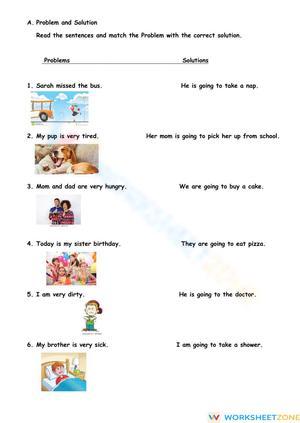
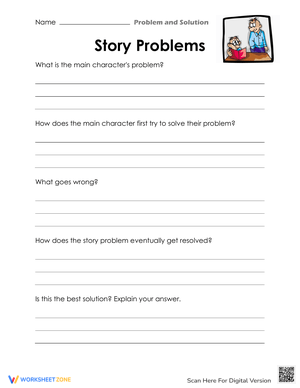
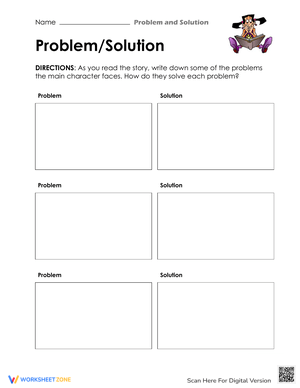
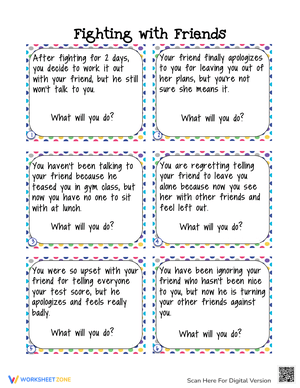
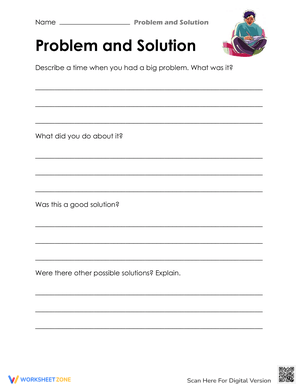
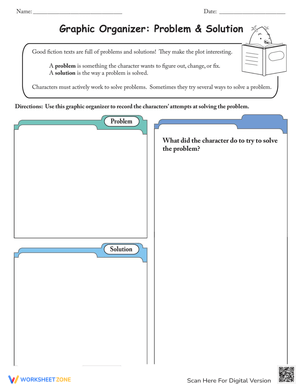
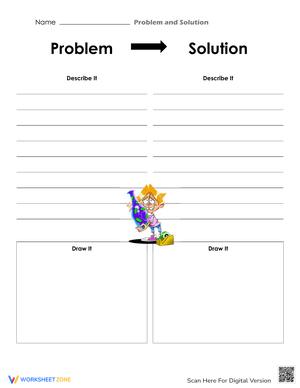
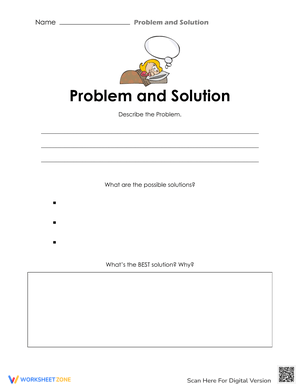
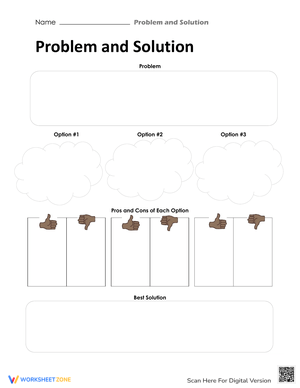
These 3rd grade problem and solution in nonfiction worksheets give teachers printable practice built around actual informational passages — the kind students encounter in science units, social studies chapters, and current events texts. Each worksheet pairs a short nonfiction excerpt with a set of targeted tasks: circling signal words, filling in a graphic organizer, and writing a sentence that explains how the problem and its resolution connect. The passages cover high-interest territory: habitat loss, water conservation, early inventions, and public health challenges.
Skills Targeted Across the Set
Students work with problem and solution as a text structure — not just a reading skill, but a way of understanding how nonfiction authors organize ideas to explain real-world challenges. The tasks across each worksheet move through several layers of that understanding.
- Identifying the central problem in a passage, including cases where it appears mid-text rather than in the opening sentence
- Locating the solution and distinguishing it from a consequence that simply follows from events
- Marking signal language: as a result, to address this, the challenge was, engineers developed, scientists determined
- Completing T-chart and simple flow-diagram organizers that map the problem-to-solution relationship
- Writing a two- to three-sentence response explaining, in students' own words, how the problem and solution connect
The written-response component matters beyond comprehension practice. When students put the relationship into their own sentences, gaps in understanding surface immediately — and that is where the real teaching happens.
Mistakes Students Make That These Worksheets Help You Catch
The most persistent confusion at third grade is between cause/effect and problem/solution. Both structures involve a "because this happened, that followed" relationship — but problem/solution requires an intentional action, a deliberate human or institutional response to a conflict. A student reading about ocean pollution might correctly identify the problem but then write "fish died" as the solution because that detail appears after the problem in the paragraph. That answer shows the student has cause/effect logic; it shows they do not yet have problem/solution logic. The fastest classroom correction is asking a single question: "Did someone choose to do this?"
A second error pattern surfaces when a passage describes multiple attempts before a successful resolution — texts about early flight or vaccine development are common examples. Students frequently record only the final solution and ignore the intermediate failed attempts, which means they miss the structure of the argument entirely. The flow-diagram organizer on each worksheet directly addresses this by prompting students to track attempts in sequence before arriving at the outcome.
There is also the signal-word trap. Students who learn to scan for as a result will sometimes flag a consequence when that phrase introduces what happened because of the problem, not what fixed it. Pointing to a specific line in the passage and asking "Did this make the problem go away, or did it make it worse?" resolves the confusion faster than re-explaining the definition.
Building These Worksheets Into Your Weekly Literacy Block
The most efficient entry point is the Monday warm-up or the ten minutes after morning meeting, especially early in a nonfiction unit. Project the passage on the board, mark up the signal words together, and let students complete their own graphic organizer independently. That small whole-group model followed by independent application is a solid gradual-release sequence for a skill students are just starting to internalize.
During guided reading rotations, these worksheets anchor a small-group session focused on informational text. Read the passage aloud, pause at signal words, and ask students to predict whether a problem or solution is coming next. That prediction step — before filling anything in — is often where the deepest comprehension work happens. For a 3rd grade problem and solution in nonfiction worksheets used as an exit check, the T-chart section alone is sufficient; save the written-response component for lessons where there is time to discuss answers and address the cause/effect confusion that almost always comes up.
Standard Alignment
These worksheets address RI.3.8, which asks third graders to describe the logical connections between particular sentences and paragraphs — including comparisons, sequences, and cause/effect chains. Problem and solution is the logical structure that most directly maps to the argument-building students encounter in science and social studies texts at this grade, making RI.3.8 the clearest instructional target. Identifying the solution also requires students to return to specific lines in a passage for evidence, which simultaneously reinforces RI.3.1.
Looking ahead, the same analytical habit feeds directly into RI.4.5, which requires students to describe the overall structure of an informational text. Third graders who can locate problem and solution within a paragraph arrive at fourth grade already thinking in structural terms — not just about what a text says, but about how it is built. That is worth establishing early.
Adjusting the Set for a Range of Learners
For students who struggle with comprehension, the most effective adjustment is reducing cognitive load before they read: preview the passage title together, name the topic, and establish whether the problem is likely to be human-caused or natural. That orientation removes the unfamiliarity tax and lets students focus on the structure itself rather than spend their working memory on background knowledge gaps. Sentence frames for the written-response section — The problem in this passage is ___. The author explains that ___ was the solution because ___.— give these students a structure that mirrors what proficient readers do internally.
For students reading above grade level, look for passages where the solution is implied or where the author proposes a fix without confirming it succeeded. Those texts require inference rather than retrieval, which is a substantially harder task at this age. You can also use a 3rd grade problem and solution in nonfiction worksheets from this set as a jumping-off point for a short writing assignment: ask students to write a new paragraph using the same text structure around a problem they have actually encountered, which forces them to apply the organizational logic rather than just identify it in someone else's writing.
Frequently Asked Questions
How is problem and solution different from cause and effect at the third grade level?
Cause and effect describes what happened and why — rain caused flooding. Problem and solution requires an intentional response: someone recognized the flooding as a problem and built a levee. The classroom test for third graders is asking "Did someone choose to do this?" If the answer is yes, it is almost always problem and solution structure. Cause and effect happens to people; problem and solution is acted upon by people. That distinction is the one worth drilling repeatedly.
What types of nonfiction passages work best for teaching this structure?
Passages about inventors, engineers, conservationists, and public health workers tend to work best because the intentional action is explicit — a person or group identified a problem and built, designed, or implemented a fix. Texts about natural events like storms or erosion are better paired with cause/effect instruction. Once students are solid on problem/solution, mixing the two passage types and asking students to sort them by structure is actually one of the more productive lessons of the unit.
Can these worksheets serve as formative assessment?
Each worksheet works as a formative check. The T-chart section shows whether a student can retrieve and categorize information; the written-response section shows whether they understand the relationship between the two. When students complete the T-chart correctly but write a confused explanation, that tells you the gap is at the synthesis level rather than the identification level — which changes the next instructional move. For a 3rd grade problem and solution in nonfiction worksheets used as a quick exit check, the T-chart alone is usually sufficient to gauge where the class stands before the next lesson.
What if a passage contains more than one problem or solution?
At third grade, most leveled passages have one central problem and one primary resolution, though the solution may involve a sequence of steps or attempts. If a passage includes multiple distinct problems, guide students to identify the most significant one first, then note secondary problems separately. The flow-diagram organizer handles sequential solutions better than the T-chart does, so having both formats available gives teachers flexibility depending on the structure of a given passage.












 Interactive Worksheet Maker
 Quiz Maker
 Word Search Maker
 Crossword Puzzle Maker
 Word Scramble Generator
 Sentence Scramble Generator
 Handwriting Worksheet Generator
 Name Tracing Generator
 Fill In The Blank Generator