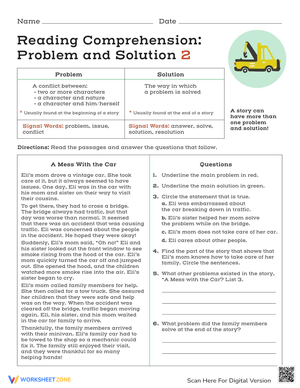
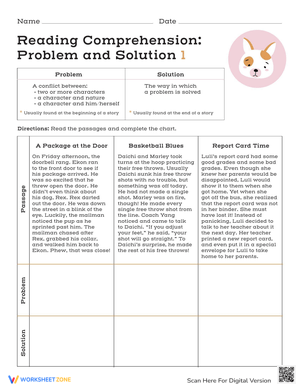
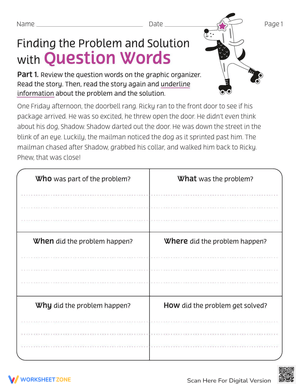
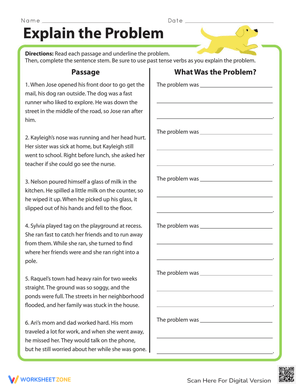
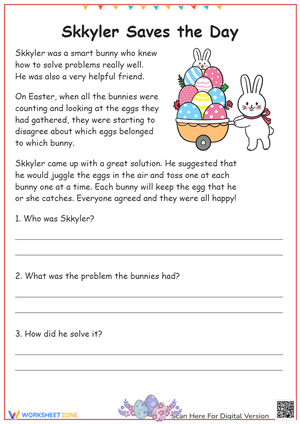
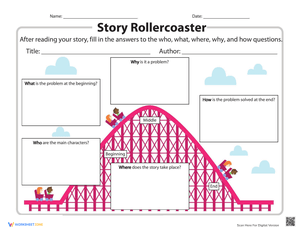
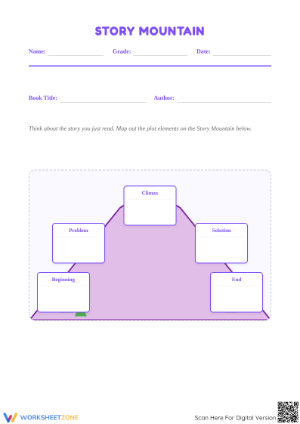
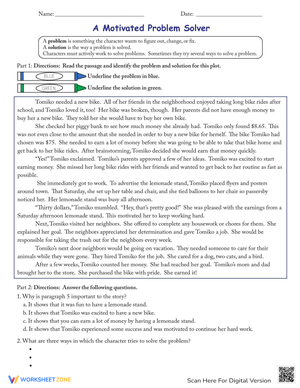
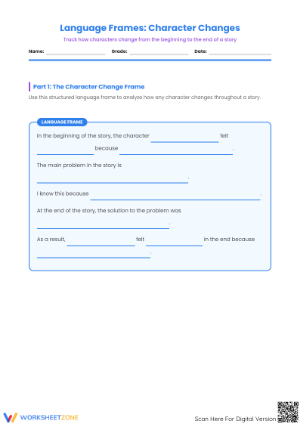
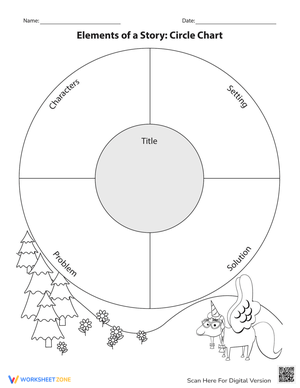
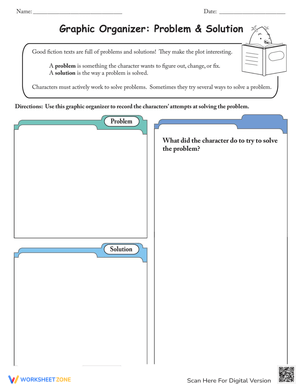
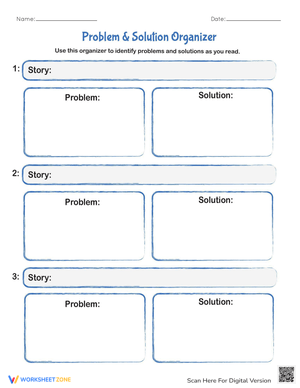
These 3rd grade problem and solution in fiction printable worksheets resources give teachers focused, ready-to-use materials for a skill that looks straightforward on the surface but consistently trips up eight- and nine-year-olds: isolating the central conflict in a story and tracing exactly how it gets resolved. Each worksheet pairs a short fiction passage with a structured graphic organizer so students practice identifying, naming, and explaining both elements — not just circling a sentence and calling it done.
The Specific Skills Each Worksheet Builds
The work across the set moves through several connected reading tasks. Students read a fiction passage at an appropriate third-grade level, then complete a graphic organizer prompting them to name the central problem in their own words, identify the character most responsible for solving it, and describe the resolution — distinguishing it from the climax, which is a separate step many third graders initially conflate. Some worksheets include a follow-up prompt asking students to explain how the main character's traits or choices drove the outcome. That final step is what pushes students from basic comprehension toward the kind of character-event connection that deeper narrative analysis requires.
The fiction passages cover relatable third-grade conflicts: friendship disagreements, personal fears, competition pressure, and the lost-or-broken-object problem that appears constantly in early chapter books. Passage topics matter here because students identify conflict more accurately when they can connect emotionally to the character's situation. A student who has never worried about losing something important will have more trouble naming a character's urgency than one who immediately recognizes the feeling.
Mistakes Students Make That These Worksheets Help You Catch
The most common error at this level isn't that students skip the problem entirely — it's that they identify a minor inconvenience instead of the central conflict. A student will write "the problem is that Marcus forgot his lunch" when the actual problem is that Marcus has to navigate a difficult conversation with a classmate he's been avoiding. Students default to the most concrete, event-level detail rather than the narrative obstacle that drives the story forward. The graphic organizer format surfaces this error early because it asks for the problem in one or two sentences, which forces students to commit to an interpretation rather than drift into summary.
A second pattern shows up in how students describe resolutions. They frequently write what happened rather than what the character did: "the problem was solved" or "everything turned out okay" instead of naming the decision or action that broke the tension. If a student writes "the dog came back" instead of "Lena posted flyers and asked neighbors until someone recognized the description," the worksheet makes that gap visible. That's exactly the kind of specific, correctable error a teacher can address in a two-minute conference rather than a full re-teach.
A third error — less common but worth knowing — is that students sometimes identify the climax as the solution. The climax is the moment of highest tension; the resolution is what the character does to bring that tension down. Third graders who read quickly often treat the most dramatic moment as the ending, especially in texts where the climax and resolution happen close together on the page. Discussing one clear example as a class before students work independently prevents most of this confusion.
How to Work These Worksheets Into Your Reading Block
The most natural placement is as a post-read reflection tool during guided reading. After a group finishes a passage, hand each student a worksheet and give them eight to ten minutes of quiet individual work before the group discusses. That silent period is diagnostic — you see in real time who has the structure and who is still describing plot events without distinguishing their weight. The conversation that follows is sharper because students come to it with a committed answer written down, not just a vague impression.
For literacy centers, these work well as a partner comparison station. Two students read the same passage, complete their worksheets independently, then compare responses. The disagreements that arise — one student identifies the problem as X, another as Y — send both students back into the text to settle the question. That argument-from-evidence move is exactly what strong reading instruction looks like, and it happens naturally without teacher facilitation.
As a formative tool, a completed worksheet tells more than a quiz score. If a student correctly names the problem but writes a vague resolution, you know they grasp narrative conflict but haven't yet connected resolution to character agency. That precision makes the next mini-lesson straightforward to plan. These 3rd grade problem and solution in fiction printable worksheets materials also work as a Monday warm-up: hand one out after the previous Friday's read-aloud, give students five minutes to complete it from memory, and use the responses to gauge retention before moving forward.
Standard Alignment
These worksheets align directly with RL.3.3 (Reading: Literature, Grade 3), which requires students to describe characters in a story and explain how their actions contribute to the sequence of events. In classroom terms, that standard is almost entirely driven by problem-solution analysis: the sequence of events in third-grade fiction typically unfolds as a direct response to a central conflict. Students who can name the problem, trace the character's attempts to resolve it, and articulate the outcome have demonstrated the core of RL.3.3 in a form that's easy to review and document.
The set also supports RL.3.1, which asks students to ask and answer questions about a text using explicit evidence. Every graphic organizer prompt requires students to ground their responses in specific story details rather than general impressions — "the character did X because Y was happening" rather than "the story was about a hard situation." That evidence-anchoring habit is what RL.3.1 is actually building toward.
Adjusting These Worksheets for Different Student Levels
For students who are still building reading fluency, these resources function better as listening activities than independent reading tasks. Read the fiction passage aloud, then have the student complete the graphic organizer from memory and comprehension rather than from decoding. Separating the reading demand from the thinking demand lets you assess narrative comprehension without fluency getting in the way — which is information worth having.
Students ready for extension can write a short alternative resolution: same problem, different character choice, different outcome. That task asks them to hold the narrative structure in mind while manipulating one variable, which is a substantially more demanding move than identification alone. The 3rd grade problem and solution in fiction printable worksheets format supports this extension because the graphic organizer naturally functions as a pre-writing frame — students already have the problem named and the resolution outlined, so the written response becomes a next step rather than starting from scratch.
For students who write thorough responses with ease, the completed graphic organizer can become a structured response frame that mirrors how problem-solution comprehension appears on state reading assessments — short constructed responses grounded in textual evidence. Using it that way adds assessment-prep value without changing anything about the worksheet itself.
Frequently Asked Questions
How do I help students tell the difference between the main problem and a minor obstacle?
Teach students to ask: "Would most of the story exist without this?" Minor obstacles come and go; the central problem is the one the character is still dealing with ten sentences — or a chapter — later. A practical classroom move is to have students check their problem statement against the story's ending: does the resolution directly address the problem they named? If the ending doesn't connect, they've probably named the wrong conflict. This check takes less than a minute and trains students to think about narrative structure as a whole rather than as isolated moments.
What's the most effective way to introduce this concept before students use the worksheets independently?
Start with real-life framing before touching any text. Ask students to describe a small problem they solved recently — not a crisis, just something ordinary — and walk through the three-part structure: what was the obstacle, what did they decide to do, what happened? Once students name that architecture in their own experience, move immediately to a short read-aloud and pause at the "uh-oh" moment — the exact point where the main character realizes something has gone wrong — and again at the "phew" moment when the tension finally breaks. Naming those two emotional beats before introducing the vocabulary significantly reduces confusion on the first worksheet attempt. Students who have physically felt that story rhythm in a listen-aloud transfer it to independent reading much faster than students who get the vocabulary first.
How does this reading work connect to what third graders are doing in writing?
Third-grade writing standards ask students to craft narratives with a situation, a character, and a sequence of events that unfolds naturally. Students who have practiced identifying story problems as readers bring that structural awareness to their own writing — they're far more likely to give their protagonist a real obstacle to work through rather than stringing together unrelated events. The 3rd grade problem and solution in fiction printable worksheets set reinforces narrative architecture on both the reading and writing sides of the curriculum, which means time spent on these worksheets pays off in more than one instructional area.












 Interactive Worksheet Maker
 Quiz Maker
 Word Search Maker
 Crossword Puzzle Maker
 Word Scramble Generator
 Sentence Scramble Generator
 Handwriting Worksheet Generator
 Name Tracing Generator
 Fill In The Blank Generator