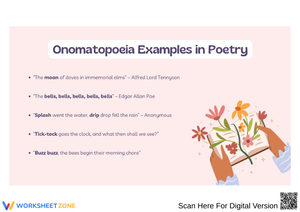
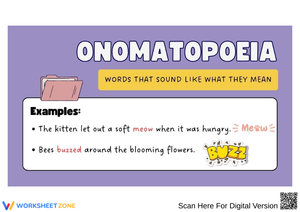
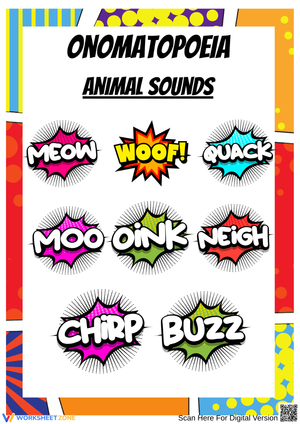
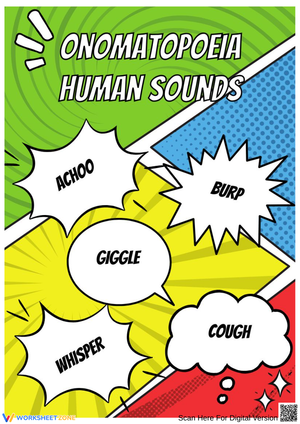
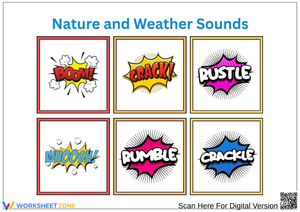
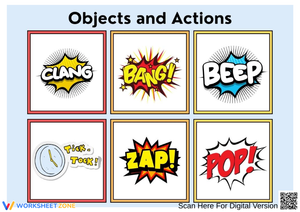
These onomatopoeia printable worksheets for 3rd grade give teachers a ready set of resources built around a concept that sits at an interesting intersection: it is officially figurative language, but it is also the most concrete figurative device students will encounter because the relationship between word and sound is direct and sensory. The set moves students through identification in context, sorting by sound category, and original sentence writing — three task types that each ask something distinct from the learner. Each worksheet stands alone, so teachers can sequence several across a unit or pull one for a targeted warm-up whenever the lesson calls for it.
What the Set Covers
The worksheets address sound-word knowledge from multiple angles because one pass through a vocabulary list does not produce durable understanding. Students need to encounter the same words in different task formats before they start reaching for them independently during writing.
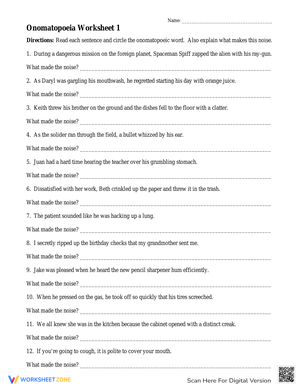
- Identification in context: Students read short passages and underline or circle words that imitate sounds. Passages draw from animal settings, weather events, and everyday action scenes — varied contexts rather than isolated lists.
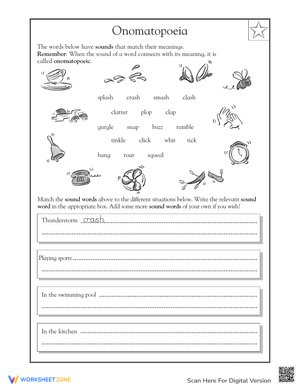
- Sorting by category: Students classify words into groups — animal sounds, impact and action sounds, water and nature sounds, mechanical noises. That kind of categorical organization supports later recall in a way that alphabetical word lists simply do not.
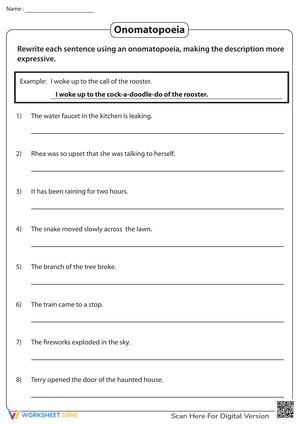
- Sentence rewriting: Students replace vague descriptions with specific sound words. "The car was loud" becomes a sentence they must rewrite using a target word, which forces them to understand how the word functions grammatically, not just what it means.
- Original composition: Later worksheets ask students to write their own sentences using sound words without a provided list, or to caption a simple image. This is where teachers see whether the vocabulary has actually transferred.
Mistakes Students Make That These Worksheets Help Surface
The error that surprises most teachers is not misspelling squeak or mixing up hiss with hush — it is the category confusion where students decide that any vivid or unusual word qualifies. Eight-year-olds regularly mark enormous or glittering in an identification task because those words feel strong and interesting. That error reveals something specific: the student has grasped "special language tool" but not yet "sound-imitation word." The identification tasks in these worksheets ask students to circle their answers and then explain their choices, which surfaces that confusion early rather than letting it calcify into a stable misconception.
A second pattern shows up consistently in the writing tasks. Students who correctly identify crackle in a reading passage will turn around and write "the fire made a crackle sound" when composing their own sentences — slipping the word into a noun slot where it loses its sensory force entirely. That construction is worth flagging and discussing, because it points to something precise about what still needs direct instruction: the student knows the word exists but has not yet internalized how it does its work.
Building These Worksheets Into Your Lesson Plans
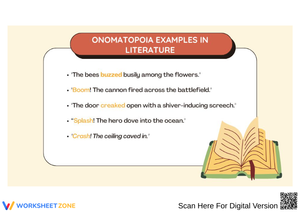
The most productive entry point is a ten-minute read-aloud. Pick a text that runs dense with sound words — The Very Quiet Cricket works well, and so does any action-heavy comic strip — read it once for enjoyment, then reread it asking students to tap their desks each time they hear a sound word. That auditory priming does more in ten minutes than a definition on the board does in thirty. Following it immediately with one of the identification worksheets, while the sensory experience is still live, gives students something real to anchor their thinking to.
The sorting worksheets fit naturally as Monday warm-ups after the initial introduction, when students need retrieval practice before the week's new material starts. The composition tasks belong later — ideally after students have a working vocabulary of at least 15 sound words across two or three categories. Dropping a sentence-writing worksheet into a lesson before that foundation exists produces stalling and frustration rather than writing. The sequence matters, and the set is built so you can see where that line falls.
Standard Alignment
The resources address CCSS ELA-Literacy L.3.5a, which requires students to distinguish the literal and nonliteral meanings of words and phrases in context. For any onomatopoeia printable worksheets for 3rd grade to address that standard meaningfully, students need to do more than circle examples in a list — they need to articulate why a word qualifies and then use it productively in their own writing. That is the progression these worksheets follow. Onomatopoeia appears first among the figurative language devices introduced at this grade level precisely because the connection between word and referent is concrete and sensory rather than abstract, making it the most accessible entry point into the metalinguistic awareness that L.3.5 builds across the year.
Adjusting the Worksheets for a Range of Learners
For students still building reading fluency, the identification worksheets that pair short passages with images reduce the decoding load enough that the conceptual work stays in focus. Adding a word bank alongside the image tasks gives those students access to the vocabulary without requiring them to generate spellings they may not control yet — the task stays about the concept, not the mechanics.
Students who move through identification and sorting quickly need tasks that require more precision than matching. Ask them to swap one sound word in a sentence for a more specific alternative — replacing bang with clang, clatter, or crack depending on context — and to explain in a sentence why they chose that word. That kind of close-choice work pushes into the nuance that L.3.5a actually targets at the upper range. The onomatopoeia printable worksheets for 3rd grade in this set include enough open-ended composition tasks that stronger writers are not simply marking time once the identification work is done.
Frequently Asked Questions
Is 3rd grade when onomatopoeia is formally introduced, or have students already seen it?
Most students have played with sound words before 3rd grade — picture books like Chicka Chicka Boom Boom make the exposure nearly universal — but the formal expectation to identify, categorize, and use them analytically begins at 3rd grade through L.3.5a. The developmental reason is that 3rd grade is when metalinguistic work enters the curriculum systematically: students are expected to think about how language functions, not just what it communicates. Earlier exposure is genuinely useful, but the application-level demands these worksheets target are specifically a 3rd-grade ask.
How many sound words do students need before the writing tasks make sense?
A working vocabulary of 15 to 20 words across three or four categories — animal sounds, impact sounds, water and nature sounds, mechanical noises — gives students enough raw material to actually write with. Below that threshold, composition tasks become exercises in repeating the same three or four words in slightly different arrangements. The identification and sorting work in this set is built to establish that baseline before students are asked to compose independently.
Can I use these worksheets as formative assessments, or are they better suited to independent practice?
The identification and sorting worksheets work well as quick formative checks — they tell you at a glance whether a student understands the concept at a recognition level. The composition tasks, where students produce their own sentences using sound words without a model, give you evidence of application. For the clearest signal of real transfer, look at whether students are reaching for onomatopoeia naturally in their writing journals, outside of any prompt. The onomatopoeia printable worksheets for 3rd grade in this set are structured so that formative recognition tasks and open-ended application tasks are both present, giving you options depending on where you are in the unit and what you need to know.












 Interactive Worksheet Maker
 Quiz Maker
 Word Search Maker
 Crossword Puzzle Maker
 Word Scramble Generator
 Sentence Scramble Generator
 Handwriting Worksheet Generator
 Name Tracing Generator
 Fill In The Blank Generator