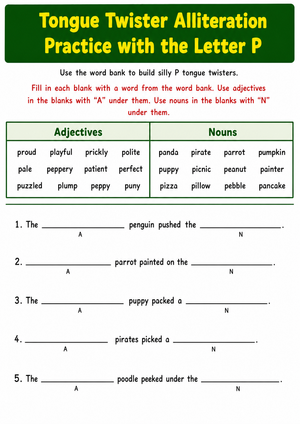
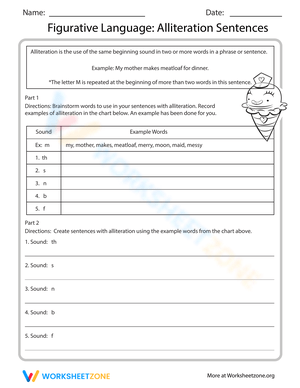
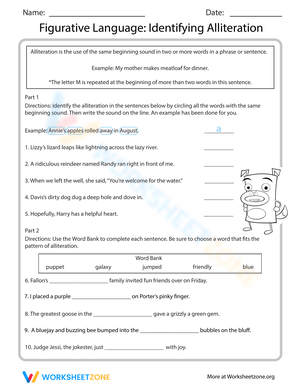
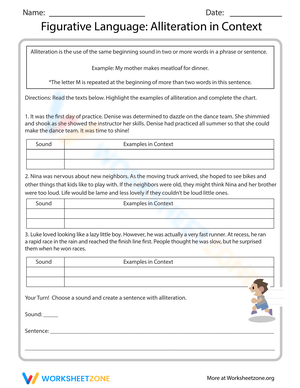
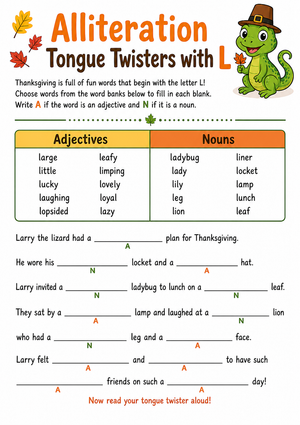
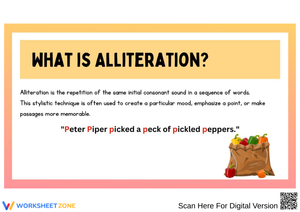
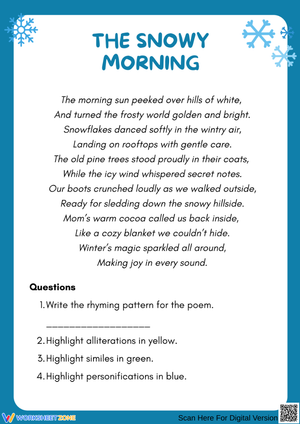
These 3rd grade alliteration worksheets give teachers a targeted set of resources for one of the more phonemically precise skills in the figurative language strand — the ability to hear initial sounds rather than just recognize their spelling on a page. Each worksheet addresses a distinct task: identifying alliterative pairs, distinguishing sound from spelling, constructing original phrases, and applying the device in narrative character work. The progression runs from simple recognition toward deliberate composition, which is where the real teaching happens at grade 3.
Skills Targeted Across the Set
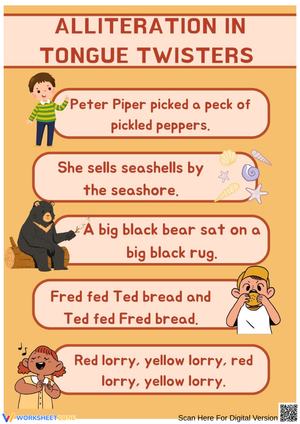
The identification tasks ask students to mark alliterative words inside complete sentences and sort word pairs by shared initial sound — not shared spelling. The phrase-building worksheets move into generative work: students match adjectives to nouns that open with the same phoneme, then rewrite flat descriptions using alliterative word choices. Several worksheets focus on character naming, which gives alliteration an immediate function in narrative writing; a student who constructs "Daring Diego" or "Miserable Mira" understands the device in a way no recognition drill fully captures. One worksheet uses classic tongue twisters as raw material — students identify the repeating sound, mark every instance, then extend the phrase by adding one more alliterative word of their own. That extension step is harder than it looks, and watching students reach for a thesaurus when their first-choice word doesn't fit the pattern produces exactly the vocabulary work grade 3 writers need.
Where Third Graders Reliably Go Wrong With This Device
The most consistent error is treating alliteration as a letter-matching exercise. Students who correctly identify "bouncing bears" will still mark "giant giraffe" and "green grass" as alliterative with each other — the G is visible, and the distinction between the soft /j/ in giant and the hard /g/ in green requires conscious phonemic attention that most eight-year-olds haven't had to apply before. The reverse problem surfaces with silent letters and digraphs: "knobby knees" gets dismissed as non-alliterative because the spelling looks mismatched, even though both words open with the /n/ sound.
The /f/ phoneme and ph spelling is a third reliable sticking point. "Photo" and "fish" open with the same sound, but students see a P and an F and conclude they're different. A class pronunciation check before any exercise involving ph words takes about thirty seconds and prevents the misconception from settling in. These edge cases — the soft G, the silent K, the ph spelling — are built directly into the exercises, so the teaching moment is already prepared rather than improvised.
When and How These Worksheets Do Their Best Work
The identification worksheets fit cleanly right after a read-aloud — five to eight minutes of focused task work while the language from the book is still in students' ears. Picture books that lean heavily on sound (Graeme Base's Animalia is the strongest classroom example for this particular device) give students a living demonstration before they move to the written task. Hearing first, then analyzing on paper, is the right sequence here because alliteration is fundamentally auditory — students who only ever see it in print miss the point of why it exists.
The phrase-building and character-naming tasks fit better mid-unit, once students are confident in recognition. The 3rd grade alliteration worksheets that focus on character construction also function well as a pre-writing warm-up before a narrative assignment; ten minutes building alliterative character names before a draft session gives students a concrete experience of how word choice shapes personality on the page. Friday review blocks and the eight minutes before a specialist period are natural slots for the shorter identification exercises, which stand alone without any lesson setup.
Standard Alignment
These worksheets address CCSS.ELA-LITERACY.RL.3.4, which expects third graders to determine the meaning of words and phrases in a text, with specific attention to figurative language and word relationships. Alliteration is the standard's most accessible entry point at this grade level — concrete enough to hear and name, which makes it a productive first figurative language target before students move into metaphor and personification later in the year. The phrase-construction tasks also touch CCSS.ELA-LITERACY.L.3.3, which covers word choice and language conventions in writing. When a student revises "the cold wind" into "the biting breeze," that single decision works both standards at once.
Adjusting the Worksheets for a Range of Learners
Students who are still building phonemic awareness at the letter-sound correspondence level do best with the sorting tasks when they say each word aloud before writing anything. Limiting those exercises to single-syllable, phonetically regular words — bat, ball, bone rather than beautiful, bouncing, brilliant — removes the vocabulary barrier and keeps attention on the initial sound. Pairing these students with a partner to confirm each answer before recording adds a brief oral rehearsal step without changing anything on the worksheet itself.
Students who have already internalized the basic concept need a different challenge. Ask them to find alliterative phrases in their independent reading books, sticky-note each page with a note explaining what sound repeats and what effect it creates, then bring that example to a small group share. Several of the 3rd grade alliteration worksheets include an open-ended extension prompt for exactly this purpose — students who finish the core task move into evaluation rather than repetition. At the upper end, drafting a four-line verse that sustains a single consonant sound throughout requires both understanding the device and having enough vocabulary range to carry the pattern, which is a meaningful stretch goal at grade 3.
Frequently Asked Questions
Does alliteration apply to vowel sounds, or only consonants?
For grade 3 instruction, keep the focus on consonant sounds. When vowel sounds repeat at the start of words — "every elephant eats" — that pattern is technically assonance, not alliteration in the traditional definition. Introducing both terms simultaneously tends to create confusion. Once students are solid on consonant-based alliteration, the vowel question is worth revisiting as an extension conversation or a bridge into assonance in grade 4.
Do the alliterating words need to be right next to each other?
Not strictly. Small function words like "the," "and," or "a" can sit between alliterating words without breaking the pattern — as long as the repeating sound is close enough for the ear to catch it. The 3rd grade alliteration worksheets in the set open with adjacent pairs, where the sound repetition is easiest to detect, then move toward spread examples as students build confidence identifying the pattern when words aren't immediate neighbors.
How do I address the "photo" and "fish" confusion without turning it into a lengthy detour?
Pronunciation before pencils, always. Before any exercise that includes ph words, have the class say them aloud together and confirm the shared sound. Most third graders have heard "photograph" many times but have never consciously noticed which phoneme it opens with. A thirty-second spoken check before students begin prevents the error from taking hold and reinforces the core principle that sound is what drives this device, not the letter on the page.
Is alliteration tested at grade 3 on state reading assessments?
In states following Common Core ELA standards or close adaptations, third-grade reading assessments include figurative language questions that can involve alliteration — typically asking students to identify an example, explain its meaning in context, or describe why an author made a particular word choice. Practice with identification and effect-analysis tasks builds the vocabulary students need to answer those questions accurately rather than defaulting to guesses.












 Interactive Worksheet Maker
 Quiz Maker
 Word Search Maker
 Crossword Puzzle Maker
 Word Scramble Generator
 Sentence Scramble Generator
 Handwriting Worksheet Generator
 Name Tracing Generator
 Fill In The Blank Generator