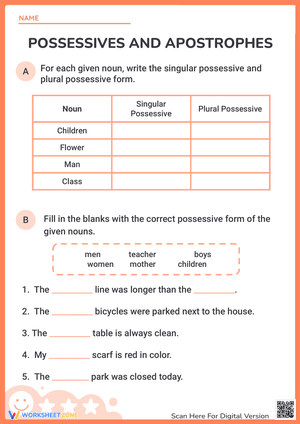
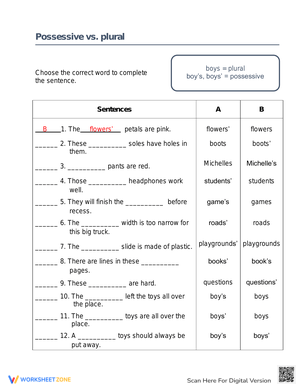
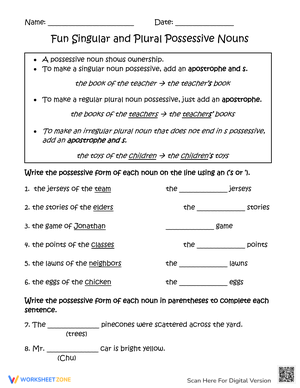
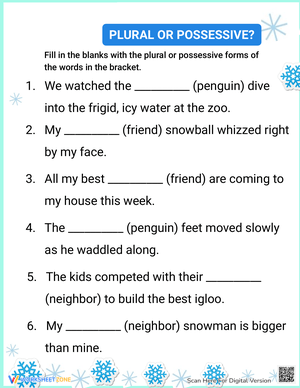
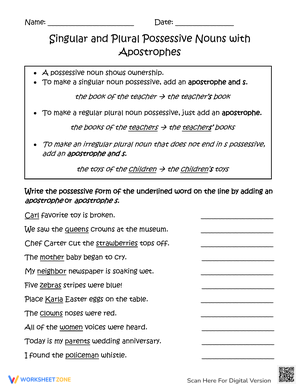
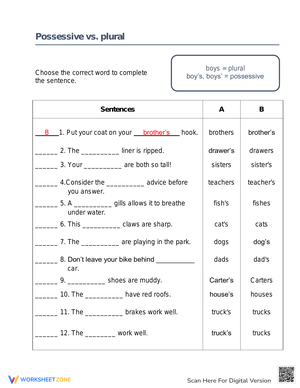
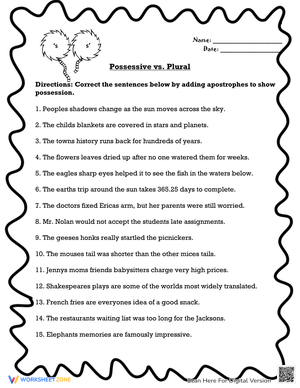
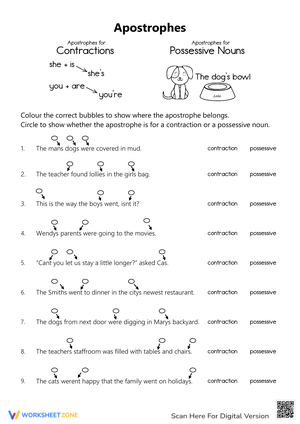
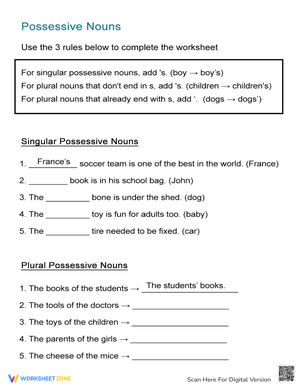
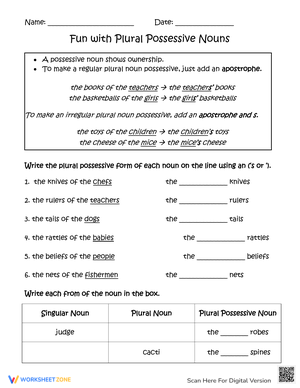
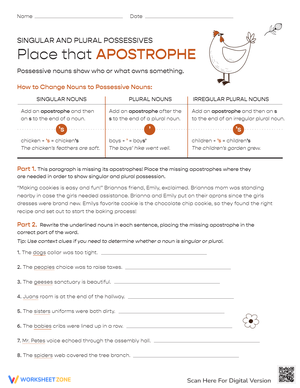
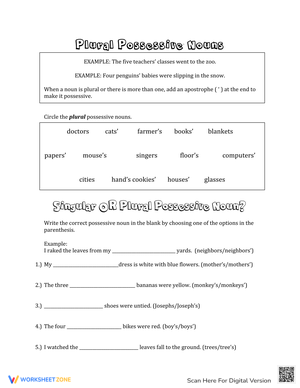
These plural possessives printable worksheets for 3rd grade address the two rule sets students need to hold simultaneously — regular plurals that already end in -s (place the apostrophe after the existing s) and irregular plurals that don't (add -'s, the same treatment as a singular possessive). Each worksheet isolates one or both rule types with enough varied examples to make the visual pattern recognizable before students encounter it inside their own drafts.
The Specific Skills Targeted
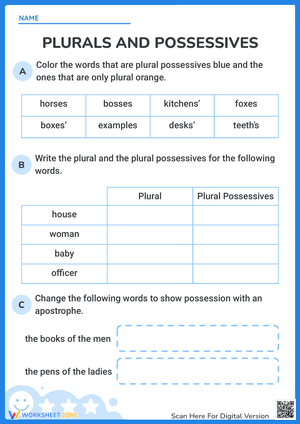
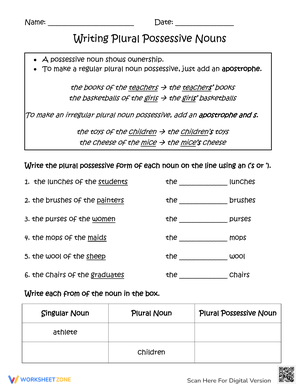
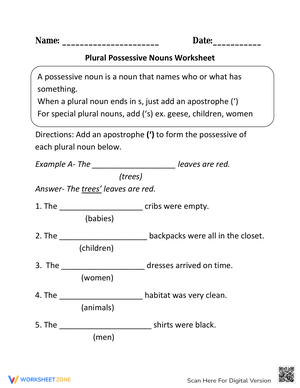
Students work through four distinct exercise types across the set. First, they identify whether a noun phrase is a plain plural, a singular possessive, or a plural possessive — forcing the discrimination before any apostrophe is placed. Second, they rewrite noun-of phrases ("the nests of the birds") as possessives ("the birds' nests"), which grounds the ownership relationship in something concrete rather than abstract punctuation rules. Third, they correct intentionally wrong apostrophe placements, which surfaces the underlying logic more sharply than fill-in-the-blank tasks ever do. Fourth, they apply plural possessives inside short sentences, where surrounding context doesn't cue the answer and the grammar has to carry itself.
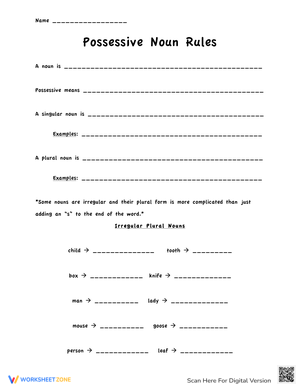
The irregular plural section gets its own dedicated practice. Words like children, men, women, and mice appear repeatedly because they trip students up long after the regular rule feels settled. Students underline the base plural, confirm it doesn't end in -s, and then mark the -'s in a contrasting color — a two-step process that keeps the reasoning visible instead of collapsed into a guess.
Frequent Errors Worth Watching For in Student Writing
The most persistent error is what writing teachers sometimes call apostrophe scatter — students who decide any word ending in -s probably needs an apostrophe and produce sentences like "The dog's are barking" or "The teacher's went to a meeting." It's not random carelessness; it comes from noticing that possessives and plurals both involve -s and then overgeneralizing from there. Plural possessives printable worksheets for 3rd grade counter this by structuring every exercise around a prior question — does this word show ownership? — before any apostrophe decision is made. Students practice that check repeatedly, which is the habit that actually moves the needle over time.
The second error is subtler and more durable: placing the apostrophe before the -s when the intended meaning is group ownership. A student who writes "the girl's backpacks" to describe backpacks belonging to a whole classroom of girls isn't being careless — they're applying the singular rule they learned first and haven't yet updated for the plural case. The position of the apostrophe tells readers exactly how many owners exist, and students need to hear that principle named plainly, not just see the corrected version handed back to them.
With irregular plurals, the typical slip is writing "childrens'" — treating children as if it ends in -s and skipping the apostrophe-s entirely. The fix is training students to read the word itself before applying any rule: if it doesn't end in -s, treat it like a singular and add -'s. That's a different move than what they do for regular plurals, and it takes separate, focused practice to become automatic.
Working These Worksheets Into Your Week
The correction-focused worksheet works especially well as a Monday warm-up after morning meeting, when students are settling in and a short, concrete task holds attention without demanding fresh creative energy. The rewriting exercises — converting noun-of phrases to possessives — fit naturally inside a writing workshop mini-lesson because they connect directly to the sentence-level revision students are already doing in their drafts. Six to eight practice items take roughly ten minutes, which leaves room for a quick whole-class debrief before independent writing time starts.
Using one worksheet as a formative check mid-unit tells teachers more than waiting until the end-of-unit assessment. The correction task in particular reveals which error pattern a student is carrying — apostrophes on plain plurals, wrong placement for plural possessives, or irregular-plural confusion. Those three errors require different follow-up conversations, and a single worksheet pass surfaces them clearly enough to group students for a five-minute targeted pull-aside rather than reteaching the entire rule to the whole class.
Adjusting the Worksheets for a Range of Learners
Students still sorting out the basic plural-versus-possessive distinction benefit from having a printed reference beside the worksheet — a two-column reminder showing "more than one: add -s or -es" alongside "one owner: add -'s" and "more than one owner: plural first, then apostrophe at the end." That's not simplifying the task; it's reducing the memory demand so the reasoning itself can be practiced instead of the recall.
Students who have the regular rule solid but freeze on irregulars need the irregular list made explicit before they begin. Giving them a short reference — children, men, women, mice, geese, teeth — keeps the lesson focused on apostrophe logic rather than on whether they can recall that "gooses" isn't a word. At the upper end, students who finish quickly can compose two original sentences for each rule type and trade with a partner for correction, turning reception into production and giving the skill somewhere further to go.
Standard Alignment
These resources address CCSS ELA-Literacy L.3.2.d, which requires third graders to form and use possessives correctly. In classroom sequencing, this standard lands after students have worked through singular possessives and are ready to extend the logic to groups. Most third-grade grammar units introduce plural possessives in late fall or winter and then expect students to apply both forms accurately during independent writing for the remainder of the year. Plural possessives printable worksheets for 3rd grade fit squarely into the mid-instruction window — after direct teaching and before self-monitored composition — where practice has the most immediate payoff and errors can still be addressed before they harden into habits.
Frequently Asked Questions
Do these worksheets cover irregular plural possessives, or just regular ones like "dogs'" and "birds'"?
Both. The set includes dedicated practice on irregular plurals — words like children, men, and mice that form the plural without adding -s. Because those words follow the same apostrophe-s rule as singular possessives, students frequently apply the wrong logic. The exercises ask students to identify the plural form first, before placing any apostrophe, which addresses the confusion directly rather than leaving students to work it out on their own.
When in a grammar unit should these worksheets be introduced?
They work best during the guided and independent practice phase — after the initial lesson, not as the first exposure to the concept. The correction tasks and rewriting exercises assume students have heard the rule explained and seen worked examples. Using plural possessives printable worksheets for 3rd grade at that mid-instruction point, rather than holding them until a summative check at the unit's end, gives teachers time to identify and address errors while instruction is still ongoing and adjustment is still practical.
Can students complete these at home, or are they better kept in class?
The regular plural worksheets travel home well — the rule is intuitive enough that a student who has had in-class instruction can apply a self-check independently: look at the word, confirm it ends in -s, place the apostrophe after. The irregular plural worksheets are better kept in class the first time through. Students who encounter "children's" or "women's" at home without support sometimes lock in the wrong reasoning and come back the next day more confused than when they left. Send those home after they've been worked through in class at least once.












 Interactive Worksheet Maker
 Quiz Maker
 Word Search Maker
 Crossword Puzzle Maker
 Word Scramble Generator
 Sentence Scramble Generator
 Handwriting Worksheet Generator
 Name Tracing Generator
 Fill In The Blank Generator