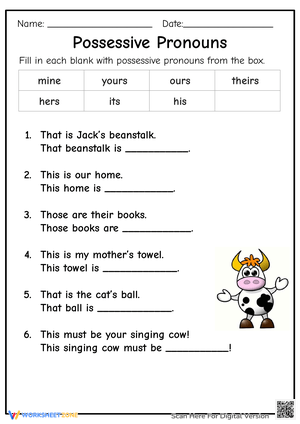
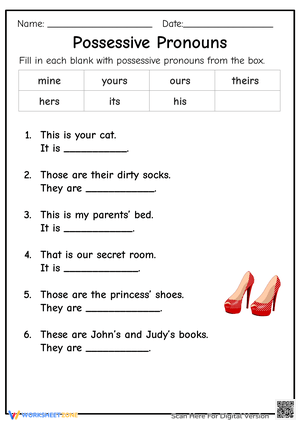
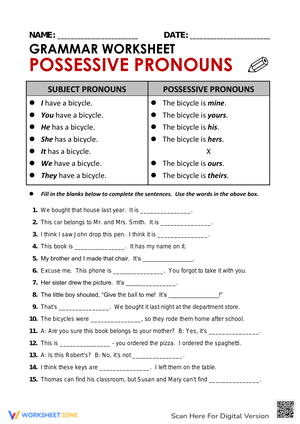
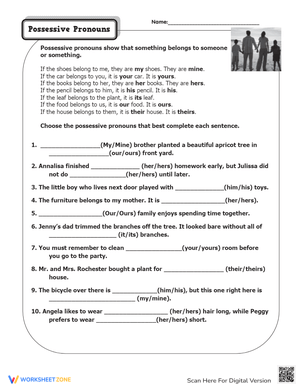
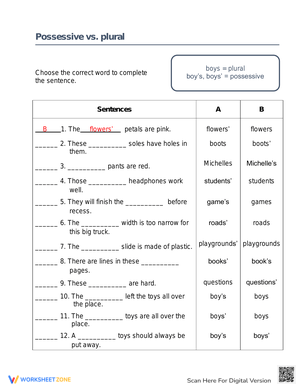
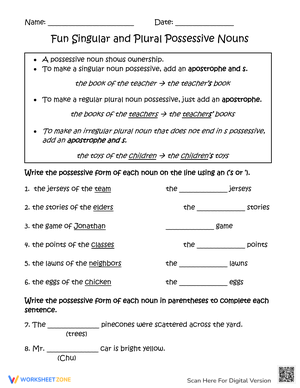
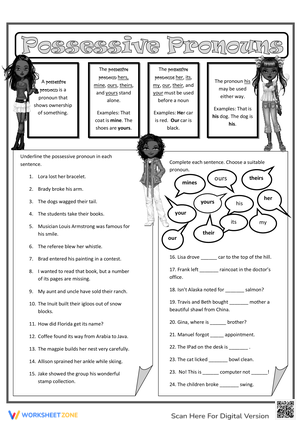
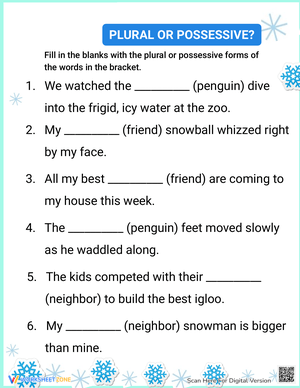
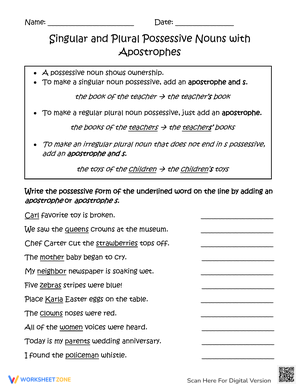
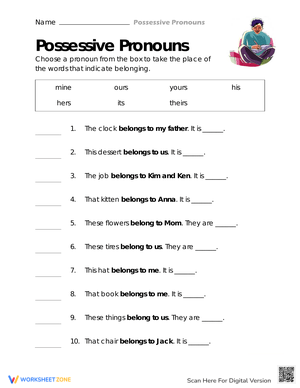
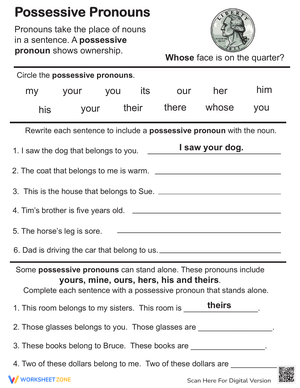
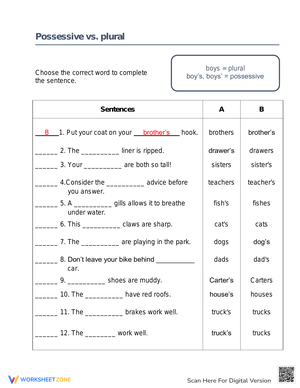
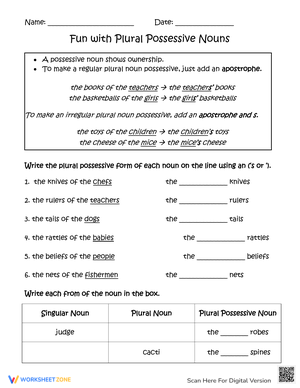
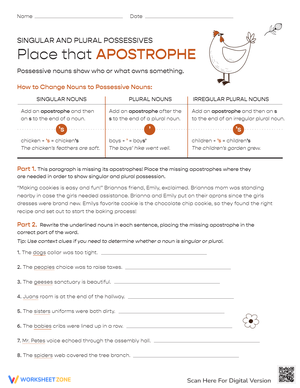
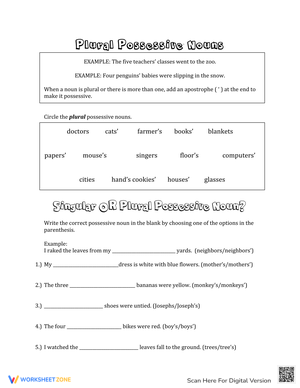
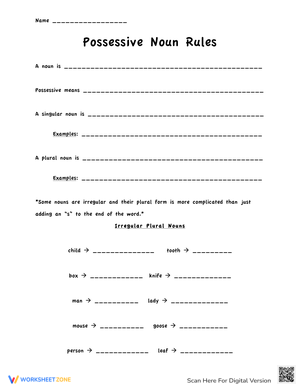
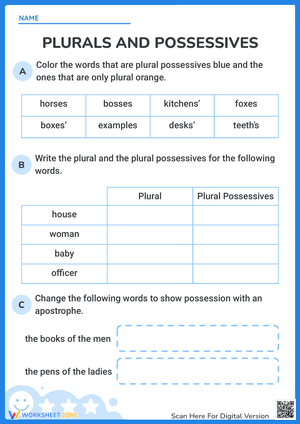
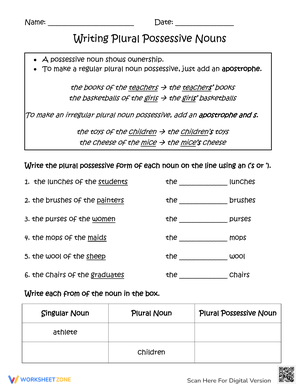
These possessive pronouns printable worksheets for 3rd grade tackle a grammar shift that trips up most eight-year-olds: the move from "That's Maria's backpack" to "That backpack is hers." The set includes sentence transformation tasks, sorting exercises, and context-based fill-in-the-blank work — the range of formats matters because no single exercise type fully closes the gap between recognizing a pronoun and using it fluently in original writing.
What Each Worksheet Targets
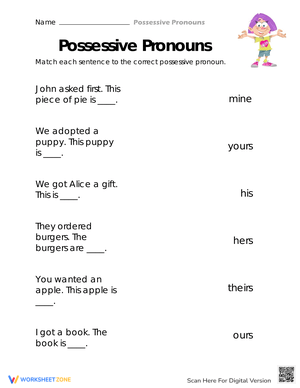
The worksheets focus on the full set of standalone possessive pronouns — mine, yours, his, hers, its, ours, theirs — treated as words that replace entire noun phrases rather than words that sit next to nouns. The activity formats across the set include:
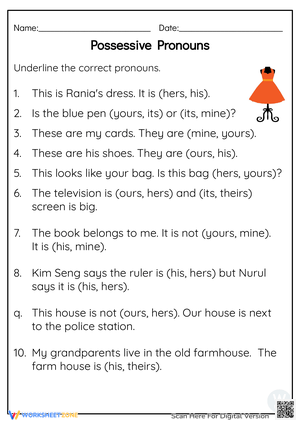
- Sentence transformation: students rewrite a repetitive sentence by substituting the correct possessive pronoun, directly practicing the editing move they need in their own writing
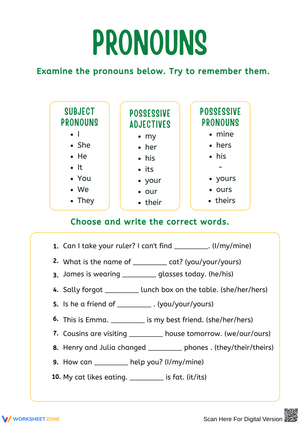
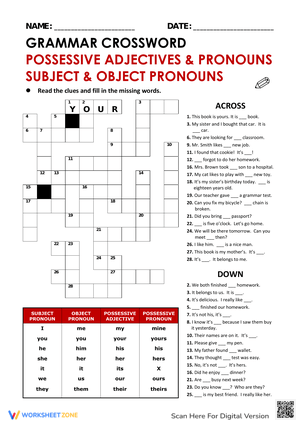
- Sorting: two-column tasks that separate possessive adjectives from possessive pronouns — a visual separation that reinforces the structural difference before students have to apply it in original sentences
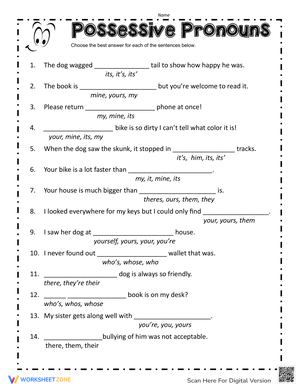
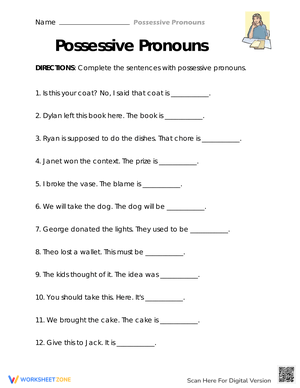
- Context-based fill-in-the-blank: short passages where character ownership provides the clue for which pronoun fits, requiring reading comprehension alongside grammar judgment
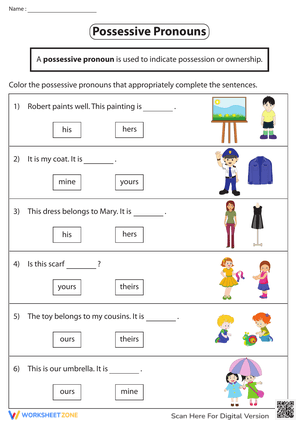
- Picture-supported identification: illustrations of people holding objects, giving students a concrete reference point for determining whether "his," "hers," or "theirs" applies
Each worksheet keeps sentence content concrete — characters holding objects, items left at a desk, a dog with its toy — so students aren't splitting attention between decoding unfamiliar vocabulary and working out a grammar rule at the same time.
Student Errors Worth Catching Before They Stick
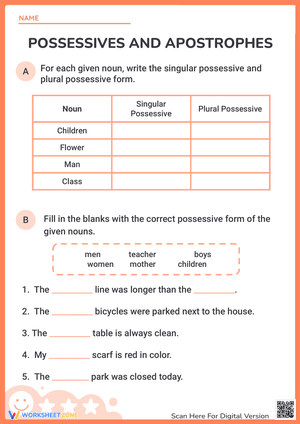
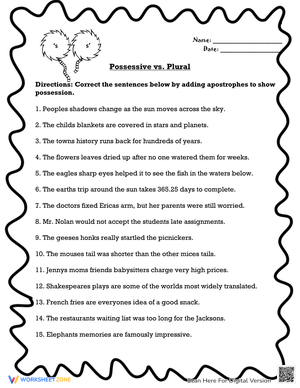
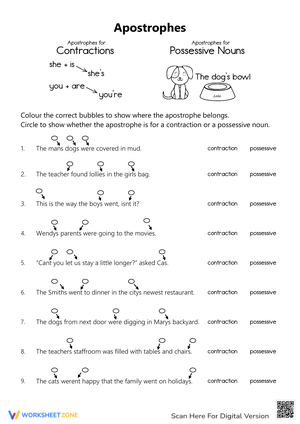
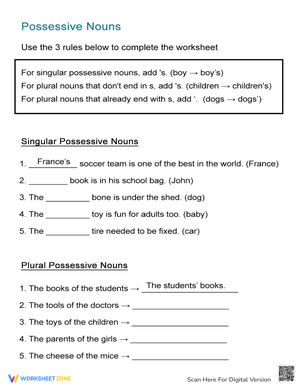
The apostrophe problem is the dominant error, and it's predictable. Because Grade 3 students have recently learned that possessive nouns need an apostrophe — "Mr. Harris's room," "the cat's bowl" — they apply that rule directly to pronouns. On any given worksheet, expect to see her's, our's, and their's appear regularly until explicit correction takes hold. The instructional point that breaks through: possessive pronouns already have ownership baked into their spelling. There's no separate possessive marker being added; the whole word is the possessive form.
A second, quieter error involves its versus it's. Students who write "The puppy wagged it's tail" aren't being careless — they're applying a rule about contractions inconsistently. The substitution test works: if "it is" fits in the sentence without sounding wrong, they need the apostrophe. If it doesn't, they don't. Running that check aloud in class before students attempt the worksheet independently cuts the error rate considerably.
A third error pattern shows up specifically in transformation tasks: students who understand the concept still land on the adjective form instead of the pronoun form — "The jacket is her" instead of "The jacket is hers." Sorting worksheets that require students to physically place words into separate columns before writing them in sentences help interrupt that reflex.
How to Work These Worksheets Into Your Lesson Plans
The most productive use of possessive pronouns printable worksheets for 3rd grade is as a five- to ten-minute warm-up at the start of the language arts block rather than as a standalone grammar lesson. Students who encounter a worksheet on Monday as a brief opener, revisit a second one on Wednesday during independent work, and use a third on Friday as a formative check — that spaced practice pattern produces more durable retention than a single forty-minute grammar lesson. The Friday worksheet gives teachers a clean snapshot of who still has the apostrophe confusion before the class moves on.
For independent literacy centers, sorting activities work especially well. A student can complete them without needing teacher support mid-task, which matters when the teacher is conferencing at a small group table. The sentence transformation worksheets are better reserved for guided practice at first, because students need to confirm their substitutions make sense — a step that benefits from a partner check or quick teacher scan before students work independently.
Standard Alignment
These worksheets directly address CCSS ELA-Literacy L.3.1, which requires third graders to demonstrate command of standard English grammar and usage conventions in both writing and speaking. Within that standard, the specific instructional target is pronoun case — producing and correctly using pronouns appropriate to their function in a sentence. At Grade 3, the expectation is not just recognition but accurate deployment in writing, which is why the transformation tasks carry more instructional weight than identification-only drills. By the time students reach fourth grade, pronoun errors are expected to be largely resolved; catching the apostrophe confusion in Grade 3 prevents it from becoming a habit that follows students into upper elementary.
Adjusting the Worksheets for a Range of Learners
For students still solidifying basic pronoun recognition, the fill-in-the-blank and sorting worksheets offer enough structure to participate without being overwhelmed. Pairing the worksheet with a simple reference card — a two-column chart with possessive adjectives on one side and their corresponding standalone pronouns on the other — lets those students cross-check their work independently without stopping to ask for help every few minutes.
Students who already have the concept and need a stretch benefit most from the transformation worksheets paired with one added step: after rewriting the sentence, they write an original sentence using the same pronoun. That extension takes about thirty seconds to explain verbally before the worksheet goes out and requires no modification to the resource itself. The possessive pronouns printable worksheets for 3rd grade in the set include enough variation in sentence structure that strong writers encounter genuine thinking work rather than mechanical substitution.
Frequently Asked Questions
What's the difference between possessive adjectives and possessive pronouns, and do I need to teach both?
Yes, and teaching them side by side makes the distinction clearer than addressing them in separate lessons. Possessive adjectives — my, your, his, her, its, our, their — always appear directly before a noun: "my notebook," "her jacket." Possessive pronouns — mine, yours, his, hers, its, ours, theirs — stand alone without a following noun: "The notebook is mine." Seeing both categories on the same sorting worksheet helps students recognize the structural pattern rather than memorize two disconnected lists.
How do I handle the its/it's confusion without derailing the lesson?
Treat it as a quick class-wide check before independent work: if you can read the word as "it is" and the sentence still makes sense, use the apostrophe. If the sentence is showing ownership — "the tree lost its leaves" — no apostrophe. Doing that check aloud takes about two minutes and prevents the error from spreading across an entire set of worksheets that then require individual correction.
Can these worksheets serve as assessment tools rather than just practice?
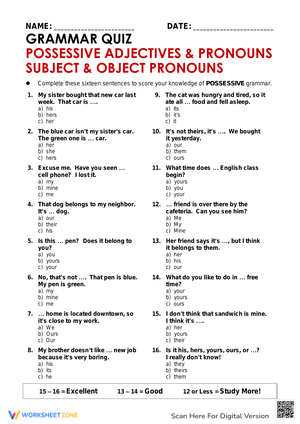
The transformation and fill-in-the-blank formats produce clear, gradable evidence of student understanding. A teacher reviewing completed possessive pronouns printable worksheets for 3rd grade can quickly identify three distinct error types — apostrophe insertion, wrong pronoun form, and pronoun-noun agreement issues — each of which points to a different instructional next step. That diagnostic clarity makes the resources useful at the end of a unit as well as during it.












 Interactive Worksheet Maker
 Quiz Maker
 Word Search Maker
 Crossword Puzzle Maker
 Word Scramble Generator
 Sentence Scramble Generator
 Handwriting Worksheet Generator
 Name Tracing Generator
 Fill In The Blank Generator