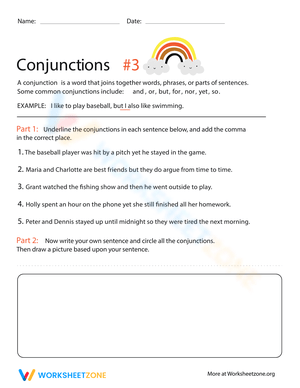
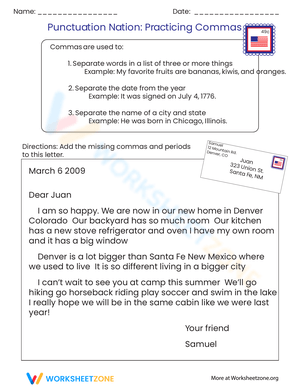
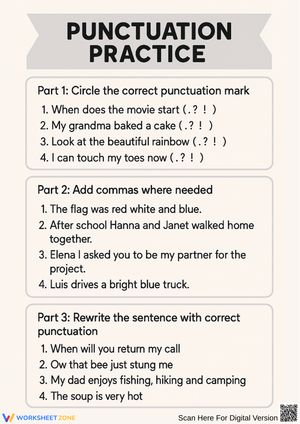
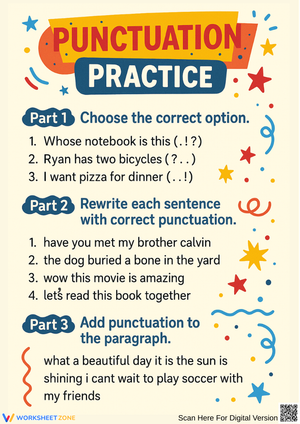
These commas printable worksheets for 3rd grade target the two punctuation skills the Common Core introduces at this grade level — address formatting and dialogue punctuation — without retreading the rules students covered in first and second grade. The set picks up exactly where prior learning ends, giving students structured practice on the skills that actually produce errors in their writing.
The Specific Skills Each Worksheet Builds
The worksheets cover CCSS.ELA-LITERACY.L.3.2.B and L.3.2.C through varied task formats. Editing tasks present addresses and dialogue lines with missing or misplaced commas; students locate the error and correct it. Rewrite tasks ask students to take a broken sentence and reconstruct it from scratch — a step harder than simple insertion. A smaller number of worksheets include short production tasks: write a brief dialogue exchange from a prompt, then punctuate it. That sequence from correction to production matches the actual difficulty curve. Students identify errors before they can reliably generate correct forms independently, and the set builds both skills.
Address tasks start with clean examples — "Portland Oregon" with the comma missing — and move into contexts where students have to decide whether a comma belongs, which surfaces the students who are over-applying the rule. Dialogue tasks cover both end-position speaker tags ("I'm ready," she said) and beginning-position tags (She said, "I'm ready."), because those two structures look different enough that a student who handles one reliably still stumbles on the other. The commas printable worksheets for 3rd grade address both patterns because the error data in actual student work shows you need to.
Errors That Surface in Third-Grade Writing
The comma-sprinkle pattern — dropping commas wherever a sentence runs long — is real, but it's a different problem from what these worksheets target. The errors worth anticipating are more specific.
With addresses, the most consistent mistake is writing "Columbus Ohio" with no comma at all. Students see city-state pairings on screens and in headings formatted without commas constantly, and that visual exposure competes with the rule. A smaller group over-applies it and adds a comma between the house number and the street name. Neither error disappears from re-explanation; both respond to editing tasks where students have to identify and justify each correction.
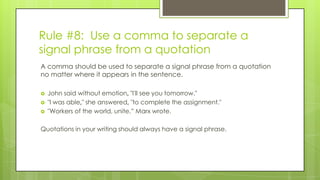
Dialogue is more complex. The mistake that signals the deepest gap isn't misplaced punctuation — it's no punctuation at all. A student who writes She said I'm ready without any marks hasn't yet connected the speaker tag to the quoted words as a unit. Among students who are trying to punctuate, the most consistent specific error is placing the comma outside the closing quotation mark: ready", instead of ready,". Having students highlight the spoken words in one color and the speaker tag in a second color before adding any commas makes the boundary visible — the comma belongs at the junction of those two sections, inside the quotation mark, not after it. That simple pre-step cuts that particular mistake dramatically.
Standard Alignment
These worksheets address CCSS.ELA-LITERACY.L.3.2.B, which requires students to use commas to separate city and state in addresses, and CCSS.ELA-LITERACY.L.3.2.C, which introduces commas and quotation marks in dialogue. Both fall under the Conventions of Standard English cluster in the Language strand for Grade 3. In classroom terms, L.3.2.B surfaces most naturally during letter-writing and nonfiction writing units, typically in the second half of the year. L.3.2.C gets the most traction during narrative writing, when students are expected to include dialogue in their stories. The commas printable worksheets for 3rd grade align directly to those instructional windows, so teachers can pull the right worksheet when the standard comes up in the writing unit rather than searching through a general punctuation folder.
Building These Worksheets Into Your Instructional Week
The strongest placement for these isn't a standalone grammar period — it's the 8 to 10 minutes after a writing mini-lesson, while the rule is still active. Introduce dialogue punctuation, show two or three examples on the board, then send students to an editing worksheet immediately. The move from whole-class modeling to individual application happens while the teaching is still fresh, and you get a read on who understood before the writing block starts.
Short editing tasks also work well as Monday warm-ups. Three sentences to correct and justify takes about six minutes and reveals retention gaps faster than a re-explanation would. Students who corrected those structures correctly on Friday and miss them on Monday are flagging something about consolidation that you wouldn't otherwise notice until the next writing assignment comes back.
For exit tickets, five or six dialogue items gives you sortable data in under two minutes. Stack the responses into three groups: solid, close, needs follow-up. That sort determines your small-group work the next morning. The address tasks are particularly clean for this use because the correct answer is unambiguous and marking goes fast.
Adjusting the Resources for Mixed-Ability Classrooms
For students who are still developing reading fluency, the longer dialogue editing tasks carry an unintended load. Decoding the sentences draws enough working memory that the student arrives at the comma decision already fatigued — errors follow not from misunderstanding the rule but from depletion. Reading the sentences aloud before those students work independently keeps the practice focused on the mechanics rather than the reading.
Students who are ready to go further can take a corrected worksheet and produce an original version: rewrite each sentence using the same structural pattern with entirely new words. A corrected dialogue line becomes a model they have to replicate in their own language. That move from correction to production closes the gap between recognizing correct punctuation and generating it independently, which is the harder skill.
For English language learners, the address convention is worth a brief explicit detour. U.S. city-state-zip formatting is not universal, and students whose families use different conventions have no prior intuition to anchor the comma placement. A quick side-by-side comparison showing how addresses look in two or three countries helps students recognize the U.S. format as a specific convention to learn on its own terms — one worth memorizing, not something derived from grammatical logic.
Frequently Asked Questions
What comma rules do these worksheets cover?
The set focuses on the two L.3.2 standards introduced at this grade level: commas separating city and state in addresses, and commas setting off dialogue tags from quoted speech. First- and second-grade rules like commas in a series or in dates are treated as background knowledge here, not the instructional focus.
How do I help a student who keeps placing the comma outside the quotation marks?
The two-color highlight method works reliably for this error. Before the student adds any punctuation, have them mark the spoken words in one color and the speaker tag in a second color. The comma belongs at the junction of those two sections — inside the quotation mark, not after it. Once students can see that junction as a visible colored line, most self-correct immediately. The visual makes the rule concrete rather than something to hold in working memory while also managing other writing decisions.
Are these useful for formative assessment, or only for practice?
Both. The commas printable worksheets for 3rd grade that isolate dialogue punctuation work particularly well as exit tickets because the comma placement is either correct or it isn't — there are no ambiguous cases to interpret when you're sorting through a class set of responses. A focused task of five or six items, completed in about 8 minutes, gives you the data you need to decide who is ready to move forward and who needs a small-group follow-up session.
What if a student understands the rule but still makes errors in independent writing?
That gap — knowing a rule in isolation but not applying it while writing — is exactly what repeated focused practice addresses. Placing a comma correctly in a controlled sentence requires far less working memory than generating one inside a story where the student is also managing plot, word choice, and sentence structure simultaneously. Consistent work on targeted comma tasks builds enough automaticity that the rule becomes available without deliberate effort during writing, which is the actual goal.












 Interactive Worksheet Maker
 Quiz Maker
 Word Search Maker
 Crossword Puzzle Maker
 Word Scramble Generator
 Sentence Scramble Generator
 Handwriting Worksheet Generator
 Name Tracing Generator
 Fill In The Blank Generator