These 3rd grade possessive pronouns printable worksheets target the specific moment in grammar instruction when students stop writing "That is Maria's pencil" and start writing "That pencil is hers" — a shift that looks minor on the surface but demands real conceptual work. The set covers all seven standalone possessive pronouns (mine, yours, his, hers, its, ours, theirs) through exercises that move from recognition toward correct substitution in original writing.
What Each Worksheet Covers
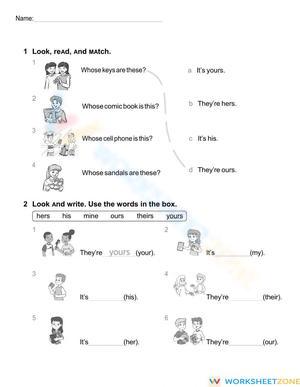
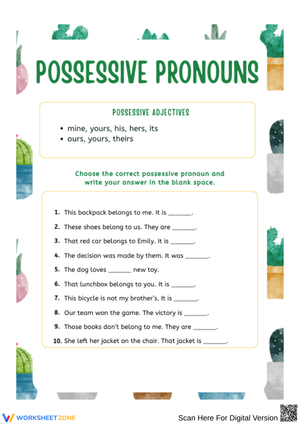
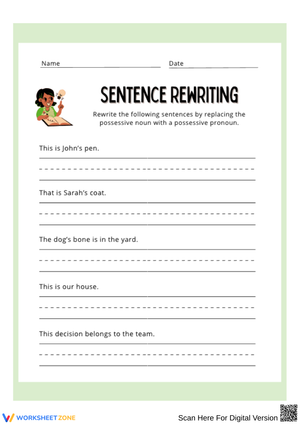
The exercises are deliberate about sequence. Students begin by identifying possessive pronouns in sentences — underlining the word, naming what it replaces. From there, the work shifts to substitution: rewrite the sentence so the noun phrase disappears and the standalone pronoun does its job. A sentence like "That lunchbox is Jayden's lunchbox" becomes "That lunchbox is his." That single transformation, practiced across many sentences, builds the right intuition faster than any definition alone.
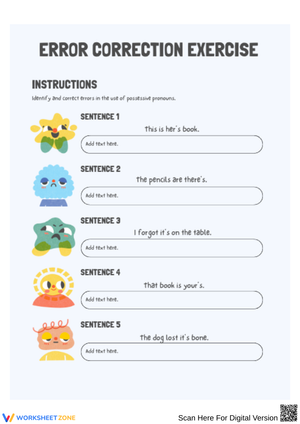
Later worksheets add error-correction tasks, where students read a sentence with a wrong form written in, cross it out, and supply the correct one. These are particularly useful near the end of a unit, when the goal is catching mistakes rather than just avoiding them. The full range of skills addressed includes:
- Identifying standalone possessive pronouns within a sentence
- Distinguishing possessive pronouns from possessive adjectives — mine vs. my, hers vs. her
- Rewriting noun phrases using the correct standalone form
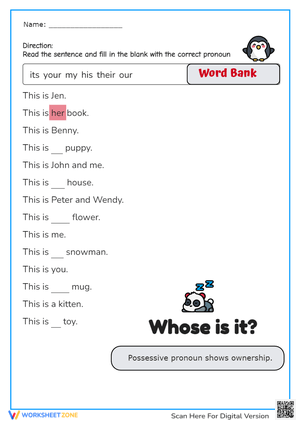
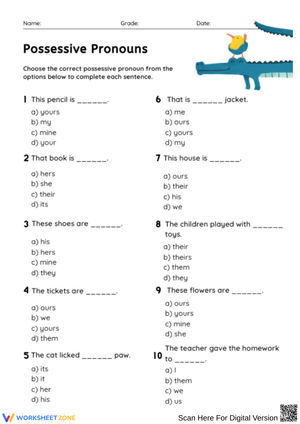
- Filling in blanks using a word bank, then without one
- Correcting sentences where the wrong form appears
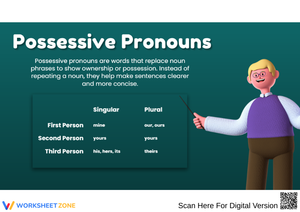
- Sorting pronouns by singular and plural function
Mistakes Students Consistently Make — and Why They Make Them
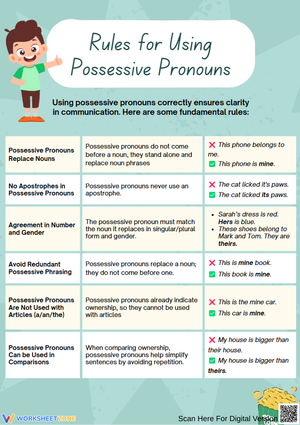
The apostrophe error is predictable and persistent. Third graders have already internalized the rule that apostrophe-s signals possession — "the dog's collar," "Leah's backpack" — so when they turn to possessive pronouns, they reach for the same tool. The result is "her's," "our's," and "their's" appearing in writing across the class. The most stubborn version is "it's" used where "its" belongs. A student who writes "The cat licked it's paw" has done exactly what good pattern-matching looks like; the problem is that possessive pronouns are an exception to a rule they just learned. Naming that exception directly — "these words carry ownership inside them already, so the apostrophe would be a duplicate" — tends to land better than simply marking it wrong.
A second error pattern is less obvious but equally common: students use possessive adjectives where pronouns belong. When asked to rewrite "This backpack is my backpack," they write "This backpack is my" and stop there. The sentence feels finished to them because my does imply ownership. What they haven't absorbed yet is that the standalone pronoun form (mine) is required when no noun follows. Watching for this in student work tells you immediately whether the pronoun-adjective distinction has actually landed or just been nodded at.
Fitting These Worksheets Into Your Week
The most natural placement is the six to eight minutes before the writing workshop block opens — short enough to feel low-stakes, long enough to get real practice in. One worksheet at the start of a writing day, scored quickly with a show of hands or a turn-and-talk, gives you real-time information about which pronouns still need attention before students open their drafts.
Several teachers use these 3rd grade possessive pronouns printable worksheets as pre- and post-assessments around a pronoun unit. A fill-in-the-blank worksheet at the start of the unit shows you exactly where the gaps are — whether students are solid on singular forms but confused by "ours" and "theirs," or whether the apostrophe question is hitting everyone equally. That information changes what you do on Day 2. Running a matching worksheet as a quick exit check after the unit closes the loop without adding a formal assessment event to your week.
Literacy centers are another reliable fit. A sorting task — group the pronouns by singular or plural, then write one sentence using a word from each group — works well for a partner station and generates the kind of peer conversation a solo worksheet can't replicate. The back-and-forth of "no, 'hers' doesn't need an apostrophe, look at the card" is more memorable for most students than a correction delivered from the front of the room.
Standard Alignment
These 3rd grade possessive pronouns printable worksheets address CCSS.ELA-LITERACY.L.3.1a, which requires students to demonstrate command of standard English grammar conventions — specifically, correct use of pronouns including case, number, and person. Possessive pronouns sit at the intersection of all three: hers is third-person singular, ours is first-person plural, and the case distinction between possessive adjective and possessive pronoun is exactly what L.3.1a asks students to control. The error-correction tasks also connect to CCSS.ELA-LITERACY.L.3.3b, which asks students to recognize and correct inappropriate shifts in pronoun number and person. Teachers preparing students for the end-of-year writing assessment find this pairing useful because L.3.3 errors appear frequently in prompted writing samples even when students perform well on identification tasks.
Adjusting the Set for Different Student Levels
For students who freeze when an unfamiliar sentence appears, the word bank versions of each worksheet reduce that moment of paralysis without removing the grammar decision. The student still has to choose the correct form — they just aren't generating it from scratch. Once a student completes the word-bank version correctly a couple of times, pulling the bank for the next worksheet tends to go smoothly.
For students moving faster than the class, the error-correction tasks are the natural next step — but you can also ask them to write a short paragraph (four to six sentences) describing who owns various objects in the classroom, then swap with a partner and underline every possessive pronoun used. That extension produces genuine writing practice alongside the grammar work, which is a more honest measure of mastery than filling in blanks alone.
Students with language backgrounds where possession is marked differently — particularly some Spanish-speaking students still sorting out English pronoun forms — benefit from a quick reference card that pairs each possessive adjective with its pronoun counterpart: my → mine, your → yours, her → hers. Keeping that card visible during worksheet time, then setting it aside for exit checks, gives those students a bridge to independent use without making the support permanent.
Frequently Asked Questions
What is the difference between a possessive pronoun and a possessive adjective, and do these worksheets address both?
A possessive adjective — my, your, her, our, their — always attaches to a noun: "That is her notebook." A possessive pronoun — mine, yours, hers, ours, theirs — stands alone in place of the noun phrase: "That notebook is hers." The worksheets address both by including substitution exercises where students replace the adjective-plus-noun construction with the standalone pronoun form. This distinction gets blurred fast when instruction focuses only on identification, so the rewriting tasks are where the real conceptual work happens.
Why do students keep writing apostrophes in words like "hers" and "ours" even after direct instruction?
Because the rule they already know — apostrophe-s marks possession — is a strong and well-practiced one by the time possessive pronouns arrive in the curriculum. Telling students the exception doesn't erase the reflex; repeated writing practice does. The error-correction exercises are built specifically for that purpose: students see the wrong form ("our's"), cross it out, and write the correct one ("ours") enough times that the apostrophe-free version starts to feel right rather than strange. It typically takes more repetitions than teachers expect, which is why this set returns to the apostrophe question across multiple exercises rather than covering it once and moving on.
When during the school year should I introduce possessive pronoun practice?
Most third-grade teachers introduce possessive pronouns after students are comfortable with personal pronouns (he, she, they) and have done some work with possessive nouns — usually the second or third month of the year in a writing-heavy ELA program. The 3rd grade possessive pronouns printable worksheets in this set work best as follow-up practice after initial whole-class instruction, not as the introduction itself. Students encountering these words for the first time need a shared reading or interactive lesson first; the worksheet practice that follows is substantially more productive once the concept has been introduced in context.
Can I send these home as homework?
Yes, with one practical caveat: the substitution and error-correction exercises sometimes prompt questions that a parent or caregiver can't easily answer if they weren't part of the classroom lesson. The fill-in-the-blank and identification exercises travel home more smoothly. If you're sending the error-correction tasks home, a brief note on the worksheet reminding families that "possessive pronouns never use apostrophes" saves a fair amount of confusion at kitchen tables.












 Interactive Worksheet Maker
 Quiz Maker
 Word Search Maker
 Crossword Puzzle Maker
 Word Scramble Generator
 Sentence Scramble Generator
 Handwriting Worksheet Generator
 Name Tracing Generator
 Fill In The Blank Generator