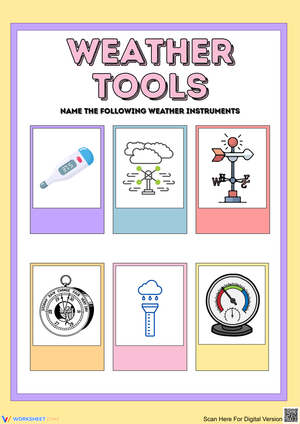
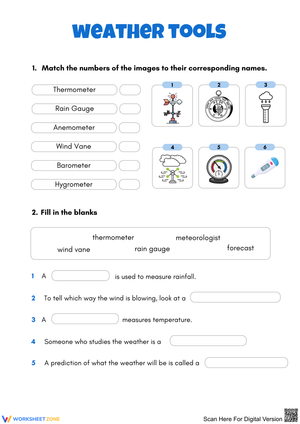
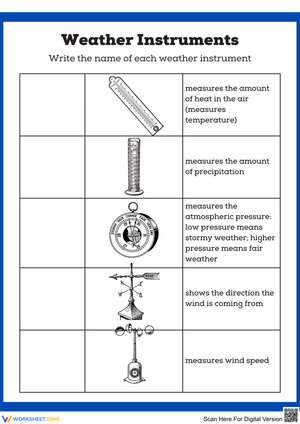
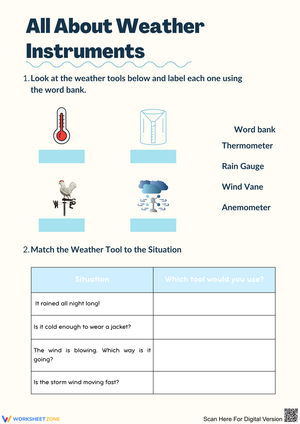
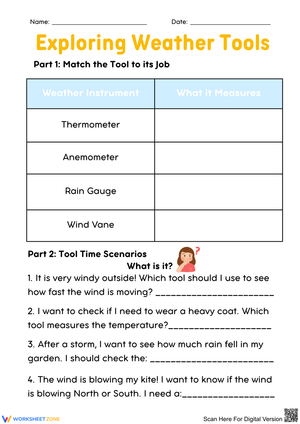
These weather tools worksheets for 2nd grade give students structured, repeated practice identifying the five core meteorological instruments — thermometer, rain gauge, wind vane, anemometer, and barometer — and connecting each one to what it actually measures. Each worksheet stands alone as a focused activity, so teachers can pull individual ones for warm-ups, station rotations, or whole-class instruction without committing to a fixed sequence.
The Specific Skills Targeted
Second graders arrive at weather science with strong observational instincts but little framework for measurement. These worksheets build that framework by pairing instrument names with their functions in formats that match how 7-year-olds actually process new vocabulary — through visual association, physical manipulation, and repeated retrieval across varied contexts.
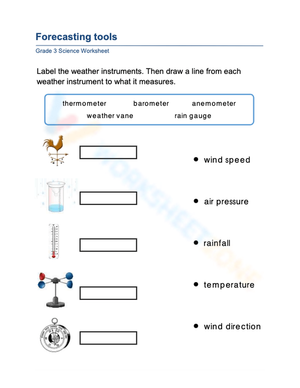
- Tool-to-function matching: Students draw lines connecting each instrument to the weather element it measures. Wind direction versus wind speed is a common point of confusion at this age, and matching tasks force that distinction explicitly.
- Diagram labeling from a word bank: Given an illustrated instrument and a set of terms, students write the correct label. This format supports emerging readers while still assessing content knowledge rather than decoding ability.
- Cut-and-paste sorting: Students categorize instrument pictures by what each one measures — temperature, precipitation, or wind. The physical cutting and sorting keeps Grade 2 attention engaged and gives teachers a clear visual record of where misconceptions sit.
- Thermometer reading: Worksheets include thermometer diagrams marked at different levels; students read and record the temperature shown. This doubles as applied number-line practice, reinforcing math alongside earth science.
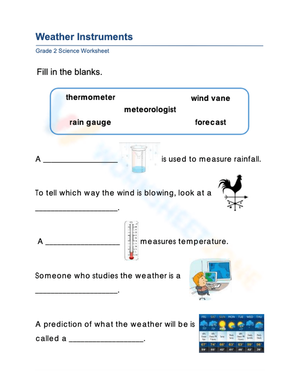
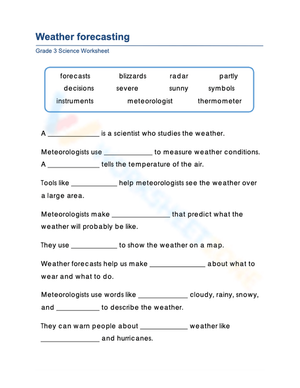
- Fill-in-the-blank sentences: Short cloze sentences ask students to retrieve tool names and functions in writing, moving recall from recognition to production.
- Weather observation logs: Open recording sheets prompt students to note which tool they would use under a given set of conditions, connecting instrument knowledge to real observational decisions.
Standard Alignment
These worksheets align with NGSS 2-ESS1-1 and the broader 2-ESS2 Earth's Systems cluster, which ask second graders to use information from multiple sources to identify patterns in weather across seasons and locations. In classroom terms, that standard requires students to understand what data means before they can discuss patterns — and weather tools are the mechanism through which meteorological data is generated. A student who cannot connect a rain gauge to precipitation measurement cannot meaningfully interpret a monthly rainfall chart. These worksheets address that prerequisite directly, building the instrument knowledge that makes data interpretation possible later in the unit.
Frequent Student Errors Worth Watching For
The wind vane and anemometer generate the most consistent confusion in student work. Students understand intuitively that wind does something — they feel it — but the distinction between direction and speed is abstract, and many will assign both functions to whichever wind tool they learned first. A student who correctly labels a thermometer will often write "measures how fast the wind blows" for both wind instruments. The matching worksheets address this directly by placing the two wind tools side by side and requiring separate answers for each.
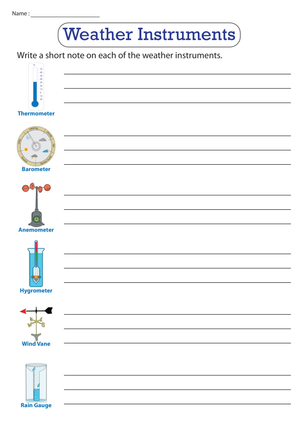
The barometer creates a different problem. Unlike the other four instruments, students cannot observe what it measures — air pressure is invisible and unfelt. Expect students to guess that it measures temperature (because thermometers are the most familiar weather tool) or to leave the function blank entirely. Worksheets that include a brief illustrated explanation alongside the barometer diagram reduce this gap more effectively than verbal instruction alone, because students can refer back to the image while working independently.
A subtler error appears in thermometer reading: students who can count up a number line accurately will still misread a thermometer when the scale increments by twos rather than ones. Watch for students who mark 74°F as 73°F because they counted each line as one degree. Thermometer worksheets that use varying scale increments surface this error quickly and give teachers a concrete formative signal before moving to outdoor observation.
Lesson-Planning Ideas to Get the Most From These Worksheets
The most productive place for a weather tools worksheet is immediately after a brief concrete encounter with the instrument itself — not before, and not as a standalone introduction. Spend five minutes at the start of class with a real or model thermometer. Ask students what they notice. Then distribute the labeling worksheet. That sequence — observe, then record — is the structure these worksheets are designed to reinforce, and skipping the observation step makes the paper activity feel arbitrary to 7-year-olds.
Sorting worksheets work well during the 8–10 minutes before a transition, when there is enough time for a focused task but not enough for a full lesson segment. Cut-and-paste activities hold attention better than silent reading in that window, and the resulting sorted sheets give teachers something concrete to scan as students line up.
For the weather observation log worksheets, consider running them across a Monday–Friday cycle during morning meeting. Students check a classroom window thermometer and a simple rain gauge set outside, record the data on the log, and decide which tools would have been relevant that day. By Friday, students have produced a week's worth of weather data they observed themselves — a natural entry point for discussing patterns, which is exactly where the NGSS expectations for this grade level land.
Adjusting the Worksheets for a Range of Learners
For students who are still building reading fluency, add a picture key alongside the word bank on labeling and fill-in-the-blank worksheets. Small icons next to each instrument name reduce the decoding load without removing the science content — the student still retrieves the correct term and writes it in. Laminating a reference card with all five instruments and their functions also allows struggling students to cross-check without requiring teacher support on every item.
Students who move through the core tasks quickly benefit from a short extension at the bottom of the worksheet rather than a separate activity sheet. Ask them to write one sentence explaining how a scientist would use two different tools on the same rainy day, or to sketch what a weather station might look like using three of the five instruments. These prompts require synthesis rather than recall, which shifts the cognitive demand without adding prep time for the teacher.
For whole-class projection during initial instruction, these worksheets hold up well on a screen. Working through a matching or labeling task together before independent practice is a reliable gradual-release move — students hear the reasoning modeled, see the worksheet conventions demonstrated, and then have a clearer sense of what independent work looks like. That shared experience also reduces the volume of procedural questions once students begin working on their own.
Frequently Asked Questions
Which five weather instruments do 2nd graders need to know?
The five instruments addressed at this grade level are the thermometer (temperature), rain gauge (precipitation), wind vane (wind direction), anemometer (wind speed), and barometer (air pressure). Each worksheet in this set focuses on one or more of these tools in formats that match Grade 2 literacy and science expectations.
Can these worksheets work as a formative assessment?
Yes — matching and labeling worksheets are particularly useful as quick formative checks. Because each item has a clear correct answer, teachers can scan a class set in a few minutes and identify which instruments students are misidentifying. Wind vane versus anemometer confusion and barometer-function errors are the two patterns that show up most reliably, and seeing them in writing gives teachers a concrete next step before moving the unit forward.
Do students need prior instruction before using these worksheets?
For most students, yes. The worksheets are designed to reinforce and assess instrument knowledge rather than introduce it cold. A brief whole-class demonstration with a physical or model instrument — even just holding up a thermometer and asking what it does — gives the worksheet activity a concrete anchor. Students who encounter the instrument name on paper before seeing the tool tend to treat it as a vocabulary exercise rather than a science one.
How do the thermometer-reading worksheets connect to math standards?
Reading a thermometer requires students to interpret a vertical number line with marked intervals, which directly reinforces the measurement and data strand of second-grade math. Worksheets that vary the scale increments — some marked by ones, others by twos or fives — give teachers a window into whether a student's thermometer error is a science-content gap or a number-line fluency gap. That distinction matters for planning the right intervention.












 Interactive Worksheet Maker
 Quiz Maker
 Word Search Maker
 Crossword Puzzle Maker
 Word Scramble Generator
 Sentence Scramble Generator
 Handwriting Worksheet Generator
 Name Tracing Generator
 Fill In The Blank Generator