


























Views
Downloads
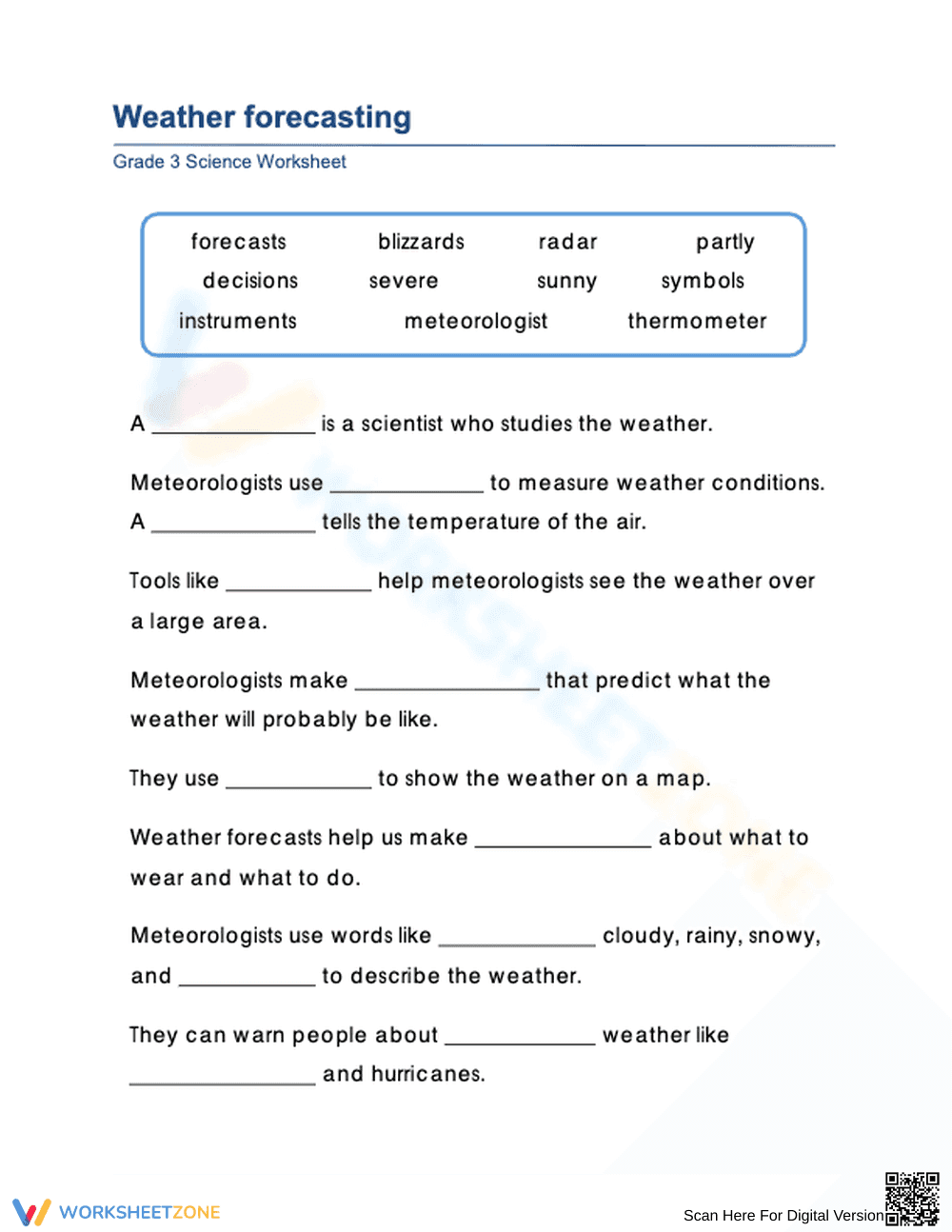

Essential Grade 2 Weather Forecasting Worksheet
Paste this activity's link or code into your existing LMS (Google Classroom, Canvas, Teams, Schoology, Moodle, etc.).
Students can open and work on the activity right away, with no student login required.
You'll still be able to track student progress and results from your teacher account.
This Grade 2 weather forecasting worksheet introduces students to the essential tools and roles of meteorology. Students identify key vocabulary like thermometer and radar while understanding how forecasts help us make daily decisions. By completing structured fill-in-the-blank sentences, learners build a foundational understanding of weather patterns and severe conditions.
At a Glance
- Grade: 2 · Subject: Science
- Standard:
3-ESS2-1— Represent data in tables and graphical displays to describe typical weather conditions- Skill Focus: Weather Forecasting Tools & Vocabulary
- Format: 2 pages · 10 problems · Answer key included · PDF
- Best For: Introduction to meteorology or sub plans
- Time: 15–20 minutes
This resource features a focused one-page worksheet with 10 fill-in-the-blank questions designed to test comprehension of weather concepts. It includes a clear word bank containing terms such as meteorologist, thermometer, and severe weather to support vocabulary development. The second page provides a complete answer key with responses highlighted in red for quick teacher review and grading.
Zero-Prep Workflow
- Print: Print the single-sided student page in under 30 seconds for immediate classroom use.
- Distribute: Hand out copies and have students use the word bank to complete the sentences independently or in pairs (15 minutes).
- Review: Use the provided answer key for immediate feedback, peer-grading, or quick collection (2 minutes).
This streamlined process makes it an ideal choice for busy mornings or emergency sub plans where teacher prep time is limited.
Standards Alignment
The worksheet is primary aligned to 3-ESS2-1, which requires students to represent data in tables and graphical displays to describe typical weather conditions expected during a particular season. While it focuses on the terminology of forecasting, it provides the essential vocabulary needed to analyze weather data and predict outcomes. This standard code can be copied directly into lesson plans, IEP goals, or district curriculum mapping tools.
How to Use It
Use this worksheet as a formative assessment during your weather and climate unit to gauge student understanding of meteorological tools. It works best after a direct instruction lesson on how scientists predict the weather. One formative-assessment observation tip: check if students can distinguish between a tool (thermometer) and a scientist (meteorologist). The expected completion time is 15 to 20 minutes depending on reading level.
Who It's For
This resource is designed for Grade 2 students but is also appropriate for Grade 3 review. It supports diverse learners with a word bank that provides visual and linguistic scaffolds. It pairs naturally with a classroom weather station or a reading passage about extreme weather events to deepen the connection between vocabulary and real-world application.
The integration of specialized vocabulary in science instruction is a critical component of academic literacy. This Grade 2 weather forecasting worksheet aligns with 3-ESS2-1 by providing the linguistic scaffolding necessary for students to describe and predict weather conditions. Research from Fisher & Frey (2014) emphasizes that background knowledge is the foundation of comprehension, and this resource builds that foundation through focused vocabulary practice. By identifying tools like thermometers and radar, students develop the conceptual framework required to analyze meteorological data. The structured format of 10 tasks ensures that the cognitive load remains manageable while still demanding precise use of scientific terms. This approach supports the gradual release of responsibility, moving students from basic identification to the ability to explain how forecasts influence human decision-making and safety during severe weather events like blizzards or hurricanes.


