


























Views
Downloads
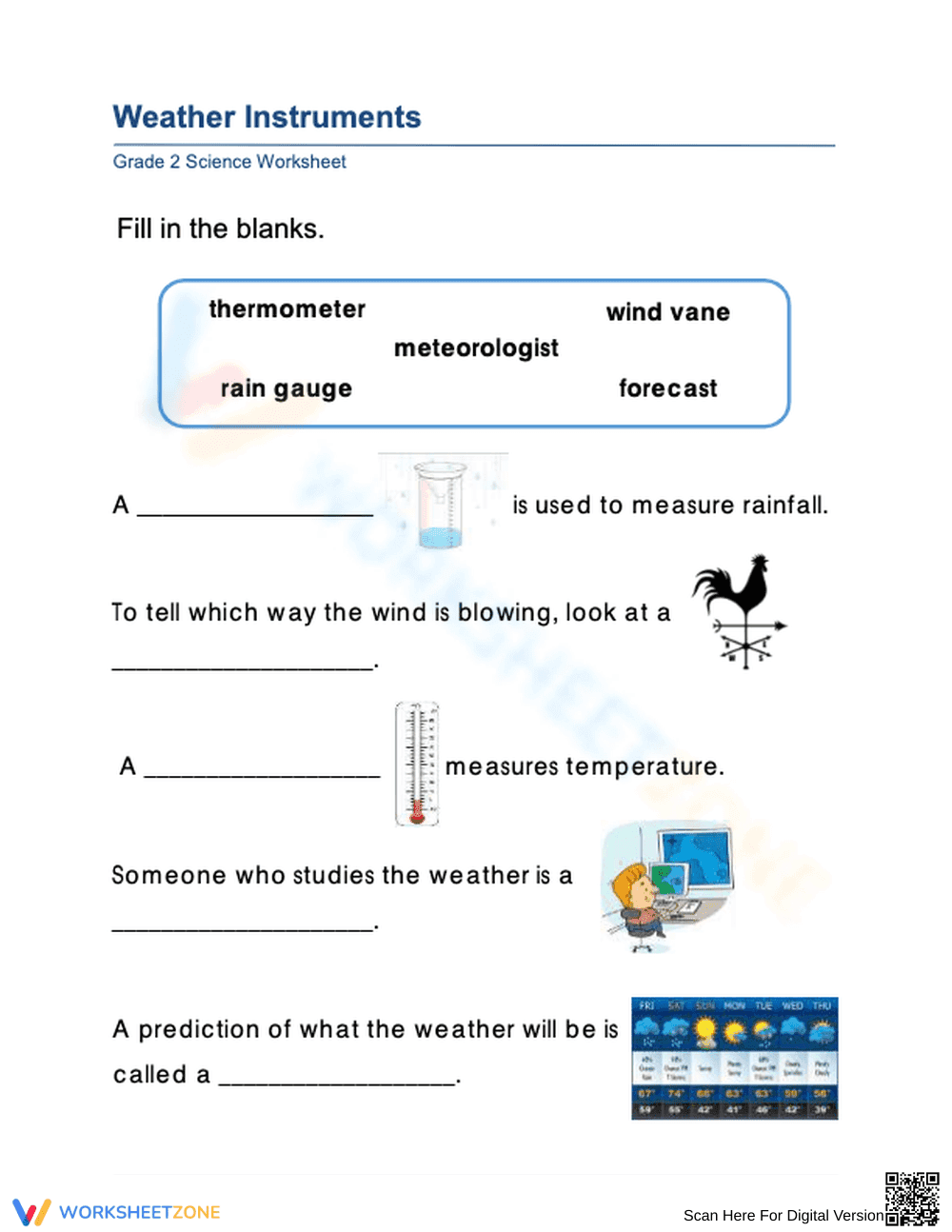

Essential Weather Instruments Worksheet | Grade 2 Science
Paste this activity's link or code into your existing LMS (Google Classroom, Canvas, Teams, Schoology, Moodle, etc.).
Students can open and work on the activity right away, with no student login required.
You'll still be able to track student progress and results from your teacher account.
This Grade 2 science worksheet introduces students to fundamental weather instruments and terminology through a focused fill-in-the-blank activity. Students observe visual cues to identify tools like thermometers and rain gauges, reinforcing their understanding of how meteorologists measure atmospheric conditions. It is a perfect resource for building early scientific literacy and vocabulary in Earth systems.
At a Glance
- Grade: 2 · Subject: Science
- Standard:
K-2-ESS2-1— Use and share observations of local weather conditions to describe patterns over time.- Skill Focus: Weather instrument identification
- Format: 1 page · 5 problems · Answer key included · PDF
- Best For: Independent practice or quick formative assessment
- Time: 10–15 minutes
This single-page PDF features five structured fill-in-the-blank questions accompanied by clear, student-friendly illustrations. A word bank is provided to support vocabulary acquisition for terms including meteorologist, forecast, and wind vane. The layout includes ample writing space and a matching answer key, ensuring students can self-correct or teachers can grade rapidly without searching for external resources.
Zero-Prep Workflow
- Step 1: Print the 1-page student sheet and the accompanying answer key (under 1 minute).
- Step 2: Distribute the worksheets as a warm-up, center activity, or part of a sub plan (30 seconds).
- Step 3: Review the answers together using the provided key to identify any misconceptions about weather tools (5 minutes).
Total teacher preparation time for this activity is under two minutes, making it ideal for busy classrooms.
Standards Alignment
Primary standard K-2-ESS2-1. Students will use various tools to gather and analyze data regarding Earth's systems and weather patterns. By identifying the specific tools used by meteorologists, learners build the foundational knowledge necessary to describe and record atmospheric conditions over time. This standard code can be copied directly into lesson plans, IEP goals, or district curriculum mapping tools.
How to Use It
Assign this worksheet during the "Explain" or "Evaluate" phase of a 5E lesson on weather. It serves as an excellent formative assessment to check if students can distinguish between different instruments. Observe whether students use the word bank effectively or rely on the visual cues provided next to each sentence. Expected completion time is 10 to 15 minutes.
Who It's For
This resource is designed for Grade 2 students in general education classrooms, but it is also highly effective for ESL/ELL learners who benefit from the visual-to-text pairing. It pairs naturally with a classroom weather station or an introductory reading passage about meteorology to reinforce the connection between tools and data collection.
The Grade 2 Weather Instruments worksheet aligns with K-2-ESS2-1 by requiring students to identify the specific tools utilized to gather evidence about Earth’s atmospheric systems. According to Fisher & Frey (2014), providing scaffolds such as word banks and visual cues is essential for the gradual release of responsibility model, allowing students to transition from guided instruction to independent mastery of scientific terminology. By measuring conditions like rainfall and wind speed, students develop a concrete understanding of how data collection informs weather forecasting. Research from EdReports 2024 emphasizes that standards-aligned science materials must prioritize disciplinary core ideas such as ESS2.D, which focuses on measuring conditions to notice patterns. This worksheet provides the structured practice needed to reinforce these concepts, ensuring students can accurately communicate scientific observations. It is a high-utility tool for teachers seeking to integrate evidence-based practice with classroom-ready materials that support diverse learner needs through clear formatting and direct alignment.


