


























Views
Downloads
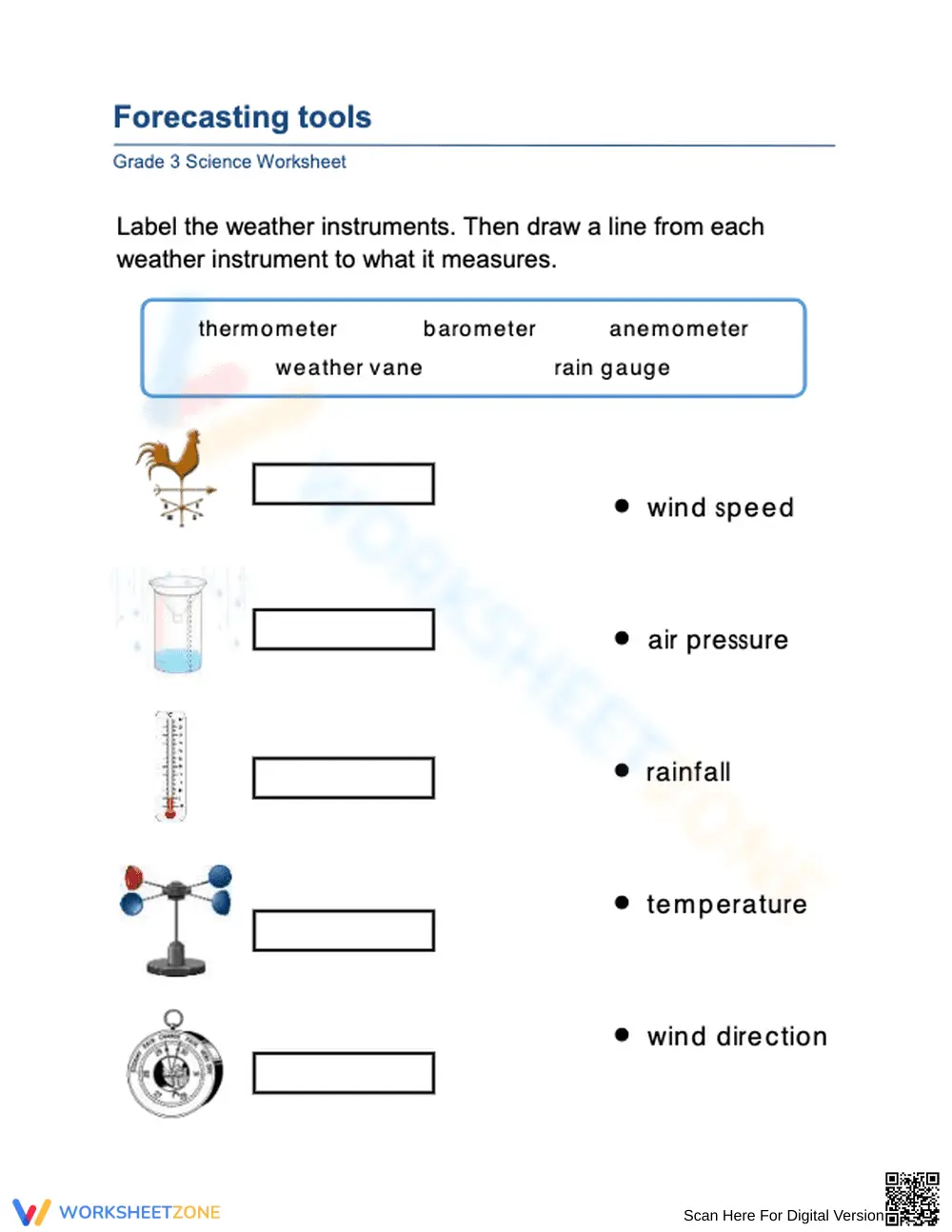

Essential Weather Tools Worksheet | Grade 2 Science
Paste this activity's link or code into your existing LMS (Google Classroom, Canvas, Teams, Schoology, Moodle, etc.).
Students can open and work on the activity right away, with no student login required.
You'll still be able to track student progress and results from your teacher account.
This Grade 2 weather tools worksheet helps students identify and understand the functions of key meteorological instruments. By labeling images and matching tools like the anemometer and barometer to their measurements, students build a foundational understanding of how scientists track atmospheric conditions. It is a focused practice resource for building essential scientific vocabulary.
At a Glance
- Grade: 2 · Subject: Science
- Standard:
3-ESS2-1— Represent data in graphical displays to describe typical weather conditions expected during seasons- Skill Focus: Weather instrument identification and function
- Format: 1 page · 10 tasks · Answer key included · PDF
- Best For: Independent practice or quick formative assessment
- Time: 10–15 minutes
What's Inside
This single-page PDF features 10 distinct tasks designed to solidify student knowledge of forecasting equipment. The worksheet includes clear illustrations of a weather vane, rain gauge, thermometer, anemometer, and barometer. Students are first asked to label each instrument using a provided word bank, followed by a matching activity that connects each tool to its corresponding measurement, such as wind speed or air pressure. A comprehensive answer key is included for rapid grading.
Zero-Prep Workflow
- Print (30 seconds): Generate copies for your entire class in less than a minute.
- Distribute (30 seconds): Hand out the worksheet as a bell-ringer, exit ticket, or homework assignment.
- Review (60 seconds): Use the provided answer key to grade quickly or project it for immediate student self-correction.
Total teacher preparation time is under 2 minutes, making it an excellent option for emergency sub plans or spontaneous review sessions.
Standards Alignment
The worksheet is primarily aligned with 3-ESS2-1, which requires students to represent data to describe typical weather conditions. By mastering the tools used to collect this data, students gain the prerequisite skills needed for higher-level meteorological analysis. This standard code can be copied directly into lesson plans, IEP goals, or district curriculum mapping tools.
How to Use It
Use this worksheet during the Evaluate phase of a science lesson on weather and climate. For a formative assessment, observe students as they match the barometer and anemometer; these are often the most challenging tools for second graders to distinguish. Completion typically takes 10–15 minutes, making it a perfect transition activity between direct instruction and hands-on classroom weather station observations.
Who It's For
This activity is perfect for Grade 2 students beginning their exploration of weather patterns. It provides scaffolding through a word bank, supporting English Language Learners and students who need literacy support. It pairs naturally with a classroom weather station or a digital weather tracking app to bridge abstract concepts and real-world scientific observation.
Effective science instruction in early elementary grades relies on the development of precise academic vocabulary and the ability to link scientific tools to their practical applications. According to the ScienceDirect TpT Analysis, structured worksheets that combine visual identification with functional matching significantly improve retention of complex scientific terms in young learners. This Grade 2 resource addresses standard 3-ESS2-1 by focusing on the fundamental instruments used to gather meteorological data, such as the rain gauge and thermometer. By providing students with 10 structured tasks, the worksheet encourages active engagement with the material while offering a clear pathway to mastery of weather forecasting concepts. The inclusion of a word bank and a visual-to-function matching component aligns with research-based strategies for tiered vocabulary instruction, ensuring that all students, including those with diverse learning needs, can successfully participate in the curriculum while developing mastery of weather-related standards.


