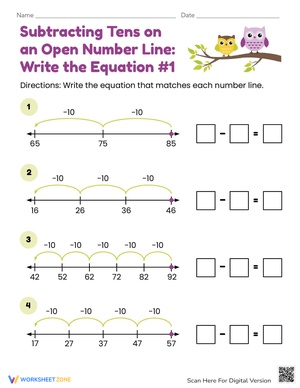
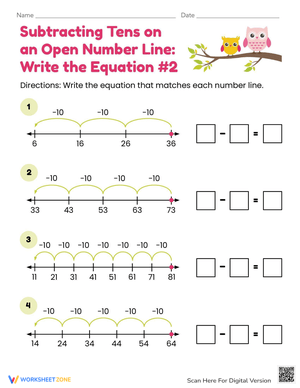
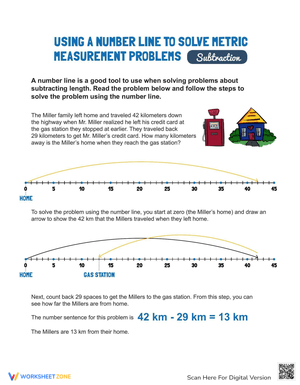
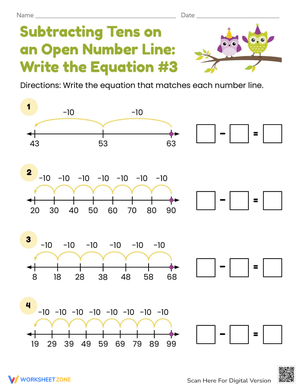
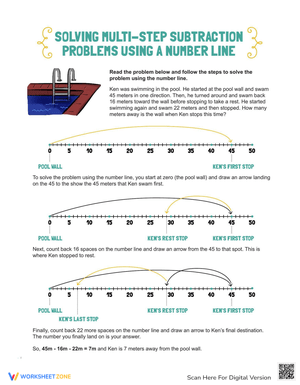
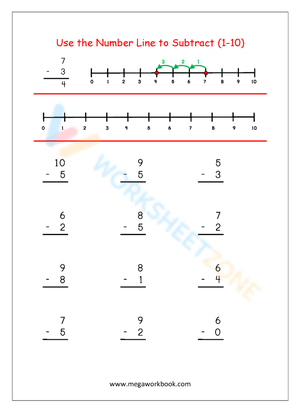
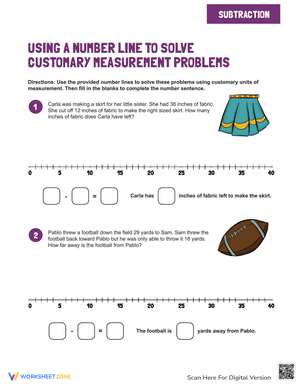
Second grade teachers introducing subtraction on a number line are usually solving a specific classroom problem: students can recite subtraction facts but freeze when a word problem asks them to show their thinking. A number line worksheet gives every student a visual tool for modeling counting back and jump strategies, which makes the reasoning behind a difference visible instead of hidden inside a memorized fact.
Why Number Lines Matter for Grade 2 Subtraction
Number line diagrams are named directly in the standards students are expected to master. Using a number line worksheet gives you a low-prep way to address that requirement while also supporting daily fluency work.
CCSS 2.MD.6 specifically requires students to represent whole numbers as lengths from 0 on a number line diagram and use it to represent sums and differences within 100, which means number line practice is not optional enrichment but a directly assessed skill in most Grade 2 math programs.
Connecting Number Lines Worksheets to CCSS 2.OA.A.1 and 2.OA.B.2
Number line subtraction worksheets do double duty when they are paired with short word problems. CCSS 2.OA.A.1 calls for solving one- and two-step within-100 word problems involving adding to, taking from, putting together, taking apart, and comparing situations with unknowns in any position. A number line gives students a consistent structure for representing any of these situations, whether the unknown is the start, the change, or the result.
At the same time, CCSS 2.OA.B.2 expects students to fluently subtract within 20 using mental strategies, with those facts known from memory by the end of the year. Number line worksheets that start with within-20 problems and gradually extend to within-100 give you one consistent model that supports both standards without switching strategies mid-year.
Classroom Implementation
Number line subtraction worksheets work best as a short, repeatable routine rather than a one-time assignment. Consider these classroom moves:
- Start a math block with a single number line problem projected on the board, having students narrate their jumps aloud before working independently
- Use a within-20 number line worksheet as a five-minute warm-up three times a week to build the fluency named in 2.OA.B.2
- Reserve within-100 open number line problems for guided math groups, where you can watch students choose jump sizes in real time
- Pair number line practice with a matching word problem so students connect the visual model to a real subtraction situation from 2.OA.A.1
Keeping the routine short and frequent tends to build more lasting fluency than one long worksheet used only once a month.
Frequently Asked Questions
1. What grade level and standard does number line subtraction align to?
Number line subtraction is a Grade 2 standard under CCSS 2.MD.6, which asks students to represent whole numbers as lengths from 0 on a number line and use it to model sums and differences within 100. It also supports CCSS 2.OA.A.1 and 2.OA.B.2 by giving students a visual model for word problems and fluency practice.
2. How is a number line subtraction strategy different from a standard algorithm?
A number line strategy shows subtraction as a series of jumps back from a starting number, making each step of the reasoning visible. A standard algorithm records subtraction in columns with regrouping, which is more efficient but hides the reasoning unless a student has already internalized place value.
3. How can teachers use number line worksheets for intervention groups?
For intervention groups, start with pre-marked number lines and within-20 problems so students focus only on counting back accurately. As fluency builds, move to open number lines and within-100 problems that require students to choose their own jump sizes.
4. What are common mistakes students make with subtraction number lines and how to fix them?
Common mistakes include counting the starting point as a jump and using inconsistent jump sizes. Worksheets that require students to label each jump make these errors visible quickly, so you can correct them during independent practice rather than after a test.
5. How many practice problems should a 2nd grade number line worksheet include?
Six to ten problems per worksheet is typically enough for a focused practice session. Fewer, clearly labeled problems give better insight into student thinking than a long page of rushed answers.













 Interactive Worksheet Maker
 Quiz Maker
 Word Search Maker
 Crossword Puzzle Maker
 Word Scramble Generator
 Sentence Scramble Generator
 Handwriting Worksheet Generator
 Name Tracing Generator
 Fill In The Blank Generator