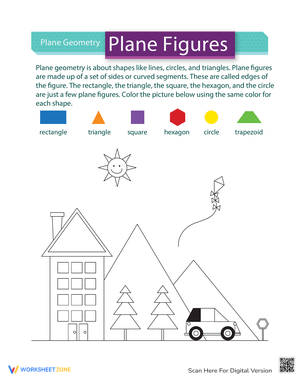
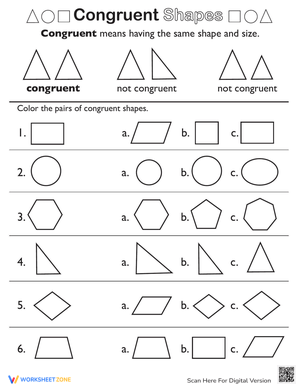
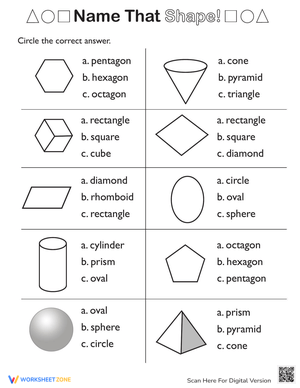
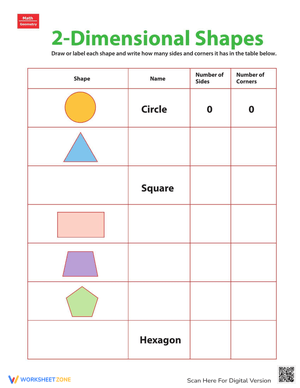
These pentagons worksheets for 2nd grade give teachers a ready set of geometry activities for the precise moment when second graders stop relying on shape memory and start using attribute counts to classify what they see. The resources target a narrow, important skill: identifying a closed five-sided figure by counting its sides and vertices rather than matching it to a remembered image. That shift is harder than it sounds, and the practice here is built to support it.
What's Inside the Set
Each worksheet targets one or two clearly defined tasks so students aren't splitting attention across too many directions at once. The set moves from recognition toward construction: early worksheets ask students to mark each side with a tick and circle each vertex as they count — a physical tracking habit that prevents the most common error on irregular figures, which is recounting the starting side and arriving at six instead of five.
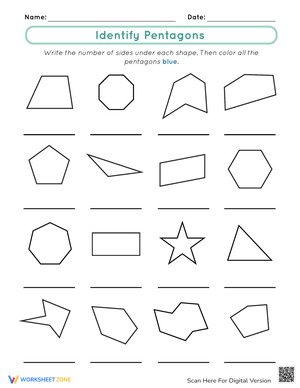
- Attribute verification — Students count sides and vertices on both regular and irregular pentagons, marking as they go. The irregular examples do the real teaching work here; a deeply asymmetrical five-sided figure forces students to count rather than match a remembered shape.
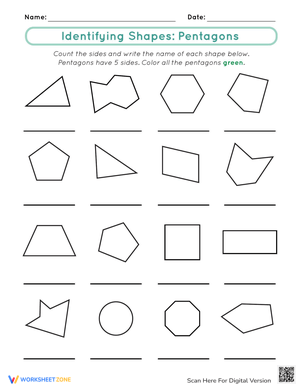
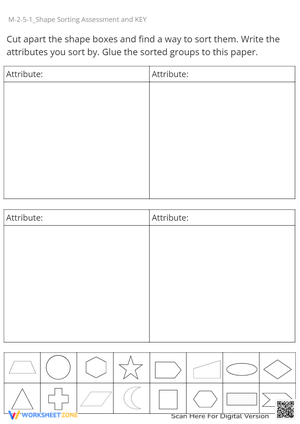
- Mixed-polygon sorting — A collection of quadrilaterals, pentagons, hexagons, and octagons gets sorted by side count. The tasks deliberately pair figures with close counts — a hexagon next to a pentagon — so students develop actual discrimination rather than rough visual pattern-matching.
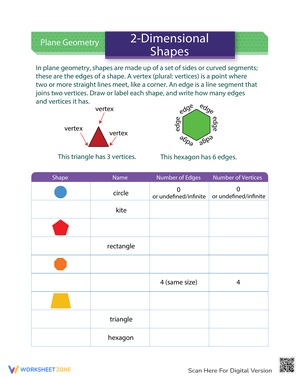
- Dot-grid drawing — Students construct their own five-sided figures on dot paper and verify the count. This task consistently surfaces one durable misconception: students who close a shape with a curved line without realizing the figure is no longer a polygon.
- Orientation practice — Pentagons appear rotated, inverted, and stretched across the set. Students who built their understanding around the standard "house" shape get immediate, productive challenge here.
- Real-world connections — Selected worksheets ask students to match geometric figures to everyday objects, helping them see that shape classification describes the physical world rather than just paper exercises.
Student Errors Worth Anticipating and Addressing
The most predictable error in this unit isn't confusing a pentagon with a hexagon — students generally hold that distinction reasonably well after direct instruction. The real trouble comes with irregular pentagons. Show a second grader a deeply asymmetrical five-sided figure — elongated, lopsided, nothing like the "house" — and a significant number will say it isn't a pentagon with full confidence. They've built their mental model around one visual example and treat anything outside that image as a different shape. The worksheets include enough irregular figures to expose this reasoning early, before it hardens.
Counting errors on irregular shapes are also common and predictable. Students working on a figure with unequal sides often recount the starting side when they arrive back at it, landing on six. The tick-mark tracking method addresses this directly — once each side has a mark, there's no ambiguity about where the count started. A third error worth watching for involves orientation: a pentagon rotated so a flat edge sits at the top genuinely feels like a different shape to many seven-year-olds. That's developmentally expected, but it means orientation exposure needs to happen deliberately, not incidentally.
Standard Alignment
These worksheets address CCSS.MATH.CONTENT.2.G.A.1, which calls for students to recognize and draw shapes having specified attributes, including a given number of angles or sides. That "recognize and draw" phrasing is worth noting — the standard doesn't stop at identification, and neither does this set. Teachers typically reach this standard during the geometry unit in the second semester, after place value and operations work wraps up. The sorting and drawing worksheets in the set cover both halves of the standard rather than treating recognition as the endpoint.
Building These Worksheets Into Your Lesson Plans
The attribute-verification worksheets work well as Monday morning warm-ups — five focused minutes of counting reactivates geometry vocabulary before instruction begins. The sorting worksheets belong mid-unit, after students have had explicit instruction on multiple polygon types. Handing a sorting task to a student who encountered hexagons for the first time that morning tends to produce frustration rather than thinking; giving it two days later, once hexagons have had real classroom time, makes the worksheet genuinely diagnostic instead of just hard.
Many teachers who use pentagons worksheets for 2nd grade find that the dot-grid drawing worksheet lands best near the end of the geometry sequence. Students need a working understanding of "closed figure" and "straight side" before drawing successfully — otherwise the task becomes a creativity exercise rather than a geometry one. Save it for the lesson when you're ready to ask students to produce examples, not just recognize them.
Adjusting the Set for a Range of Learners
For students who need more support, the pentagons worksheets for 2nd grade pair naturally with physical tools before the paper task. Five craft sticks arranged on a desk, or a pre-drawn pentagon with dotted sides for tracing, give students a concrete reference point they can touch and turn before working from a printed figure alone. Removing the physical reference once students are confident is a natural next step that happens quickly for most.
Students who move through recognition and sorting tasks quickly are ready for an extension the set supports naturally: drawing two irregular pentagons that look as different from each other as possible, then labeling every side and vertex to prove both are pentagons. This pushes thinking from identification toward genuine definitional understanding. For students who specifically struggle with irregular figures, a small reference card showing three very different-looking pentagons — taped to a corner of the desk — reduces anxiety without removing the cognitive challenge of the classification task itself.
Frequently Asked Questions
What makes a shape irregular, and do these worksheets cover irregular pentagons?
An irregular pentagon has five straight sides and five vertices, but the sides are unequal in length and the angles are unequal in measure. The shape can look stretched, compressed, or entirely asymmetrical — what determines classification is the attribute count, not the visual symmetry. The worksheets include irregular examples throughout the set, not just in one section, because that's where the real conceptual work happens for most students.
How do the worksheets handle orientation?
Pentagons appear in multiple orientations across the set — rotated, inverted, and positioned with a variety of edges or points facing down. This is one of the main reasons pentagons worksheets for 2nd grade are worth using beyond a single introductory lesson: students who only encounter the standard point-up position develop a recognition gap that shows up consistently when assessments rotate the figures.
At what point in a geometry unit do these worksheets fit best?
The attribute-counting worksheets work well at the start of a pentagon lesson, even on day one. The sorting worksheets need to follow instruction on the other polygon types — hexagons, octagons, quadrilaterals — so students aren't encountering unfamiliar shapes for the first time on a classification task. The drawing worksheet belongs at the end, once students can articulate what a pentagon is before they try to produce one.













 Interactive Worksheet Maker
 Quiz Maker
 Word Search Maker
 Crossword Puzzle Maker
 Word Scramble Generator
 Sentence Scramble Generator
 Handwriting Worksheet Generator
 Name Tracing Generator
 Fill In The Blank Generator