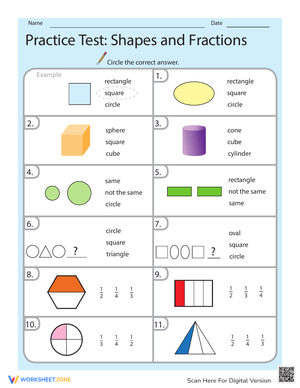
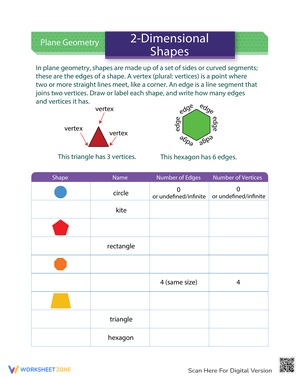
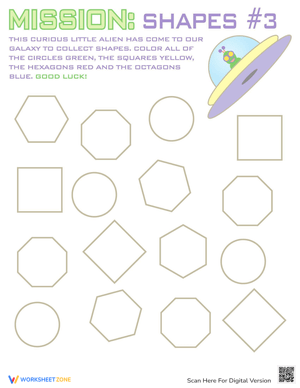
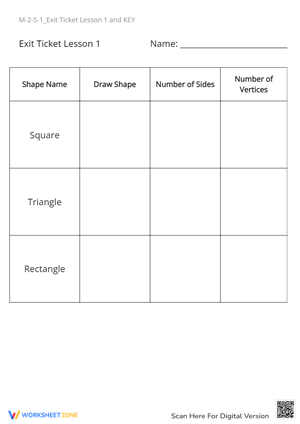
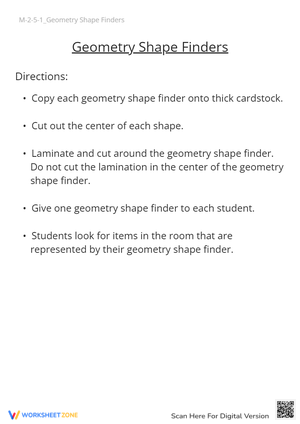
These 2nd grade hexagons printable worksheets resources give teachers a ready-to-use set for the polygon unit — covering side-counting on both regular and irregular hexagons, sorting mixed-polygon arrays, guided tracing, and freehand drawing on dot grids. The central instructional challenge at this grade level is moving students from visual recognition ("that's the honeycomb shape") toward attribute-based reasoning, and that shift is exactly what this set targets.
What Each Worksheet Covers
The activities range from straightforward identification to demanding shape-discrimination work. Students mark sides and corners on printed hexagons, trace guided dotted outlines, draw irregular hexagons from scratch on dot grids, sort polygon arrays by side count, and connect the geometry to real-world examples — honeycombs, basalt columns, hex nuts, and pencil cross-sections among them.
Drawing activities follow a deliberate progression. Early worksheets ask students to trace a regular hexagon using dotted guides. Later ones present a dot grid and six labeled points, asking students to connect them with straight lines in any configuration that produces a closed six-sided polygon. The gap between those two tasks is significant: a student who can only reproduce the familiar regular shape has not yet internalized what defines a hexagon.
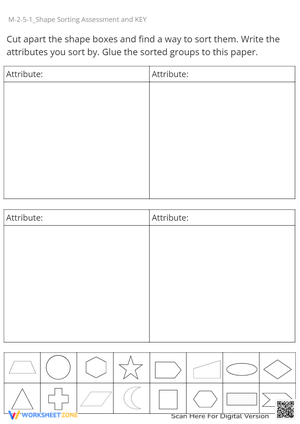
Sorting activities require examining a mixed field of polygons and identifying only the hexagons. Because a distorted hexagon and an irregular pentagon can look nearly identical at a glance, these exercises train the habit of counting rather than guessing by overall silhouette.
Student Error Patterns to Watch for Before Moving On
The most common error in this unit is not a counting mistake — it's a recognition failure. Students who have spent years working with regular hexagons from pattern block sets will look at a tall, narrow, or lopsided hexagon and call it something else because it doesn't match the shape stored in memory. When a student says "that one doesn't look right so it can't be a hexagon," the attribute rule hasn't landed yet. The irregular hexagon activities in this set put that misconception directly in front of students, repeatedly, until side-counting overrides visual guessing.
Counting errors are the second issue to watch for. When students trace a finger around an irregular hexagon without marking the sides, they frequently arrive at five or seven — especially when their starting point and ending point are close together. Teaching students to put a small tick mark on each side as they count, rather than running continuously around the perimeter, nearly eliminates this problem. A few students will try to count sides and vertices simultaneously and lose track of which feature they're recording; for those students, two separate passes work better.
A subtler problem appears in the drawing tasks. When asked to create their own hexagon, some students produce a shape with six clear sides but leave a small gap at the final vertex — an open polygon that technically isn't a polygon at all. Dot-grid worksheets reduce this error because the endpoint of the final side has a fixed location on the grid, making it easier to close the figure precisely.
Standard Alignment
CCSS.MATH.CONTENT.2.G.A.1 requires students to recognize and draw shapes with specified attributes — a given number of angles or a given number of sides — and to identify triangles, quadrilaterals, pentagons, hexagons, and cubes by name. Notably, the standard requires both recognition and production: students must identify hexagons within a set and draw them accurately. Both skills appear across this set. The standard also situates hexagons within a broader polygon classification system, which is why sorting tasks ask students to work across multiple polygon types rather than treating hexagons as a standalone topic.
How to Work These Worksheets Into Your Lesson Plans
The 2nd grade hexagons printable worksheets set works well at several distinct points in a geometry unit. Use the identification and marking worksheets early — but after students have had hands-on time with physical pattern blocks. The transition from three-dimensional manipulatives to flat printed shapes goes more smoothly when students have already built a regular hexagon out of six equilateral triangles or three rhombuses. They arrive at the printed worksheet with spatial understanding that pure visual instruction doesn't build as efficiently.
The sorting worksheets make strong Monday warm-ups once initial instruction is complete. Five to eight minutes sorting a mixed polygon array — before the main lesson begins — reinforces attribute-counting through spaced retrieval rather than massed practice. Students who sort correctly without counting are ready to move on. Students who still need to mark and count every shape are at the expected stage and just need more repetitions with the same format.
The drawing worksheets work well as a brief formative check before moving to the next geometry topic. A student who can produce two clearly different hexagons — one regular, one noticeably irregular — and correctly label the sides and vertices has demonstrated real attribute understanding, not just shape memory.
Tailoring the Set for Mixed Readiness Levels
For students who are still shaky on polygon vocabulary, provide a labeled reference card showing a triangle, quadrilateral, pentagon, and hexagon side-by-side before they begin any sorting activity. The goal is not to eliminate challenge but to remove vocabulary barriers so attention stays on the actual counting work. Some students also benefit from using a different color crayon for each side they count — six sides, six colors — which makes it immediately obvious if they've marked the same side twice.
These 2nd grade hexagons printable worksheets activities can be extended for students who finish quickly. Asking them to calculate the perimeter of a regular hexagon where each side is labeled with a whole-number length connects attribute work to addition and early measurement without requiring any new direct instruction. A strong writing extension: ask students to write one sentence explaining why a specific irregular shape is a hexagon, using only the rule about sides and vertices — no descriptions of what the shape looks like.
For students working below grade level, the dot-grid drawing worksheets offer a natural entry point. The grid dots reduce the fine motor demand of drawing straight freehand lines while keeping the cognitive work — planning a six-sided closed figure — fully intact.
Frequently Asked Questions
Do these worksheets include irregular hexagons, or only the classic regular shape?
Both types appear throughout the set. Sorting activities include distorted and asymmetrical hexagons alongside familiar regular ones, specifically to push students toward attribute-based classification rather than visual matching. This is the harder skill, and the set treats it as the primary goal.
At what point in a geometry unit should these be introduced?
The tracing and identification worksheets work best after at least one lesson using physical manipulatives. Sorting and discrimination worksheets are stronger as reinforcement once students have a working understanding of hexagon attributes. Drawing worksheets serve well as a closing formative task — they show quickly whether a student has internalized the rule or is still relying on memory of a single shape.
How are hexagons distinguished from pentagons in the sorting activities?
Students count sides — that's the only reliable method the activities accept. The 2nd grade hexagons printable worksheets sorting tasks include irregular polygons that look visually similar to hexagons at first glance, specifically so students cannot sort by silhouette alone. Pentagons have five sides; hexagons have six. The activities are built to make students practice that count repeatedly, on shapes that reward careful attention over quick visual judgment.
Is an answer key included with each worksheet?
Yes. Sorting worksheets include a completed key showing which shapes belong in each column. Drawing worksheets include annotated sample responses showing both a regular and a clearly irregular hexagon as valid answers, reinforcing the point that there is no single "correct" hexagon shape — only correct attributes.













 Interactive Worksheet Maker
 Quiz Maker
 Word Search Maker
 Crossword Puzzle Maker
 Word Scramble Generator
 Sentence Scramble Generator
 Handwriting Worksheet Generator
 Name Tracing Generator
 Fill In The Blank Generator