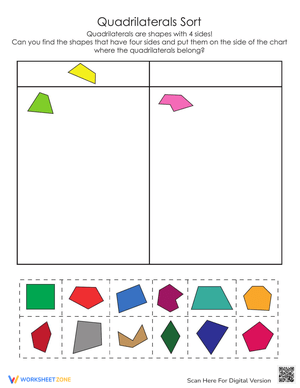
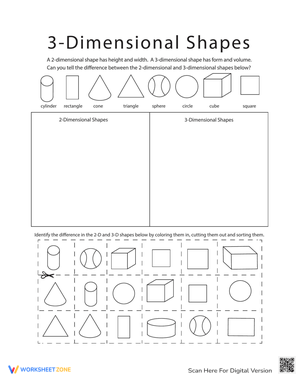
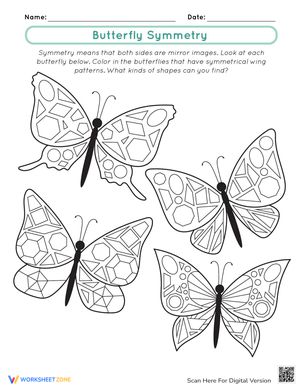
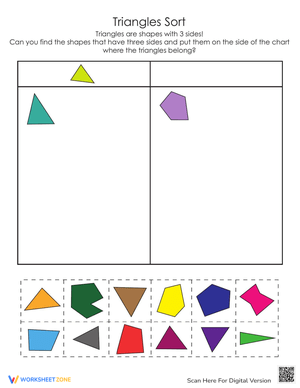
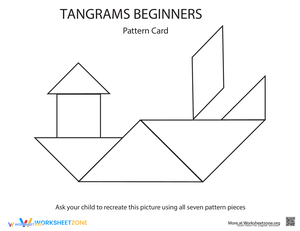
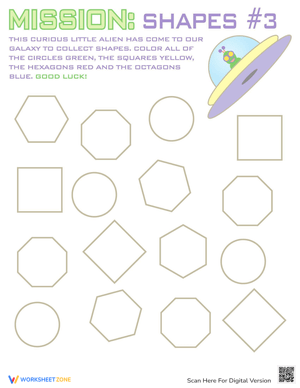
At this stage, students work with triangles, quadrilaterals, pentagons, and hexagons, and they identify each by counting sides and angles rather than by shape silhouette alone. This distinction matters more than it seems. A student who memorizes that a triangle looks a certain way can be thrown off by an unusual triangle orientation, while a student who has learned to count three sides and three angles handles any triangle variation with confidence.
Worksheets that vary shape orientation, size, and irregularity on purpose tend to produce stronger transfer than worksheets using only textbook-perfect shapes. If every quadrilateral on a page is a neat square or rectangle, students never practice the attribute-counting skill the standard is actually built on; they just practice shape recall. Mixing in irregular pentagons, skewed hexagons, and rotated triangles forces students to fall back on counting sides and angles, which is the reasoning skill 2.G.A.1 is designed to build.
Sequencing Practice From Simple Naming To Attribute Sorting With 2nd Grade Flat Shapes Worksheets
A useful worksheet sequence moves through three stages across a unit. Stage one is straightforward naming, where students label shapes they already recognize. Stage two introduces sorting tasks, where students group a mixed set of shapes by number of sides or number of angles rather than by shape name. Stage three moves into drawing tasks, where students must produce a shape that matches a written attribute description, such as a shape with four equal sides or a shape with three angles.
This progression matters for pacing. Jumping straight to attribute-based drawing without the sorting stage often leaves students guessing rather than reasoning. Give the sorting stage enough repetition, ideally across two or three short sessions, before introducing drawing tasks. Teachers who track which stage each student is working through can group flexibly for the next day's center rotation instead of moving the whole class forward at the same pace.
Classroom Implementation
For daily use, flat shapes worksheets fit naturally into short 10-15 minute math center rotations or bell-ringer warm-ups, which keeps this standard in regular rotation without requiring a dedicated full-period lesson. A simple weekly structure works well: one day of naming and sorting practice, one day of attribute-based drawing, one day paired with a hands-on shape tool, and one day used as a quick formative check.
Keep an answer key handy during centers so students can self-check sorting tasks, which frees you to circulate and support the small group working on drawing tasks, since that skill typically needs the most direct feedback. Save at least one worksheet set as a cold, unassisted check partway through the unit so you can see attribute reasoning without any scaffolding in place, rather than only ever assessing after a hands-on lead-in.
Frequently Asked Questions
1. What flat shapes should 2nd graders be able to identify by the CCSS standard?
Students should identify triangles, quadrilaterals, pentagons, and hexagons by counting their sides and angles rather than relying on shape silhouette alone, per CCSS.Math.Content.2.G.A.1.
2. How do flat shapes worksheets support the 2.G.A.1 standard specifically?
Effective worksheets go beyond naming shapes and include attribute-to-shape drawing tasks, since the standard requires both recognizing and drawing shapes from a given set of attributes.
3. How can teachers use these worksheets in small-group intervention?
A short diagnostic worksheet asking for both side and angle counts quickly reveals whether a student is confusing sides with angles, which lets you target the exact misconception in a small group.
4. How do flat shape skills connect to later Grade 2 geometry work?
Flat shape identification is a direct prerequisite for the partitioning-into-equal-shares work that comes later in the geometry cluster, since students need to recognize the shape before they can divide it accurately.













 Interactive Worksheet Maker
 Quiz Maker
 Word Search Maker
 Crossword Puzzle Maker
 Word Scramble Generator
 Sentence Scramble Generator
 Handwriting Worksheet Generator
 Name Tracing Generator
 Fill In The Blank Generator