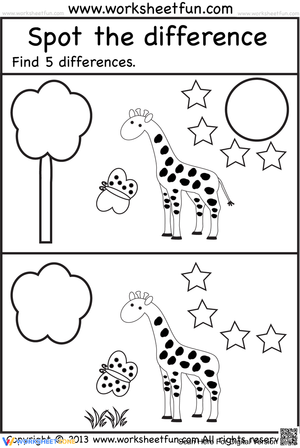
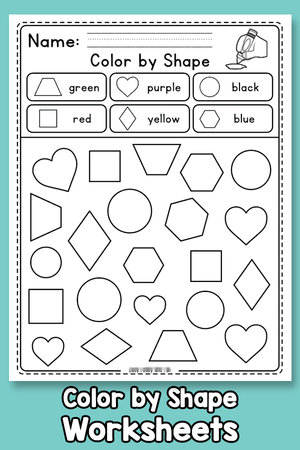
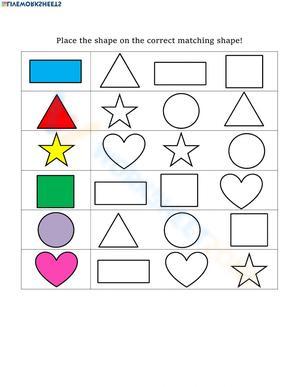
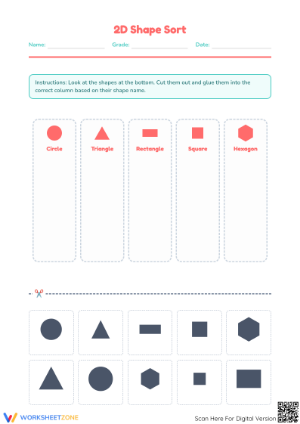
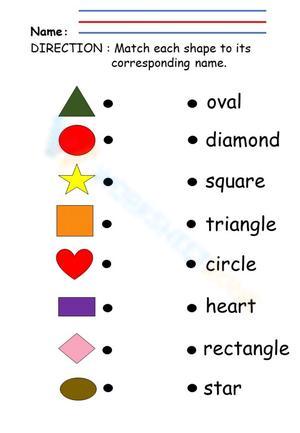
These 2nd grade geometry others printable worksheets address the full scope of Grade 2 geometry beyond basic shape naming — attribute-based classification, equal-share partitioning, rectangle tiling, and three-dimensional solid analysis. Teachers get a set of focused, independent practice resources that connect directly to lesson instruction without requiring extra preparation.
Concepts Across the Set
The core challenge in Grade 2 geometry is a conceptual shift most teachers don't anticipate as difficult: moving students from recognizing shapes by appearance to defining them by measurable attributes. A second grader who instantly calls something "a triangle" may still struggle to explain that any closed figure with exactly three sides and three angles qualifies — regardless of orientation, size, or proportion. Each worksheet in the set targets that shift in a different context.
The four main skill areas covered:
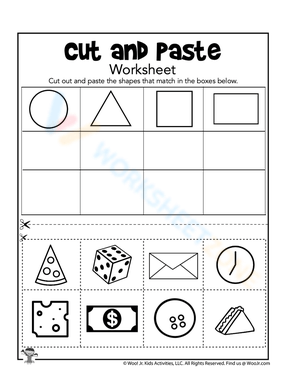
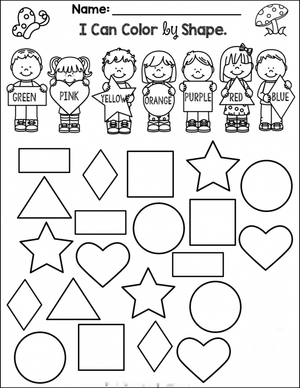
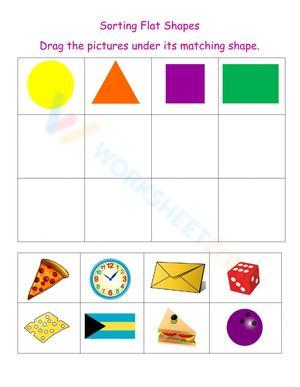
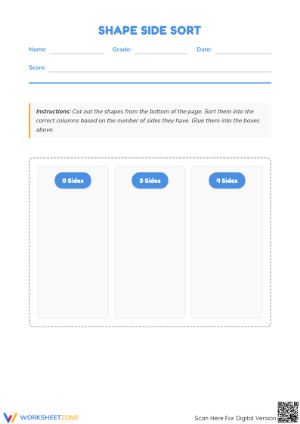
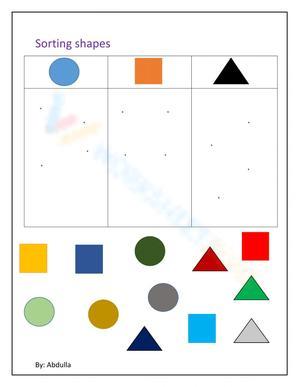
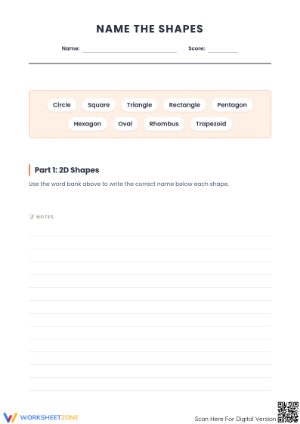
- Attribute analysis: Students count sides, angles, and vertices of two-dimensional figures and use those counts to classify and sort shapes. Activities include marking defining features on diagrams and grouping shapes by a stated attribute rather than by overall appearance.
- Equal-share partitioning: Students draw lines to divide circles and rectangles into halves, thirds, and fourths, then label the shares using precise vocabulary. Some worksheets ask students to determine whether a pre-divided figure shows equal or unequal parts.
- Rectangle tiling: Students partition a rectangle into rows and columns of same-size squares, then count the total. This builds the conceptual base for area before any formal formula is introduced, and it previews the multiplication arrays students will encounter in Grade 3.
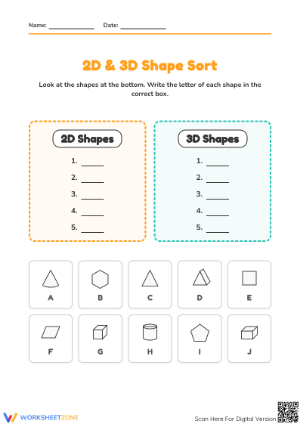
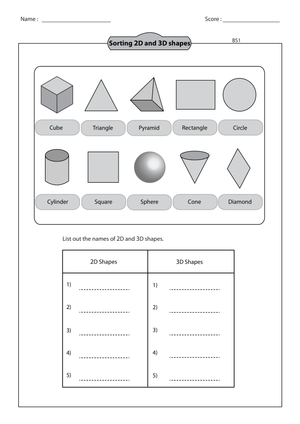
- Three-dimensional figure identification: Students name solid figures — cubes, rectangular prisms, cones, cylinders — and identify faces, edges, and vertices through matching and sorting tasks.
Frequent Student Errors Worth Watching For and Correcting
Thirds are reliably the hardest partitioning task at this grade. Students divide circles into halves easily because bisection is intuitive — fold once, and you have it. Dividing into fourths follows from halves: bisect again. Thirds require a different kind of spatial estimation with no natural midpoint to anchor the first cut. The most common error in student work is two lines that create one small share and two larger ones, with the student genuinely convinced the shares are equal because the lines look symmetric to them. Before students attempt thirds independently on paper, tearing a strip into three matching pieces and physically lining them up gives them a tactile reference for what equal means at this scale.
Orientation confusion is the other persistent pattern. A triangle with a flat base gets identified correctly almost every time. Rotate that same triangle so a vertex points left, and a real portion of second graders hesitate or say it is no longer a triangle. Worksheets that present shapes in non-standard orientations surface this confusion where teachers can address it — and it is better caught here than allowed to persist into Grade 3.
With 3D solids, students routinely confuse the count of faces with the count of edges. A cube has six faces, twelve edges, and eight vertices, and students frequently report eight or twelve faces because they are not tracking which attribute they are counting. Tasks that ask students to label all three attributes separately — rather than selecting from a list — reveal exactly where the confusion is.
Standard Alignment
These worksheets address all three standards in the CCSS 2.G.A cluster (Reason with shapes and their attributes):
- 2.G.A.1: Recognize and draw shapes with specified attributes, including a given number of angles or sides; identify triangles, quadrilaterals, pentagons, hexagons, and cubes. The attribute-sorting and shape-identification worksheets target this standard directly.
- 2.G.A.2: Partition a rectangle into rows and columns of same-size squares and count them to find the total. The tiling worksheets address this standard and establish the row-column structure that multiplication arrays depend on in Grade 3.
- 2.G.A.3: Partition circles and rectangles into two, three, or four equal shares; describe shares using halves, thirds, and fourths; recognize that equal shares of identical wholes need not have the same shape. This is the conceptually heaviest standard in the cluster and the one that most directly previews Grade 3 fraction work.
Smart Ways to Work These Worksheets Into Your Week
The partitioning worksheets make strong closure activities after whole-group instruction. When a lesson ends with eight or ten minutes left, a worksheet where students draw thirds into a rectangle gives immediate formative information — you can see at a glance who spaced their marks evenly and who defaulted to halves plus a leftover sliver. That data shapes the next day's small-group decisions without requiring any additional assessment tool.
For math centers, the attribute-counting worksheets pair well with physical pattern blocks or a small set of geometric solids. Students build a shape, count its attributes with the blocks in hand, then confirm the count on the worksheet. Moving from physical to paper this way reduces the cognitive load of working purely abstractly, which matters for seven- and eight-year-olds who are still developing spatial visualization.
The rectangle tiling worksheets work especially well in the second semester, after partitioning is established. Many teachers find these useful as 2nd grade geometry others printable worksheets to send home because parents can see exactly what the skill looks like — row-and-column square arrays are self-explanatory in a way that some math homework is not.
Adapting the Set for a Range of Learners
For students still consolidating basic shape recognition, the attribute-sorting tasks work better when shapes are presented one at a time with a labeled example visible alongside, rather than in a full sorting grid. If a worksheet shows six shapes at once and asks students to group them, covering all but one and working through them sequentially reduces the number of competing decisions at the same time.
Students who are ready to move beyond grade-level expectations can extend the partitioning worksheets by showing two different ways to partition the same rectangle into fourths. CCSS 2.G.A.3 specifically notes that equal shares of identical wholes need not have the same shape — most on-grade students won't encounter this idea until it is explicitly taught, but students who are ready can test it themselves by attempting non-congruent partitions of the same figure.
For students with pencil control challenges — a practical reality in second grade — offering a ruler for partitioning tasks removes frustration that has nothing to do with conceptual understanding. The 2nd grade geometry others printable worksheets in this set use shape sizes appropriate for this age range, but a ruler as a standard classroom tool for partitioning work prevents a motor skill gap from obscuring what a student actually knows about equal shares.
Frequently Asked Questions
Why do students have so much more difficulty with thirds than with halves or fourths?
Halves and fourths both emerge from repeated bisection — cut in half, then cut each half again. Thirds require estimating a proportion without any natural midpoint to anchor the first cut. Students who feel confident with halves often underestimate how different thirds feel until they attempt them. Physical experience with thirds — tearing a strip, dividing a row of objects into three equal groups — before independent paper practice makes a measurable difference in accuracy and reduces the frustration that shows up when students go straight to drawing.
Are the 3D geometry worksheets substantial enough to stand alongside the partitioning work?
The 3D solid worksheets are shorter tasks than the partitioning work, which reflects how most Grade 2 programs treat this strand: important but secondary to the partitioning and area-concept work. The worksheets address faces, edges, and vertices through matching and labeling tasks and are sufficient to support the CCSS 2.G.A.1 expectation for cubes. Teachers who want deeper 3D work typically supplement with physical solid models for hands-on exploration alongside the paper tasks.
How directly does this partitioning practice connect to what students will do with fractions in Grade 3?
The connection is direct. Grade 3 fraction standards (3.NF.A) expect students to understand a fraction as a number representing a part of a whole that has been partitioned into equal shares. The 2nd grade geometry others printable worksheets in this set build that foundational model — students who have labeled thirds, fourths, and halves on circles and rectangles in Grade 2 arrive at Grade 3 fraction instruction with a visual reference already in place. Teachers consistently report that early fraction work is more stable for students who did this partitioning work thoroughly the previous year.













 Interactive Worksheet Maker
 Quiz Maker
 Word Search Maker
 Crossword Puzzle Maker
 Word Scramble Generator
 Sentence Scramble Generator
 Handwriting Worksheet Generator
 Name Tracing Generator
 Fill In The Blank Generator