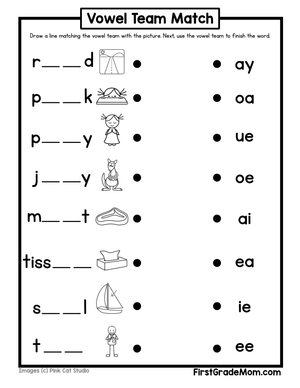
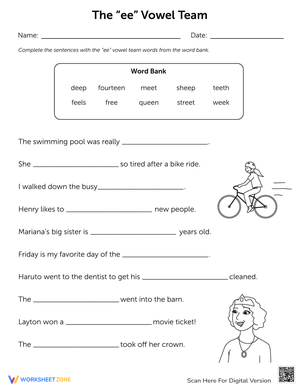
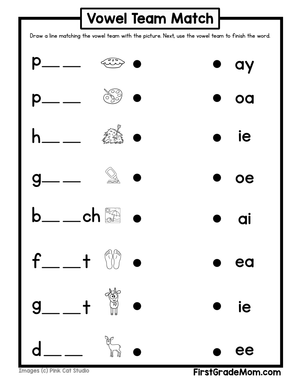
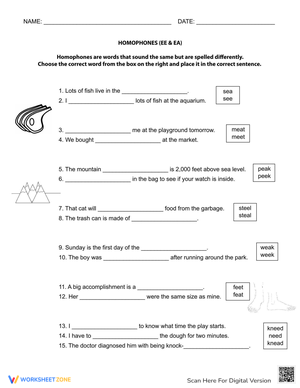
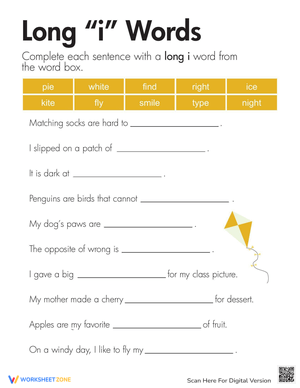
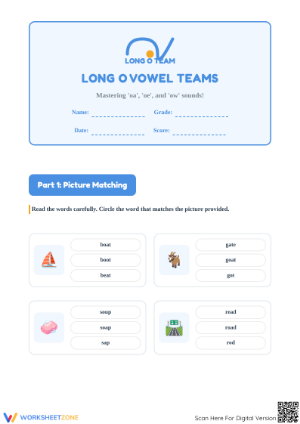
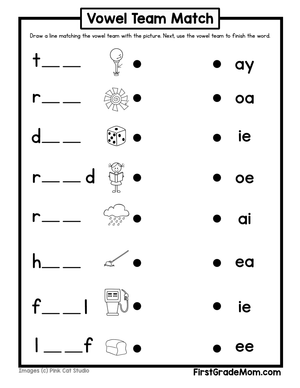
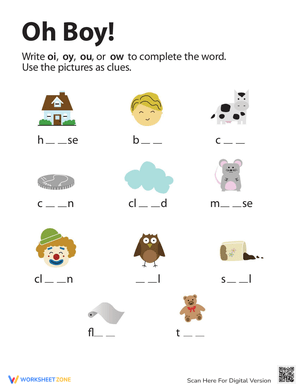
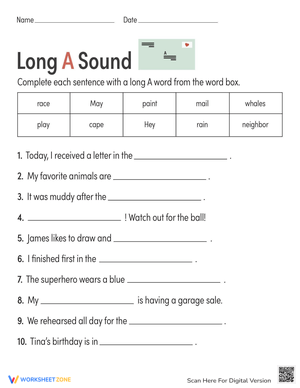
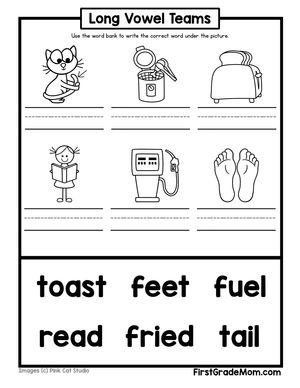
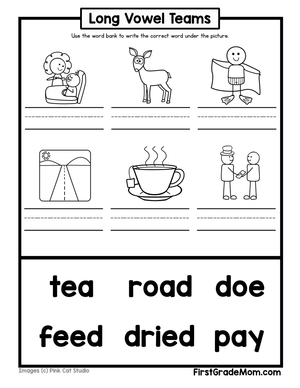
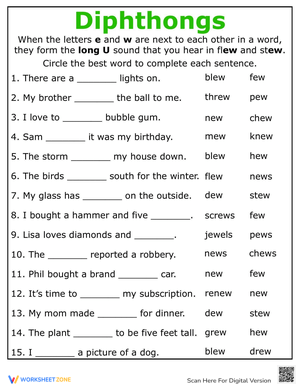
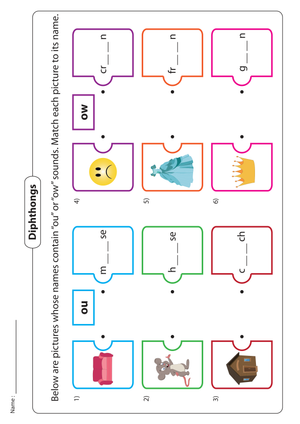
These 2nd grade vowel team worksheets give teachers a targeted practice set for one of the hardest conceptual shifts in early phonics — the moment when students have to stop treating vowels as solo letters and start reading two-letter combinations as a single sound unit. The set covers ai, ay, ee, ea, oa, oe, and ie, with each worksheet isolating one team before mixed review exercises fold them together.
The Specific Skills These Worksheets Target
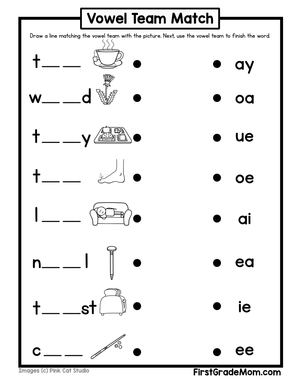
Each worksheet focuses on one vowel pair at a time, then adds cumulative review. The task formats include:
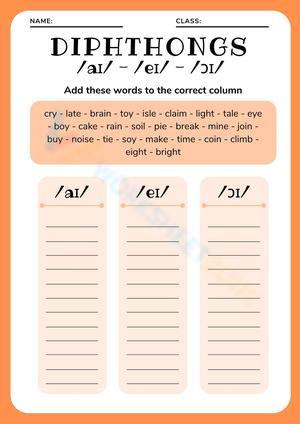
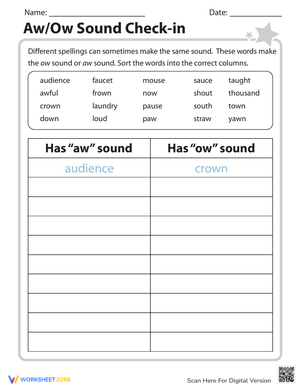
- Word sorts by vowel team, where students categorize words into columns and begin to see positional patterns rather than memorizing words individually
- Cloze sentences requiring a choice between two plausible spellings — rain or rayn, meet or mete — so students must apply phonics logic rather than recognize a familiar whole word
- Rewrite tasks where students correct a misspelled word by identifying the appropriate vowel team
- Short reading passages where the target team appears repeatedly in running text
That last format matters more than it might seem. A student who identifies a vowel team correctly on a word card can still misread that same team mid-sentence, because connected text draws more cognitive load than isolated word work. The passage tasks surface that gap before it shows up on a running record.
Mistakes Students Make That These Worksheets Help You Catch
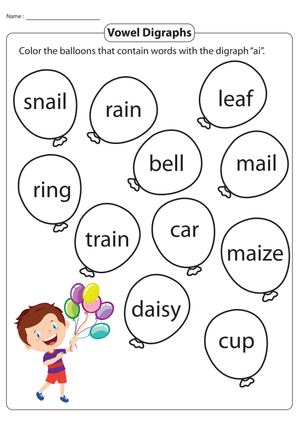
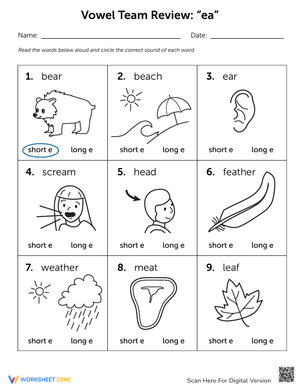
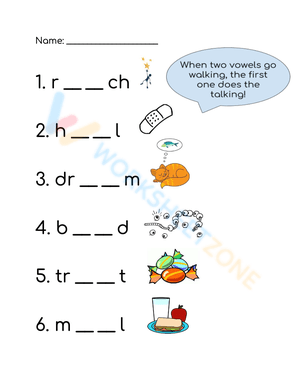
The most consistent error we see in second-grade writing is confusion between partner teams — specifically ai and ay. A student who spells play correctly will often write raine or rayn for rain, because they know the long a sound needs more than one letter but haven't internalized the positional distinction. The rule is actually reliable: ai sits inside a syllable, ay ends one. Teaching that directly outperforms the old "when two vowels go walking" rhyme, which breaks on ea alone — ea produces the long e in beach, the short e in bread, and the long a in great. Students who were taught the rhyme hit a wall with ea words, and the worksheets give them repeated practice noticing which sound a team is making in a given word rather than assuming one outcome.
Another predictable error: students treat ie as always making the long i sound because that's where the sequence usually starts — words like pie and tie. When they later encounter field or chief, they stall or miscue. The mixed-review worksheets surface this conflict earlier than most students would hit it on their own.
Building These Worksheets Into Your Weekly Phonics Rotation
These fit naturally into the ten-minute phonics warm-up that most structured literacy programs carve out at the start of the reading block, or into a small-group intervention slot. A practical sequence: introduce the vowel team explicitly with an anchor word and its sound, model two or three examples, then distribute the isolation worksheet for guided practice. The sort and cloze tasks hold up well as independent work while the teacher meets with a small group — the format keeps students on task without requiring additional teacher direction.
The 2nd grade vowel team worksheets also work well as Monday re-entry practice after a weekend gap. Spaced retrieval — returning to a pattern after a brief delay rather than massing all practice into a single session — builds more durable retention than extended phonics blocks do. Running a quick word sort from last week's team before introducing this week's new one takes about five minutes and reliably shows which students retained the pattern and which need another pass before moving on.
Standard Alignment
These worksheets address CCSS.ELA-LITERACY.RF.2.3.B, which requires second graders to know spelling-sound correspondences for additional common vowel teams. In classroom terms, that standard positions vowel teams as the central phonics focus of mid-to-late second grade — after students have consolidated CVC patterns, CVCe words, and basic r-controlled vowels from first grade. The placement reflects an instructional sequence that makes developmental sense: students who can already read make through CVCe logic are ready to extend that long-vowel knowledge to team patterns like ai and ay, which produce the same sound through a different orthographic mechanism.
Adjusting the Worksheets for a Range of Learners
For students who are still shaky on which vowel teams exist, start with the single-team isolation worksheets and limit the working word list to three or four high-frequency examples per team. Physical word-card sorts alongside the worksheet — where students handle and reposition cards — give them the kinesthetic repetition that pencil-and-paper practice alone doesn't always provide. A personal vowel-team reference chart kept in each student's reading folder gives them something to check during independent writing without needing to ask the teacher to confirm every spelling.
Students who have already internalized the common teams gain the most from the mixed-review worksheets and the passage-level tasks, where the challenge shifts from pattern identification to fluid reading across multiple team words in the same sentence. For these students, adding a timed re-read of the passage — tracking smoothness across two reads — turns a phonics worksheet into a fluency task without changing the material itself.
The 2nd grade vowel team worksheets also lend themselves to partner work: one student reads a cloze sentence aloud while the other selects the correct vowel team spelling, then they switch roles. That verbal processing — saying the word, hearing it, then committing to a spelling — reinforces the sound-symbol connection more durably than silent individual practice does.
Frequently Asked Questions
Which vowel teams should I introduce first?
Start with ee and oa — both represent one consistent sound with very few exceptions, so students build confidence quickly. Follow with ai and ay as a pair, so students learn the positional distinction from the start rather than internalizing ai alone and then needing to revise that understanding when ay appears. Save ea for after the other teams are stable; its three possible sounds make it the most demanding team in the set and the one most likely to create confusion if introduced too early.
How are vowel teams different from diphthongs?
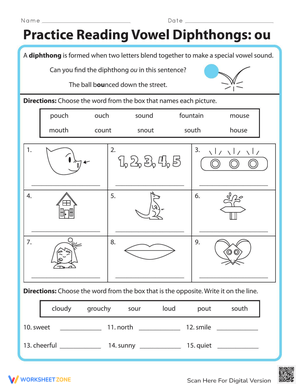
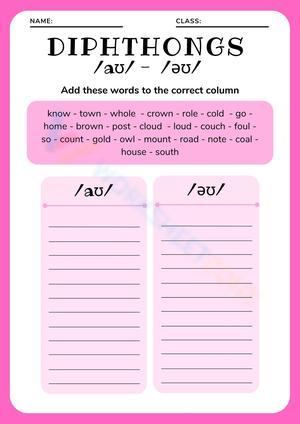
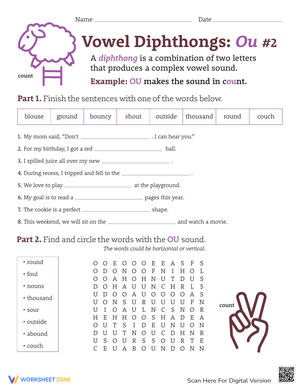
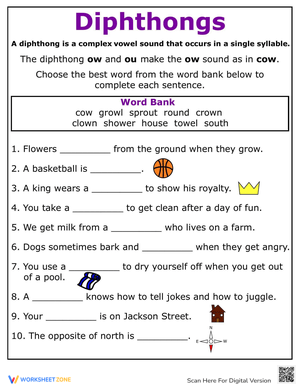
A vowel team produces one steady sound throughout — the ee in feet doesn't shift. A diphthong glides from one vowel position to another within the same syllable, the way oi moves in coin or ou shifts in cloud. Both involve two vowel letters, but the mouth movement is different. For second graders, the distinction usually doesn't need a formal label — what matters is that students hear and represent each sound accurately.
What do I do when a student keeps confusing ea and ee?
The 2nd grade vowel team worksheets include comparison tasks that put ea and ee words side by side, which is often the fastest way to make the contrast visible in context. If a student is still mixing them after repeated practice, try color-coding — marking every ea in one color and every ee in another across a short passage — before returning to the worksheet format. The visual separation often breaks a confusion pattern that undifferentiated black-and-white text sustains.