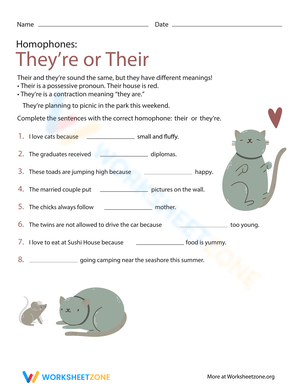
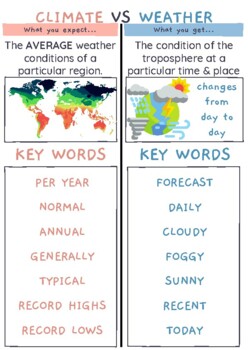
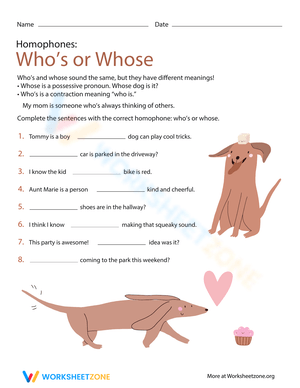
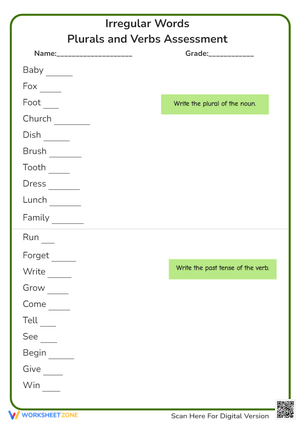
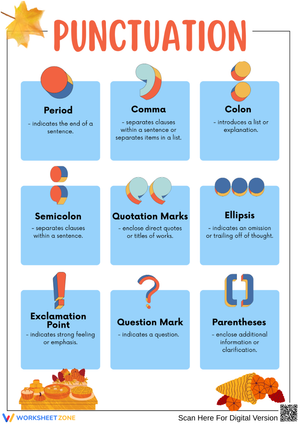
These 2nd grade punctuation worksheets resources cover every mechanic in L.2.2 — end marks, commas in dates and letter greetings, and apostrophes in contractions and possessives — organized so teachers have ready-to-print practice for each point in the second-grade writing sequence. Second grade is where punctuation stops being a single rule ("put a period at the end") and becomes a system students have to hold in memory while also managing spelling, handwriting, and meaning. Each worksheet isolates one mechanic and gives students enough repetitions to internalize it before the next rule enters the picture.
What Each Worksheet Covers
The set addresses five skill areas, each practiced in multiple formats — identification, correction, and original production — so students encounter the same rule from different angles rather than repeating the same task structure every time.
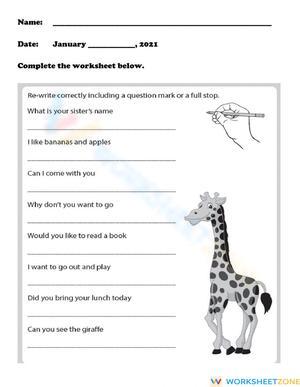
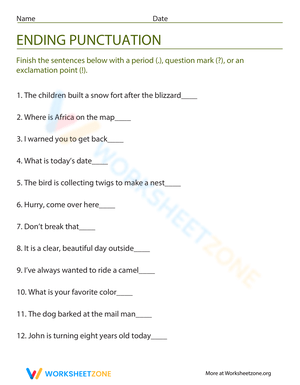
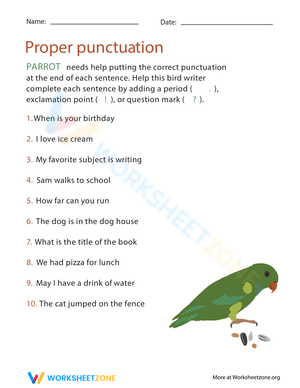
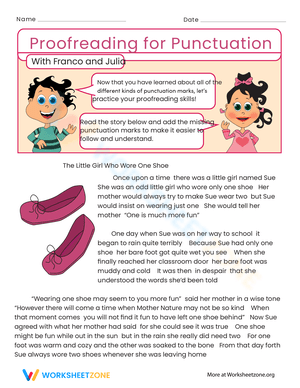
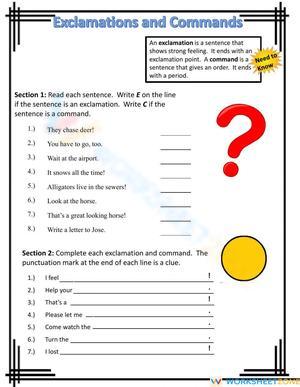
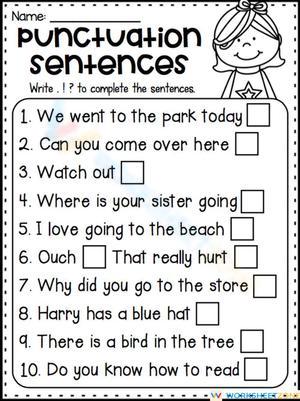
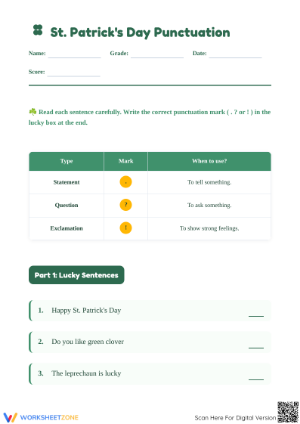
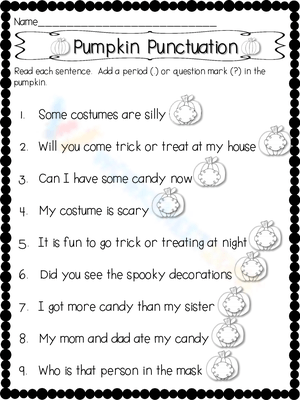
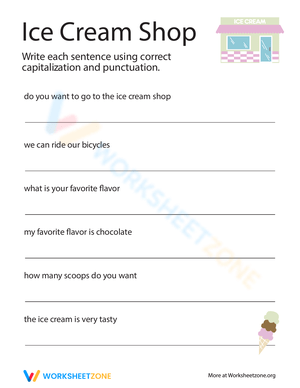
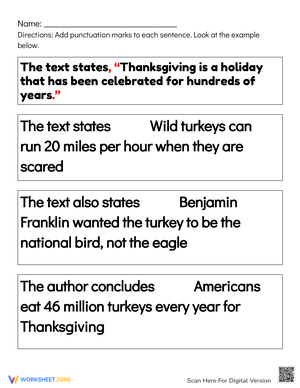
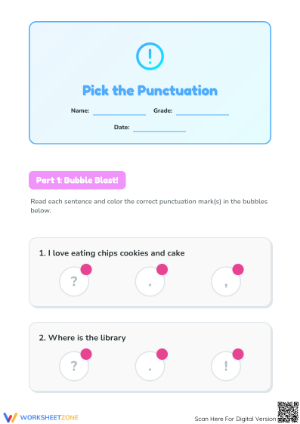
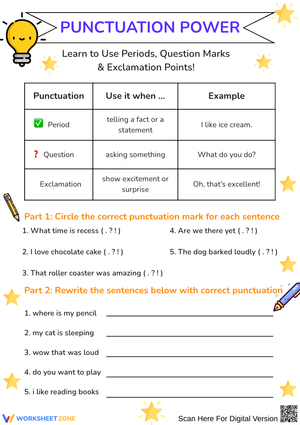
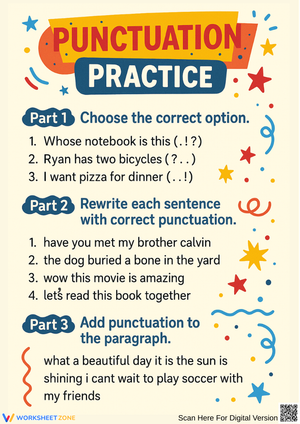
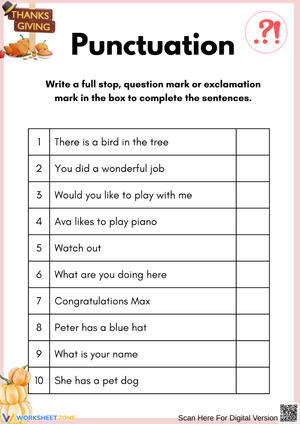
- End marks: Students sort sentences by end punctuation type, add missing marks to unpunctuated text, and rewrite sentences where the wrong mark was used. The exclamation point gets its own dedicated worksheet because second graders tend to overuse it the moment they discover it — the first week, everything becomes urgent.
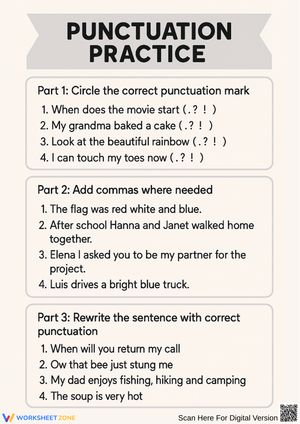
- Commas in dates: Editing exercises built around common placement errors, plus a brief daily-practice format that mirrors the morning routine of writing the date on the board.
- Commas in letter greetings and closings: Partially completed letter templates where students add the comma after the greeting and closing, followed by a short original letter where they apply the same placement on their own.
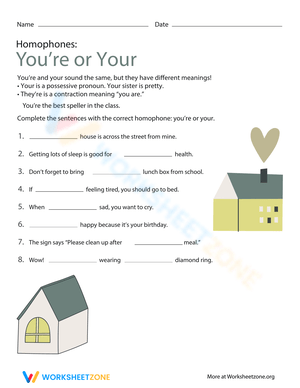
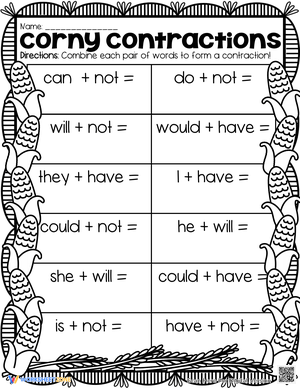
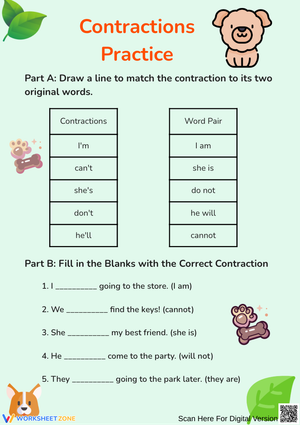
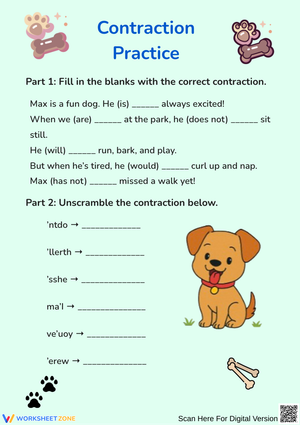
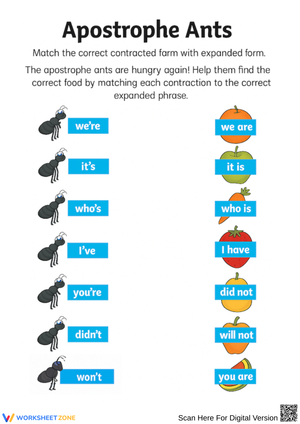
- Contractions: Matching, fill-in, and rewriting tasks that run in both directions — converting word pairs like "she will" and "do not" into contractions, and expanding contractions back into full form.
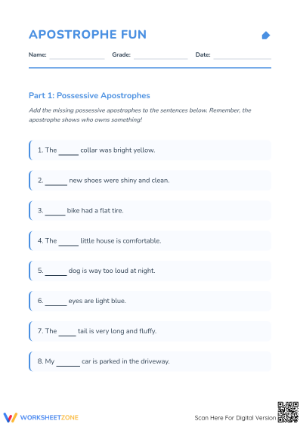
- Possessives: Side-by-side comparison exercises that pair plural and possessive forms on the same worksheet, because the distinction between "the cats ran" and "the cat's bowl" is where most second graders need the longest runway.
Student Error Patterns to Anticipate Before You Teach Each Skill
The apostrophe section produces the most durable errors. Once students learn that an apostrophe signals ownership, a significant number start placing one before every final s — "the three cat's sat on the mat," "her two friend's came over." This isn't carelessness; it's overgeneralization. Students learn a rule and apply it broadly, which is developmentally typical at this age. Worksheets that build in a meaning-check before the punctuation question — "Is something being owned here, or are there simply more than one?" — interrupt the pattern more reliably than re-explaining the rule from the front of the room. Each possessives worksheet requires students to answer that question before they mark anything.
Contraction apostrophe placement produces a quieter but predictable problem: students who know that "don't" needs an apostrophe often write "do'nt." The mental image is "apostrophe somewhere in the middle," so they guess. Pointing students to the exact letters being dropped — the o in "not" — before they write contractions reorients that instinct. The contractions worksheets ask students to circle the dropped letters first, then place the mark.
End-mark errors in free writing look different from end-mark errors on a practice worksheet. A student who marks end marks correctly in a morning exercise may write three sentences in their writing journal with no punctuation at all. That gap isn't a sign they don't know the rules — it's the cognitive cost of composing. Spelling, handwriting, sentence ideas, and story sequence are all running simultaneously, and punctuation gets deprioritized. The effective fix is a structured editing pass: students draft first, then read back through looking only for end marks. That separation of drafting and editing is what moves worksheet skill into actual writing behavior.
Lesson-Planning Strategies That Get the Most From the Set
When a 2nd grade punctuation worksheets is built into a planned weekly cycle rather than handed out as a one-off assignment, the skill shows up in student writing at a noticeably higher rate. A useful pattern is the three-touch week: one worksheet on Monday as a warm-up during the settling-in minutes before morning meeting, a second on Wednesday as a brief formative check, and a short editing task on Friday where students apply the same rule to a sentence or two from their own writing journal. That sequence — introduction, reinforcement, application — does more than completing three same-skill worksheets back-to-back in a single sitting.
The end-mark worksheets pair naturally with a quick punctuation hunt. After students complete the worksheet, they spend about eight minutes finding the same end mark in a familiar picture book, copying one sentence, and writing a phrase that explains why the author used it. "The author used an exclamation point because the character was scared" is a different cognitive event than circling the correct answer on a prepared exercise. Students who make that authorial connection start treating punctuation as a writing choice rather than a school rule.
For the letter-writing worksheets, give the letter a real destination. Students who write to a specials teacher or the school librarian check their greeting comma themselves before folding the paper, because the letter is actually going somewhere. That shift from correctness-for-the-grade to correctness-for-the-reader is worth the small logistical step.
Standard Alignment
The worksheets address CCSS L.2.2, the standard requiring second graders to demonstrate command of English punctuation conventions in writing. Two sub-standards drive the core content: L.2.2b (commas in greetings and closings of letters) and L.2.2c (apostrophes in contractions and frequently occurring possessives). These two skills are what's genuinely new at grade 2 — students have been working on end marks since first grade, so the end-mark worksheets function as consolidation and extension rather than first introduction.
In classroom sequencing, L.2.2b fits most naturally inside a mid-year letter-writing unit because the predictable structure of a friendly letter gives comma placement a visible home. L.2.2c typically runs across the second half of the year — contractions first, since students encounter them constantly in their independent reading, and possessives last, because the conceptual difference between plural and possessive takes longer to stabilize. The worksheets follow that same instructional order.
Adjusting the Set for a Range of Learners
Students who need more support with end marks benefit from a recognition-only step before any production work begins. Have them read a printed paragraph and mark every end mark with a colored pencil — one color per mark type — before they're asked to supply any on their own. That step makes the marks visible as a reading experience, which lowers the pressure of the production tasks that follow.
Students who move quickly through the end-mark and comma work are ready for the possessives content earlier than the class average, and they get the most from an extension that uses their own writing. Pull a paragraph from a student's journal, ask them to find every place an apostrophe should or shouldn't appear, and mark it before a brief conference. That task is harder than completing a prepared exercise because students have to hold the rule and apply it to text they produced — which is the actual target.
For English learners, the letter-writing worksheets may need an oral language preview before the punctuation instruction lands. The greeting-and-closing structure is a cultural-linguistic convention, not an obvious form, and students who haven't encountered it in their home language need to hear it read aloud and see multiple examples before comma placement has a context to attach to. A 2nd grade punctuation worksheets works best with ELL students when the example sentences draw on familiar vocabulary — names students recognize, common classroom objects, everyday events — so the punctuation question isn't competing with unfamiliar word meanings.
Frequently Asked Questions
Why do students who score well on punctuation worksheets still ignore punctuation in their own writing?
Recognition and production are different skills, and composing a text is cognitively heavier than completing a worksheet exercise. When a student is managing spelling, handwriting, sentence ideas, and story sequence at the same time, punctuation moves to the background. The effective response is to separate the tasks: students draft first, then return with a specific editing lens for end marks. That habit, practiced consistently during writing workshop, closes the gap between worksheet performance and what actually appears in the writing journal.
In what order should comma rules be introduced across the year?
Dates first — students write the date daily, so the morning routine creates natural repetition before any formal instruction begins. Commas in a series come next, typically during an informational writing unit in late fall or early winter, because list-making appears there organically. Letter commas are best introduced mid-year inside a dedicated friendly letter unit, where the full format gives the placement a visible reason to exist.
How do I address the apostrophe-before-every-s habit?
This is the most consistent apostrophe error in second grade, and it comes from overgeneralizing the ownership rule. A meaning-check routine does more than re-explanation: before any apostrophe goes down, the student asks aloud, "Is something being owned here?" Pair that routine with the side-by-side comparison exercises in the possessives worksheets — seeing "three cats ran away" directly next to "the cat's bowl was empty" on the same worksheet makes the distinction concrete faster than a lecture does.
Can these worksheets serve as assessment tools, or are they practice only?
Both, depending on when they appear in the instructional sequence. Used before instruction, each worksheet is a diagnostic that shows what students already know. Used during a unit, it's formative practice. Used again after the skill has been taught and reinforced, it functions as a quick performance check. A 2nd grade punctuation worksheets does different work depending on where it lands in the lesson cycle, and that flexibility is worth building into unit planning.












 Interactive Worksheet Maker
 Quiz Maker
 Word Search Maker
 Crossword Puzzle Maker
 Word Scramble Generator
 Sentence Scramble Generator
 Handwriting Worksheet Generator
 Name Tracing Generator
 Fill In The Blank Generator