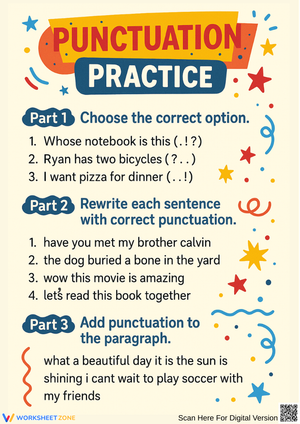
These ending punctuation worksheets for 2nd grade give teachers a focused set of materials for the three terminal marks — period, question mark, and exclamation point — built around the specific confusion patterns that show up when seven- and eight-year-olds are learning to close a sentence with intention. Each worksheet targets one or more of those marks through a distinct format, so the set moves between skill levels and lesson structures without repeating itself.
The Specific Skills Targeted
The core activity formats across the set are:
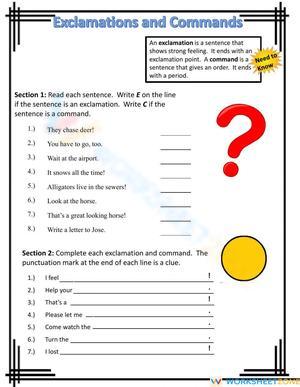
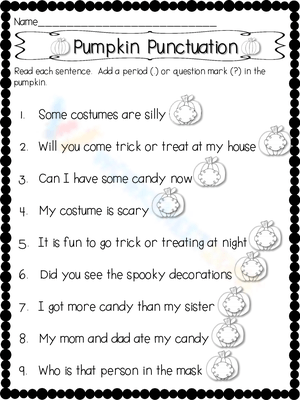
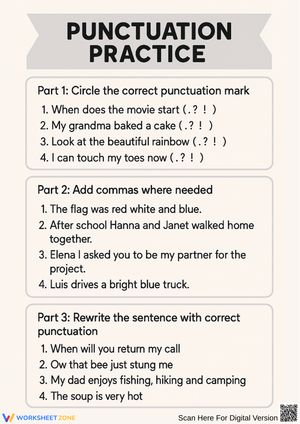
- End-mark identification: Students circle or underline the correct terminal mark on completed sentences, building the habit of reading punctuation as meaning rather than decoration.
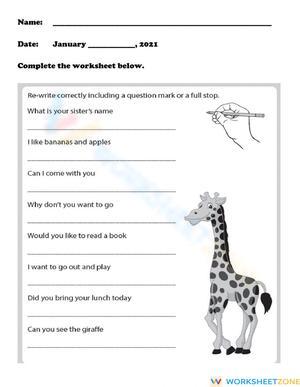
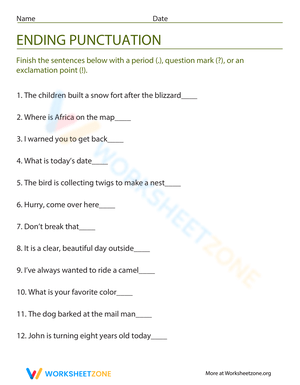
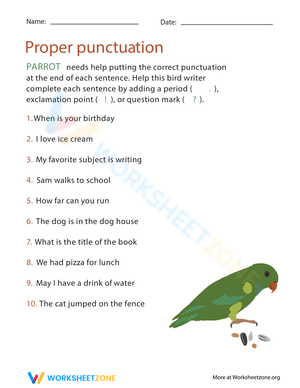
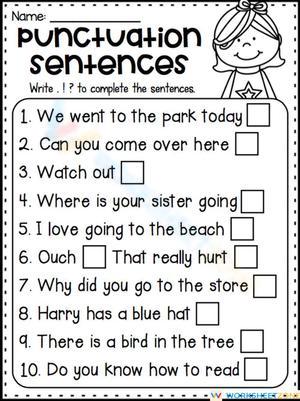
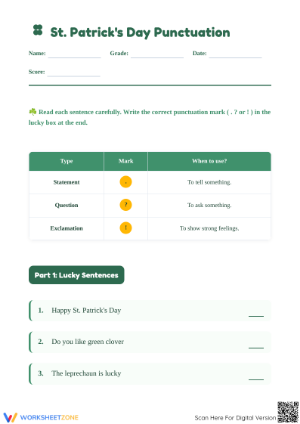
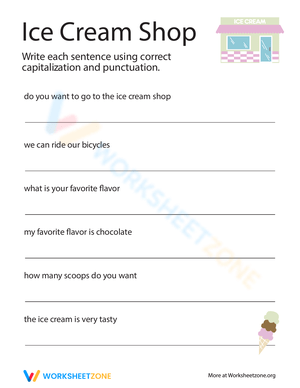
- Mark placement on stripped sentences: Sentences without any end punctuation are presented; students supply the correct mark based on structure and tone.
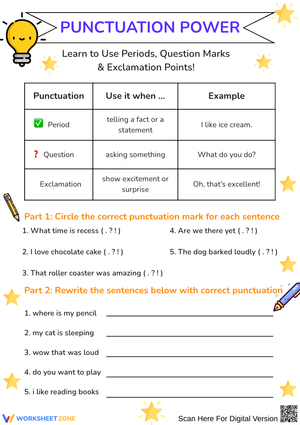
- Declarative vs. exclamatory distinction: Students decide whether a statement carries enough emotional force for an exclamation point or whether a period fits — a judgment call that requires close reading of context.
- Question-word recognition: Students identify interrogative sentence openers and apply question marks. Some exercises include embedded question words to surface a common mixing error described in the next section.
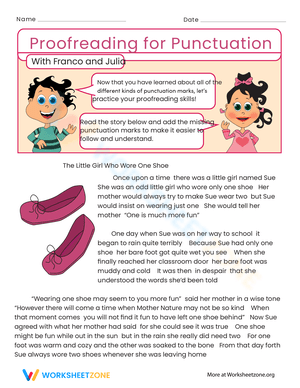
- Proofreading passages: Short paragraphs at a second-grade reading level appear with all end punctuation removed. Students annotate the text, locating sentence boundaries and adding the appropriate mark at each one.
Frequent Student Errors Worth Anticipating
The most predictable pattern is exclamation point overuse. Once second graders discover that punctuation can carry feeling, the exclamation point tends to migrate onto nearly every sentence in their journals. The worksheets give teachers a low-stakes moment to address this before it hardens into a writing habit.
The trickier error happens when a question word appears inside a sentence that is not itself a question. A student who correctly punctuates "What time is it?" will often write a question mark after "I don't know what time it is." — because they see what and apply their question-word rule without processing the full sentence structure. This is a conceptual gap, not carelessness, and it shows up consistently in student work at this level. The exercises that include embedded question words are built to surface exactly this confusion so teachers can address it directly rather than discovering it only in the next writing unit.
How to Fit These Worksheets Into Your Teaching Week
The most reliable entry point is the five minutes directly after morning meeting, before students open their writing notebooks. A short worksheet — three to five sentences requiring end marks — wakes up grammar awareness without eating into the writing block. That kind of daily repetition does more for retention than a single forty-minute grammar lesson.
For literacy centers, the proofreading passages run without any teacher presence. Students read, annotate, and check their answers against a key kept in the center folder — which catches errors in the moment rather than a day later when the teaching opportunity is gone.
Teachers who use these ending punctuation worksheets for 2nd grade as exit tickets at the end of a writing block get immediate, actionable data. A three-sentence proofreading task takes less than four minutes to complete and shows exactly which students are placing marks confidently, which are guessing, and which still cannot locate sentence boundaries — information that shapes the next day's mini-lesson directly.
Standard Alignment
CCSS.ELA-LITERACY.L.1.2b — "Use end punctuation for sentences" — is the standard these worksheets directly address. Although the code appears under Grade 1, it carries forward as a consolidation expectation in second grade, where students are expected to apply end punctuation automatically during sustained writing. Second graders who are still uncertain about end marks are not behind on a Grade 2 objective; they are closing a gap from the prior year, which matters for how teachers frame any re-teaching.
The broader CCSS.ELA-LITERACY.L.2.2 standard treats end punctuation as embedded within authentic writing practice. Using these worksheets alongside writing workshop instruction addresses both dimensions: the isolated skill repetition that builds automaticity, and the applied fluency that sustained composition demands.
Adapting the Set for Mixed-Ability Classrooms
Students who are still consolidating reading fluency sometimes struggle with the proofreading passages because decoding the text consumes their working memory before they reach the punctuation task. For those students, the stripped-sentence worksheets — where each sentence is short and presented in isolation — let the grammar work happen without the reading load working against it. The proofreading format can be introduced once their fluency has steadied.
Students who have already internalized all three marks and apply them correctly in independent writing need extension rather than review. A straightforward option: after completing each worksheet normally, those students rewrite two of the sentences in a different mode — turning a statement into a question, or flattening an exclamatory sentence into a calm declarative — and punctuate the revised version. The original task still gets done; the extension adds flexible thinking without requiring separate materials.
These ending punctuation worksheets for 2nd grade also work for first-grade students who are ready to push past basic period use, and for third graders who need a quick reset before a grammar assessment. The skill is more grade-transferable than its label suggests.
Frequently Asked Questions
How do I help students decide between a period and an exclamation point?
The clearest method is a read-aloud test. Before writing any mark, students read the sentence to themselves the way they would actually say it out loud. A sentence delivered in a flat, informational voice takes a period. One they naturally want to shout or emphasize hard takes an exclamation point. This shifts the decision from a rule students have to recall to a judgment call rooted in spoken language — something they already understand intuitively before the grammar lesson even begins.
What order should these worksheets be used in?
Start with single-mark focus: one worksheet on periods, one on question marks, one on exclamation points. Once students show confidence with each mark in isolation, move to mixed exercises that require choosing between all three. Proofreading passages come last — they require students to locate sentence boundaries and choose marks simultaneously, which is the hardest combination in the set. Moving to proofreading before students have the three marks sorted individually tends to produce guessing rather than genuine application.
Can these worksheets double as assessments?
The proofreading passages work well for formative assessment when administered without an anchor chart visible. What a student marks — including which mark they choose incorrectly, and whether they miss boundaries entirely — tells more about actual understanding than a multiple-choice question does. An ending punctuation worksheets for 2nd grade used as a quick exit task generates classroom data you can act on the next morning, not just a score to record in a gradebook.












 Interactive Worksheet Maker
 Quiz Maker
 Word Search Maker
 Crossword Puzzle Maker
 Word Scramble Generator
 Sentence Scramble Generator
 Handwriting Worksheet Generator
 Name Tracing Generator
 Fill In The Blank Generator