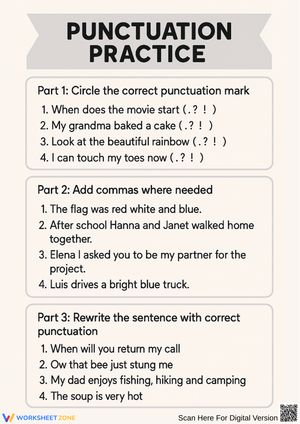
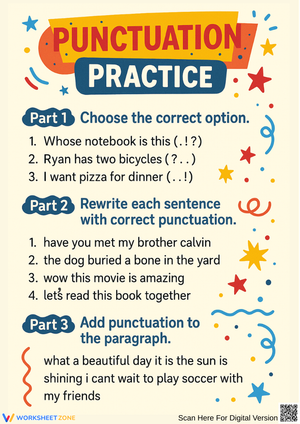
These 2nd grade commas printable worksheets give teachers a focused set of standalone resources covering the four comma conventions second graders are expected to master: separating items in a series, placing a comma between the day and year in dates, separating a city from a state or country, and punctuating the greeting and closing of a friendly letter. Each worksheet targets one rule so students build accuracy with a single pattern before encountering the next.
The Specific Skills Targeted in Each Worksheet
The series comma gets the most instructional time at this level, and the exercises reflect it — students underline list items, insert missing commas, and rewrite improperly punctuated sentences. The difficulty shifts noticeably when list items are phrases rather than single nouns: "We played soccer, jumped on the trampoline, and ate dinner outside" requires the same rule but more syntactic awareness than "apples, oranges, and grapes." All series exercises use the Oxford comma consistently, giving students one reliable pattern rather than introducing exceptions before the rule itself is secure.
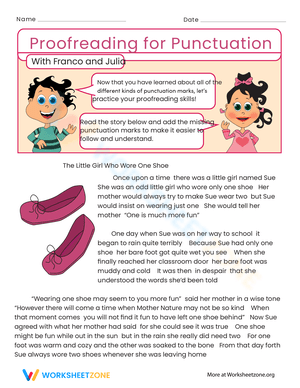
Date and city-state exercises use parallel structures, which makes them natural to teach in sequence. Students correct improperly punctuated dates and then apply the rule in sentence frames with personal information — birthdays, hometowns — so the convention connects to something meaningful rather than sitting in memory as an abstract format. The friendly letter exercises follow the same correction-then-application structure: students fix a letter with missing commas, then write a brief sentence explaining each correction. That explanation step, even one sentence, shifts the task from recognition to retrieval, which is where retention actually starts to hold.
Frequent Student Errors Worth Watching For and Correcting
The most persistent error after series-comma instruction isn't omission — it's over-application. Students who have practiced placing commas between list items start inserting them between a subject and its verb. You'll see "The brown dog, ran across the yard" from a student who identified the noun phrase, sensed that something was coming next, and applied the new mark reflexively. The 2nd grade commas printable worksheets include sorting exercises where students decide whether a comma is needed or unnecessary — and that format is exactly where over-application becomes visible. Insert-the-comma practice alone never surfaces the problem.
Comma splices — joining two complete thoughts with only a comma — show up mainly in writing from stronger students who are beginning to combine ideas. A student who writes "I ran to the park, it was really fun" has made a legitimate compositional move but reached for the wrong mark. At this grade level the most reliable correction is reading aloud: students who hear two distinct, complete thoughts usually self-correct when asked to identify where one idea ends and the next begins.
How to Work These Worksheets Into Your Lesson-Planning Rotation
Four minutes at the start of writing workshop — before students open their notebooks — is enough time to complete one worksheet and discuss two answers as a class. That brief discussion surfaces something insert-the-comma exercises alone miss: students who marked the right answer often cannot explain the rule they applied, and that gap is worth finding before you move to the next convention. Introduce the series rule first, spend three or four days on it, then move to dates, and save the friendly letter convention for when the class reaches letter-writing in their writing unit.
These 2nd grade commas printable worksheets also work well in writing centers because they do not require a teacher to be present. One worksheet per rotation provides meaningful independent practice. Students who finish early can write two original sentences demonstrating the rule — a quick extension that requires no additional materials and gives you something concrete to look at during a writing conference.
Standard Alignment
The friendly letter worksheet aligns directly to CCSS.ELA-LITERACY.L.2.2.B, which requires second graders to use commas in greetings and closings of letters — the one comma rule explicitly named at this grade level. The series and date conventions, while standard practice in second-grade classrooms, are formally specified in third-grade standards: L.3.2.B covers commas in addresses, and broader punctuation conventions continue through L.3.2. Teachers using standards-based grading should note this distinction when deciding which comma skills count toward grade-level mastery versus skills that preview third-grade expectations. Most district scope and sequence documents include series and date commas at second grade as introductory instruction precisely because the formal accountability arrives in third.
Adapting These Worksheets for Mixed-Readiness Classrooms
Students who are still developing sentence-level reading fluency benefit from hearing sentences read aloud before they punctuate. The "tap the pause" strategy — students read each sentence aloud and physically tap their desk where they sense a natural break — gives these students a physical anchor for a rule that can otherwise feel abstract. Working through the first two items together before releasing students to work independently keeps the cognitive demand in a productive range without reducing the rigor of the task itself.
Students who move through these worksheets quickly are ready for an inverse task: give them a short paragraph with no commas and ask them to insert every comma that belongs, then write a one-sentence justification for each mark. That task is harder than a standard insert-the-comma exercise because students must scan for multiple rule types simultaneously. For students who are over-applying the comma — writing "The cat, sat on the mat" — a removal exercise works better than more insertion practice. Asking them to cross out every comma that does not belong requires a different kind of reasoning than placing correct ones, and it tends to break the over-application habit more effectively than additional drilling of the rule.
Frequently Asked Questions
Are these worksheets appropriate for students above or below second grade?
The 2nd grade commas printable worksheets in this set work for first graders who have strong sentence-level reading fluency and are already writing in complete sentences. For third graders, the series and date worksheets function as a quick diagnostic — more than two errors on the series worksheet signals that the foundational rule needs re-teaching before moving to more complex comma work such as punctuating compound sentences or introductory clauses.
How do I use these for formative assessment rather than just practice?
Each worksheet serves as a formative check when used after instruction rather than during it. After two or three days of series-comma teaching, have students complete the series worksheet independently — no partner work, no discussion. Four or fewer correct out of eight items tells you the student needs more guided practice before applying the rule independently in writing. That threshold is more actionable at this level than a percentage grade.
What should early finishers do when they complete a worksheet during independent work time?
Ask them to write three original sentences — one for each comma rule covered — and then attempt a single sentence that uses two different comma rules at once. That last task is harder than it sounds. It requires students to plan their sentence structure before writing, which is precisely the kind of intentional thinking that transfers to independent writing better than completing a second worksheet would.












 Interactive Worksheet Maker
 Quiz Maker
 Word Search Maker
 Crossword Puzzle Maker
 Word Scramble Generator
 Sentence Scramble Generator
 Handwriting Worksheet Generator
 Name Tracing Generator
 Fill In The Blank Generator