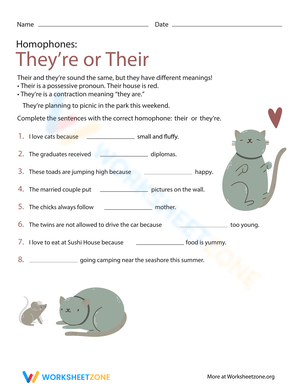
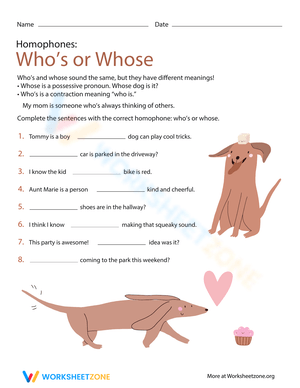
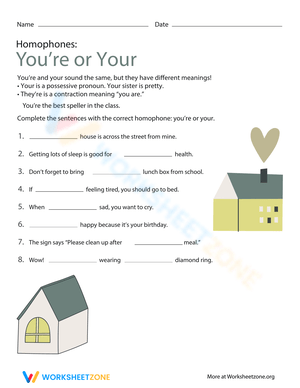
These apostrophes pdf worksheets for 2nd grade give teachers a focused set of resources that keeps contraction practice separate from possessives work — a distinction that matters because both rules land on students within the same stretch of the school year, and they blur together quickly when they're always taught side by side.
Skills These Worksheets Build
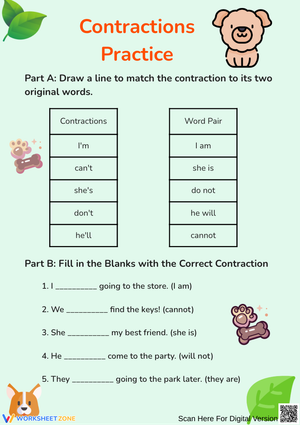
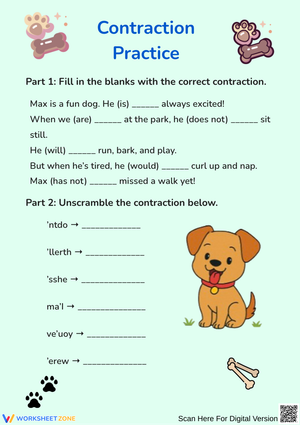
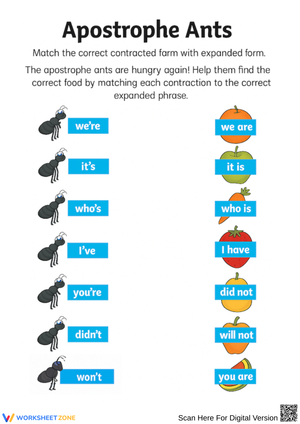
Contraction worksheets ask students to do two things: break a contraction into the two words it contains, then reverse the process by collapsing a word pair into shortened form. That bidirectional practice matters. Students who can identify "can't" as a contraction without being able to build one from "can not" are pattern-matching, not applying a rule. The possessives worksheets move through a specific sequence — identifying the owner in each sentence, then applying apostrophe-s to mark ownership, then combining both steps in rewriting tasks that increase in sentence complexity.
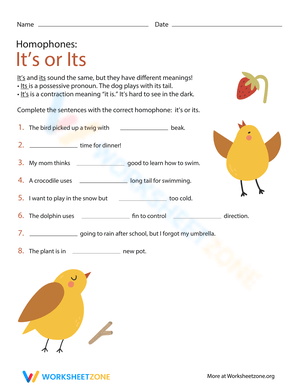
One worksheet handles "it's" versus "its" as a standalone lesson. That pairing undercuts the possession rule students have just learned, so it earns its own practice rather than getting folded into the regular possessives work. Skills across the full set include:
- Identifying contractions and writing the full word pairs they replace
- Building contractions from given word pairs
- Adding apostrophe-s to mark singular possession in rewritten phrases
- Sorting mixed sentences by apostrophe function — contraction or possessive
- Correcting sentences where the apostrophe is absent, misplaced, or incorrectly added to a plain plural
Frequent Apostrophe Errors Worth Catching Early
The most common contraction error at this grade level is not the one teachers expect. Students who read "didn't" fluently and understand it means "did not" still write "did'nt" — because they feel the boundary between the base word and "not" and put the mark there, rather than at the spot where the letter was removed. The apostrophe marks absence, and the absence in "didn't" is the "o" inside "not," not the gap between the two words. Worksheets that have students underline the specific dropped letters before placing the apostrophe address this directly and consistently reduce that error in student writing.
The second pattern worth anticipating is the rogue apostrophe in plurals. Once students learn that "'s" signals ownership, they apply that logic to any word ending in "s" — including plain plurals. "The dog's ran to the fence" appears in student writing from February onward in most second-grade classrooms. The contrast items in the correction worksheets — where students must decide whether a noun owns something or whether there are simply multiple of it — are what close that gap. Identification drills alone don't do it; students need the decision-making moment where both interpretations are on the table at the same time.
The "it's/its" confusion runs in both directions. Students fresh off possessives instruction write "it's tail" because the form looks like ownership. Students who've been drilling contractions write "its raining" because the possessive form without an apostrophe looks incomplete to them. Both errors appear predictably, and treating them as a surprise in student work means waiting too long to address them.
Where These Worksheets Fit Into the Week
The contraction worksheets are short enough to use as Monday warm-ups — five minutes of apostrophe identification before a lesson reactivates the skill without pulling instructional time away from new content. The possessives worksheets involve more rewriting and fit better as a guided practice task, worked through alongside the teacher or in small groups before students attempt the application on their own.
Small group instruction is where the set earns the most. When three or four students share one worksheet and one marks the apostrophe in "did'nt," that error becomes visible immediately and the group can reason through it before it gets repeated and reinforced. Teachers who work through one of the apostrophes pdf worksheets for 2nd grade aloud at the start of the unit — projecting it and thinking out loud about where the mark belongs and why — get measurably more out of the resources than those who assign the worksheets cold. The think-aloud step makes the punctuation decision visible, which is what students are actually missing.
One scheduling note on the "it's/its" worksheet: hold it until students have had at least two weeks of solid possessives practice. Introducing the exception before the rule is stable creates more confusion than it resolves, and the errors that result are harder to undo than the ones the lesson was meant to prevent.
Standard Alignment
CCSS.ELA-LITERACY.L.2.2c requires students to use an apostrophe to form contractions and frequently occurring possessives — and that standard is the target for the entire set. In classroom pacing terms, contraction work typically falls in January and February, once students have enough exposure to high-frequency words that the major contractions feel familiar in print. Possessives follow in late winter or early spring, after noun identification is reliable. The worksheets map to that sequence directly: contraction-focused resources come first, possessives second, with mixed-review worksheets at the end for unit assessment or progress monitoring in preparation for third-grade language expectations.
Adapting the Set for Different Starting Points
Students who arrive in second grade reading above grade level often recognize contractions by sight without understanding why they work. The expansion tasks — rewriting "won't" as "will not" or identifying exactly which letters "I'm" drops — test structural understanding rather than visual memory. Those students benefit most from the rewriting direction; identification tasks alone won't tell you whether they know the rule or are simply pattern-matching familiar words they've seen hundreds of times.
Students who are still building noun identification need a modified entry into the possessives worksheets. Working through only the first step of each task — circling the owner in each sentence before attempting to add the mark — keeps the demands manageable without skipping the content. Once they can locate the owner reliably, the apostrophe placement follows with far less confusion. The apostrophes pdf worksheets for 2nd grade in the possessives section present the identification step before the application step on every task, which makes this kind of partial-task approach straightforward to implement without major preparation.
The "it's/its" worksheet works well as an extension for students who finish the core set early. For students still consolidating the base rules, that distinction is better addressed in third grade than forced at the tail end of second.
Frequently Asked Questions
Are contractions and possessives covered together or kept in separate worksheets?
They are kept separate for the majority of the set. Mixing both functions on the same worksheet before students have consolidated either rule tends to produce surface-level performance — students toggle between two rules without internalizing the logic behind either one. The mixed-review worksheets come at the end of the sequence, after each function has been practiced independently.
What order should I introduce these worksheets in?
Contractions first, possessives second, mixed review last. Within contractions, "n't" words — "don't," "can't," "won't" — are the natural starting point because they appear most frequently in second-grade reading and the letter omission is consistent. From there, move to contractions with pronoun bases like "I'm," "I've," and "they're," where the omission pattern differs. Apostrophes pdf worksheets for 2nd grade follow a contractions-first sequence, which aligns with how most second-grade curricula introduce the topic and ensures the apostrophe mark itself is not new when possession is introduced.
How do I use these for formative assessment rather than just practice?
The correction-focused worksheets — where students identify and fix errors in pre-written sentences — are the most useful for formative purposes because each error type is distinct and scorable. A student who corrects every contraction error but misses the possessives corrections is giving you specific information about where instruction needs to continue. Review those worksheets before the next lesson, not after the unit is over, and you'll catch gaps while there is still time to address them directly.












 Interactive Worksheet Maker
 Quiz Maker
 Word Search Maker
 Crossword Puzzle Maker
 Word Scramble Generator
 Sentence Scramble Generator
 Handwriting Worksheet Generator
 Name Tracing Generator
 Fill In The Blank Generator