




























Views
Plays
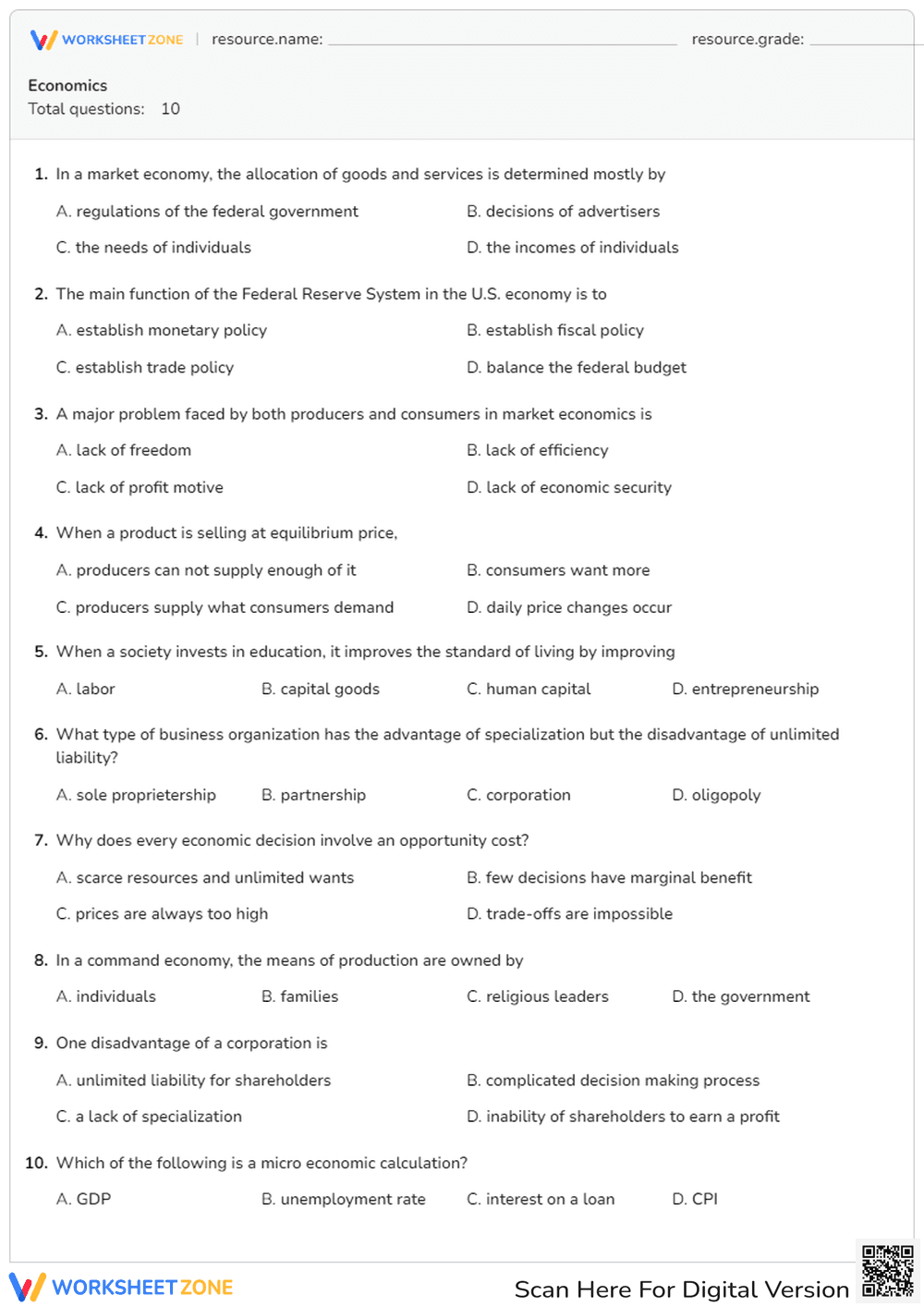

High School Economics — Printable No-Prep Worksheet

Paste this activity's link or code into your existing LMS (Google Classroom, Canvas, Teams, Schoology, Moodle, etc.).
Students can open and work on the activity right away, with no student login required.
You'll still be able to track student progress and results from your teacher account.
This high school economics worksheet provides students with targeted practice on fundamental economic principles. By evaluating scenarios related to market structures, the Federal Reserve, and opportunity costs, learners demonstrate their understanding of how economic systems function. This resource ensures students accurately identify core macroeconomic and microeconomic concepts.
At a Glance
- Grade: High School · Subject: Economics
- Standard:
D2.Eco.3.9-12— Analyze how incentives influence production and distribution in markets- Skill Focus: Core Economic Concepts
- Format: 1 page · 10 problems · Answer key included · PDF
- Best For: Formative assessment and review
- Time: 15–20 minutes
Inside this resource, educators will find a streamlined, ten-question multiple-choice quiz covering essential economic vocabulary. The single-page layout includes questions on equilibrium price, human capital, business organizations, and the characteristics of command versus market economies. A complete answer key is provided to ensure rapid grading.
This resource offers a zero-prep workflow:
- Print (1 minute): Generate copies of the single-page PDF for the class.
- Distribute (1 minute): Hand out the assessment as a warm-up or independent practice.
- Review (3 minutes): Use the included answer key to quickly score submissions.
With a total teacher preparation time under two minutes, this worksheet serves as an excellent emergency sub plan or a quick comprehension check.
This material aligns with D2.Eco.3.9-12, requiring students to analyze how incentives influence what is produced and distributed in a market system. It supports broader frameworks by asking students to evaluate institutions like the Federal Reserve. Both standard codes can be copied directly into lesson plans, IEP goals, or district curriculum mapping tools.
Deploy this quiz as a pre-assessment before a unit on market structures to gauge baseline knowledge of terms like opportunity cost. Alternatively, assign it as independent review prior to a summative exam. While students work, observe which questions require the most time; hesitation on microeconomic calculations often indicates a need for targeted reteaching. Expect completion within fifteen to twenty minutes.
This worksheet is ideal for high school students in introductory economics courses. For learners requiring accommodations, educators can modify the task by crossing out one incorrect distractor per question to reduce cognitive load. Pair this assessment with a direct instruction lesson on command and market economies to reinforce the concepts.
Mastering core economic concepts is critical for civic readiness and long-term financial literacy. Aligning instruction to D2.Eco.3.9-12 ensures students can accurately analyze how incentives influence production and distribution in markets. According to a 2024 report by EdReports, high-quality instructional materials that embed frequent, low-stakes formative assessments significantly improve long-term retention of complex social studies vocabulary and macroeconomic theories. By engaging with these ten structured multiple-choice questions, students actively retrieve essential information about business organizations, monetary policy, and resource allocation. This targeted retrieval practice strengthens neural pathways, making it substantially easier for learners to apply theoretical economic principles to real-world financial decisions and civic participation. Consistent exposure to standard-aligned vocabulary through concise, rigorous practice tools directly supports higher achievement on comprehensive end-of-course exams and fosters a much deeper understanding of global market dynamics.


