


























Views
Plays
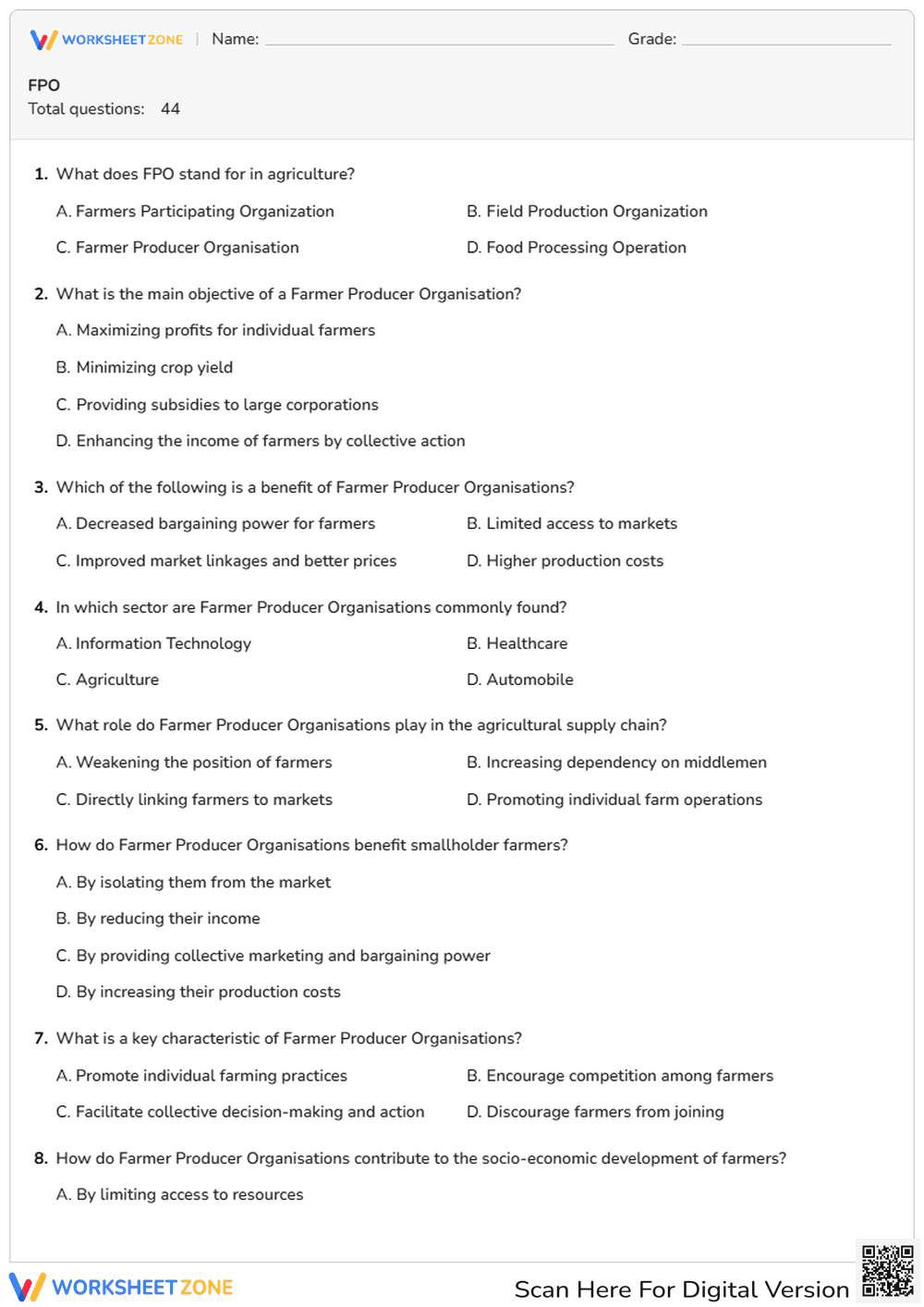


Grade 9-12 FPO Agriculture Quiz: Essential Worksheet
Paste this activity's link or code into your existing LMS (Google Classroom, Canvas, Teams, Schoology, Moodle, etc.).
Students can open and work on the activity right away, with no student login required.
You'll still be able to track student progress and results from your teacher account.
This Grade 9-12 agricultural economics worksheet provides a comprehensive assessment of Farmer Producer Organisations (FPO). Students will evaluate the role of collective action in modern farming, the functions of the SFAC, and the mechanics of agricultural credit linkages. It is designed to ensure students master complex organizational structures in the primary sector.
At a Glance
- Grade: 9-12 · Subject: Social Studies
- Standard:
RH.9-10.4— Determine the meaning of domain-specific words and phrases in a social studies context- Skill Focus: Agricultural Economics & FPO Structures
- Format: 6 pages · 44 problems · Answer key included · PDF
- Best For: Unit Assessment or Sub Plans
- Time: 45–60 minutes
This extensive 6-page PDF contains 44 multiple-choice questions. The assessment is divided into thematic blocks covering the definition and objectives of FPOs, the role of the Small Farmers Agribusiness Consortium (SFAC), and technical details regarding equity grant schemes and credit guarantee linkages. A full answer key is provided for rapid grading and immediate student feedback.
The workflow for this resource is designed for maximum efficiency. Teachers can Print the 6-page document in under 1 minute, Distribute the packets to students immediately, and Review the results using the included answer key in less than 5 minutes. This makes it an ideal high-quality option for emergency sub plans or end-of-unit reviews where teacher time is at a premium.
This resource aligns with CCSS.ELA-LITERACY.RH.9-10.4, which requires students to determine the meaning of symbols, key terms, and other domain-specific words and phrases. It also supports standards related to understanding economic systems and the role of government and private organizations in market stability. Both standard codes can be copied directly into lesson plans, IEP goals, or district curriculum mapping tools.
Use this worksheet as a summative assessment after a unit on agricultural development or economic cooperatives. It also serves as an excellent formative tool during direct instruction; have students complete the first 15 questions after discussing FPO basics. Expect students to spend approximately 50 minutes to complete all 44 rigorous questions, ensuring a thorough examination of the socio-economic development of smallholder farmers.
This resource is tailored for high school students in grades 9-12 studying economics, agriculture, or rural development. It is particularly useful for students preparing for vocational exams or advanced social studies courses. Pair this with a case study on successful farming cooperatives or an anchor chart detailing the agricultural supply chain to provide a complete instructional experience.
According to the RAND AIRS 2024 report, structured assessments that focus on domain-specific vocabulary, such as the 44 questions found in this FPO worksheet, significantly improve student retention of complex economic concepts. By aligning with RH.9-10.4, this resource ensures that students are not merely memorizing acronyms like SFAC but are understanding the underlying mechanics of market linkages and collective bargaining power. Research from Fisher & Frey (2014) suggests that high-volume practice with multiple-choice formats helps solidify the instructional model by providing a clear phase for independent mastery. This worksheet provides the necessary rigor for Grade 9-12 learners to transition from basic definitions to analyzing financial literacy and equity grants within the agricultural sector, making it a robust tool for any secondary social studies or economics curriculum.


