


























Views
Plays

Essential Cash Flow Quiz | Grade 10-12 Business
Paste this activity's link or code into your existing LMS (Google Classroom, Canvas, Teams, Schoology, Moodle, etc.).
Students can open and work on the activity right away, with no student login required.
You'll still be able to track student progress and results from your teacher account.
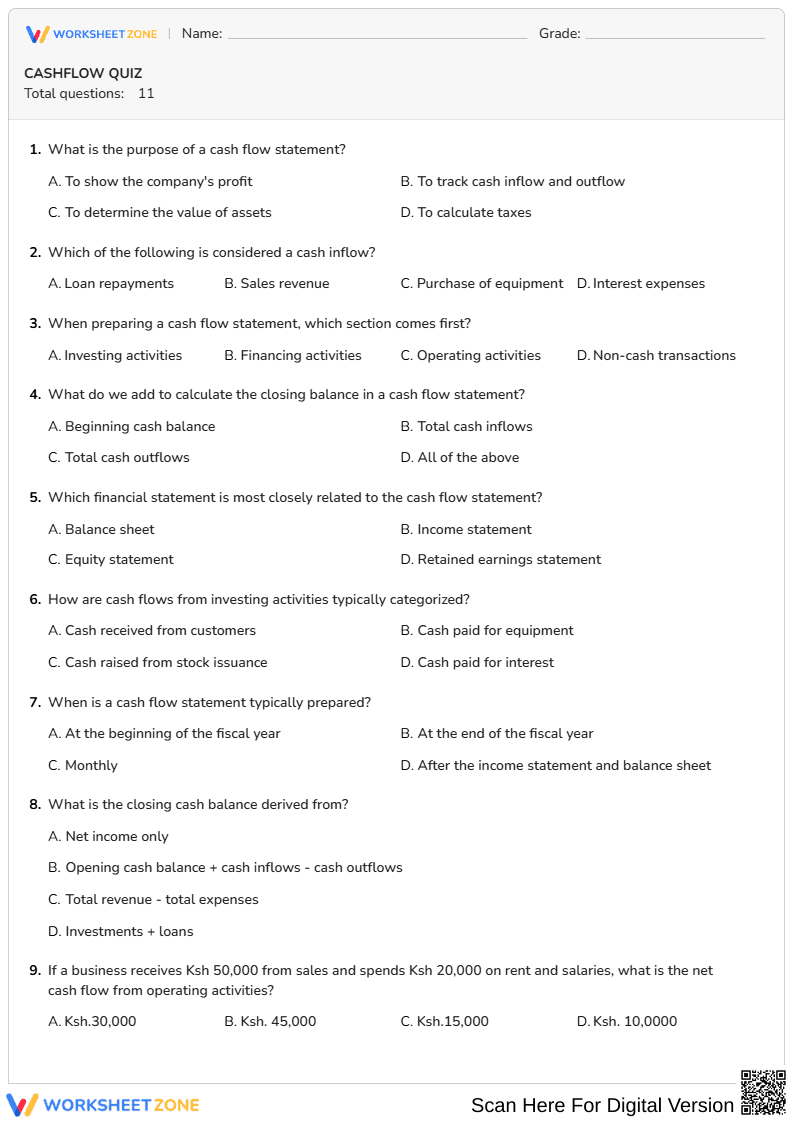
This comprehensive cash flow quiz evaluates student understanding of financial liquidity and statement preparation. Students demonstrate their ability to distinguish between operating, investing, and financing activities while performing multi-step calculations to determine closing balances. It provides a clear assessment of whether learners can translate raw transaction data into meaningful financial insights.
At a Glance
- Grade: 10-12 · Subject: Business & Accounting
- Standard:
HSN.Q.A.1— Use units to understand problems and guide the solution of multi-step problems- Skill Focus: Cash Flow Statement Analysis
- Format: 2 pages · 11 problems · Answer key included · PDF
- Best For: Summative assessment or unit review
- Time: 20–30 minutes
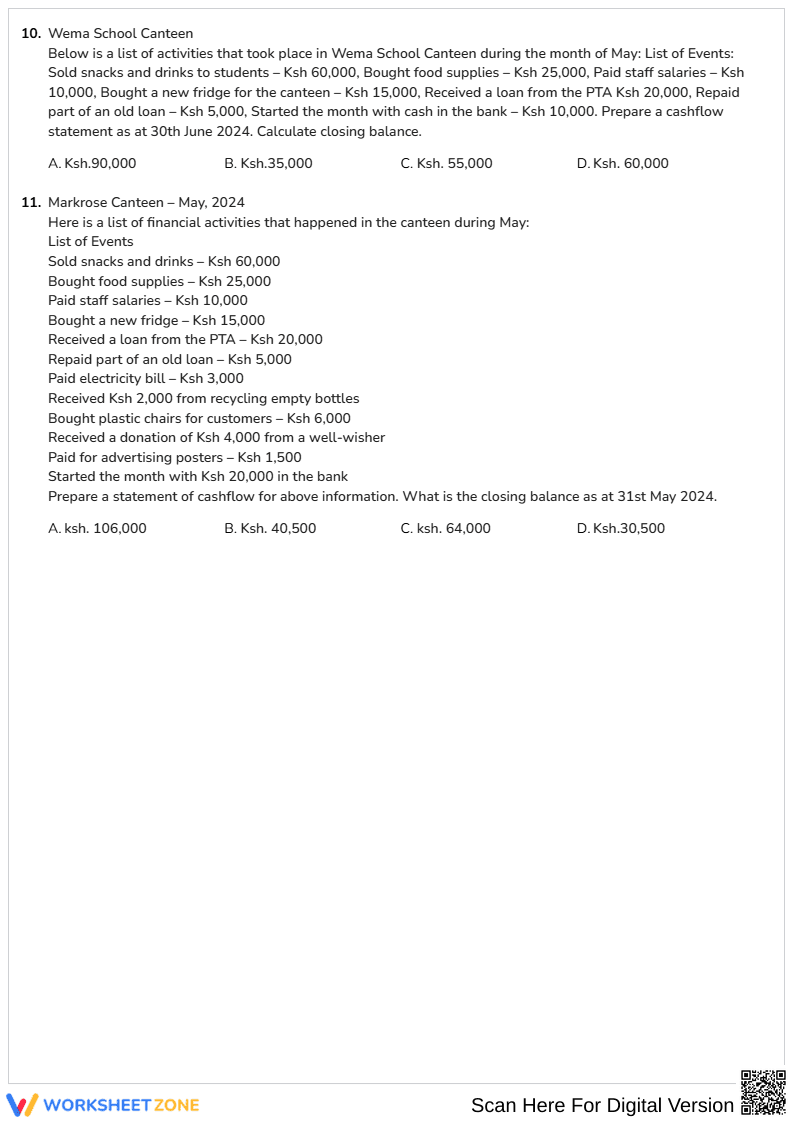
The worksheet contains 11 multiple-choice questions spread across two pages. The first eight questions focus on conceptual knowledge, such as the purpose of the statement and the categorization of activities. The final three questions transition into applied mathematics, requiring students to calculate net cash flows and closing balances from provided lists of business events using specific currency units.
This resource is designed for immediate classroom implementation. Step 1: Print the two-page PDF (30 seconds). Step 2: Distribute to students as a silent individual assessment (1 minute). Step 3: Review answers using the included key to provide immediate feedback (5 minutes). Total teacher preparation time is under two minutes, making it an ideal sub-plan for business education courses.
Aligned to HSN.Q.A.1, this quiz requires students to use units as a way to understand problems and to guide the solution of multi-step problems. It also supports standards related to financial literacy and quantitative reasoning by asking students to interpret units consistently in formulas. Both standard codes can be copied directly into lesson plans, IEP goals, or district curriculum mapping tools.
Use this quiz as a summative assessment at the end of a financial statements unit. Alternatively, assign it as a pre-assessment to gauge prior knowledge before starting complex accounting cycles. During the quiz, observe if students struggle more with the conceptual categorization or the arithmetic of the final three word problems. Completion typically takes 25 minutes for most high school learners.
This resource is tailored for high school business students, accounting electives, or introductory college finance courses. It is particularly effective for students who benefit from structured multiple-choice options when learning to interpret financial terminology. Pair this with a cash flow anchor chart or a guided lecture on the indirect method of statement preparation for a complete instructional block.
According to the RAND AIRS 2024 report, structured assessments that bridge the gap between conceptual definitions and quantitative application are vital for developing financial literacy in secondary education. This worksheet addresses that need by requiring students to identify the purpose of cash flow statements before applying that logic to 11 specific financial scenarios. By focusing on the distinction between inflows and outflows, the quiz reinforces the fundamental accounting principle that profit and cash are distinct metrics. Research from Fisher & Frey (2014) emphasizes that checking for understanding through targeted quizzes allows educators to identify misconceptions in the gradual release of responsibility. This assessment provides the necessary data points for teachers to determine if students have mastered the HSN.Q.A.1 standard or if further intervention is required. It serves as a reliable tool for measuring student progress in high-stakes business curriculum environments.


