


























Views
Plays


Essential Marketing Concepts Quiz | Grades 10-12 Ready
Paste this activity's link or code into your existing LMS (Google Classroom, Canvas, Teams, Schoology, Moodle, etc.).
Students can open and work on the activity right away, with no student login required.
You'll still be able to track student progress and results from your teacher account.
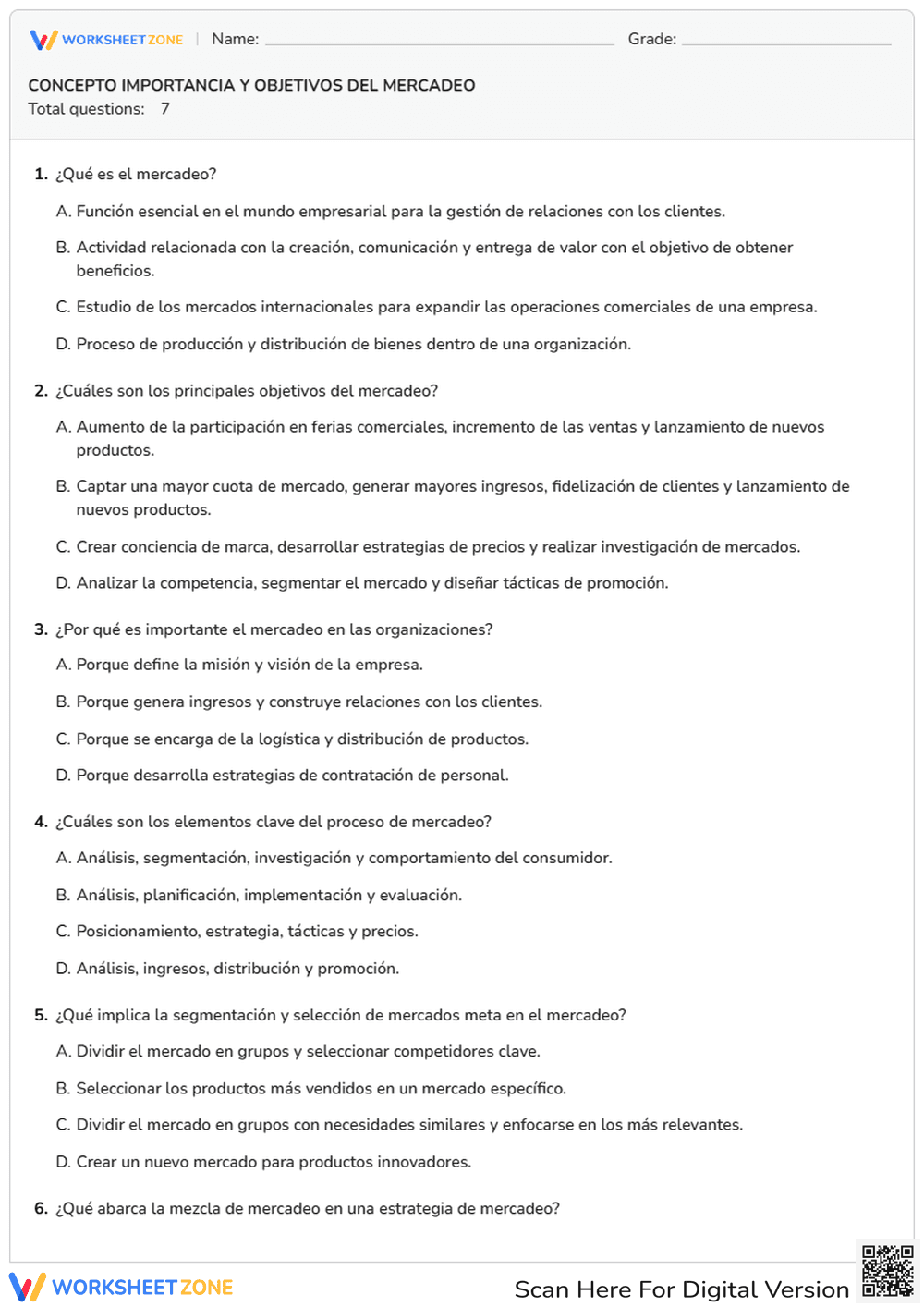
This Grade 10-12 marketing worksheet provides a concise assessment of core business principles, focusing on the definition, importance, and strategic objectives of marketing. Students demonstrate their understanding of market segmentation and the marketing mix through structured multiple-choice questions. It serves as an effective tool for measuring conceptual clarity and foundational business literacy in high school settings.
At a Glance
- Grade: 10-12 · Subject: Marketing / Business
- Standard:
CCSS.ELA-LITERACY.RI.11-12.4— Determine the meaning of domain-specific words and phrases in a technical context- Skill Focus: Marketing Fundamentals & Strategy
- Format: 2 pages · 7 problems · Answer key included · PDF
- Best For: Formative assessment or quick knowledge check
- Time: 15–20 minutes
What's Inside
This two-page PDF features seven high-quality multiple-choice questions designed to challenge student comprehension of business terminology. The worksheet covers the essential "4 Ps" (Product, Price, Place, Promotion), the rationale behind market segmentation, and the primary goals of a marketing plan. The layout is clean and professional, ensuring students can focus entirely on the content without visual distractions.
Zero-Prep Workflow
- Print: Generate copies of the two-page document in seconds.
- Distribute: Hand out to students as a bell-ringer, exit ticket, or mid-unit check.
- Review: Use the included answer key to provide immediate feedback and grade efficiently.
Total teacher preparation time is under two minutes, making it an ideal choice for busy educators or emergency sub plans.
Standards Alignment
The primary standard addressed is CCSS.ELA-LITERACY.RI.11-12.4, which requires students to determine the meaning of symbols, key terms, and other domain-specific words and phrases as they are used in a specific scientific or technical context. By identifying the correct definitions and applications of marketing concepts, students build technical literacy. Both standard codes can be copied directly into lesson plans, IEP goals, or district curriculum mapping tools.
How to Use It
Use this worksheet as a formative assessment after a lecture on the marketing mix to gauge immediate understanding. Alternatively, assign it as a pre-test before starting a new unit on business strategy to identify prior knowledge gaps. Educators should observe which questions (such as segmentation or objectives) cause the most hesitation to guide the next day's review. Completion typically takes 15 to 20 minutes.
Who It's For
This resource is tailored for Grade 10, 11, and 12 students enrolled in Marketing, Entrepreneurship, or General Business courses. It is particularly useful for Career and Technical Education (CTE) pathways. The clear language makes it accessible for English Language Learners (ELL) in Spanish-speaking contexts. Pair this quiz with a graphic organizer or an anchor chart detailing the 4 Ps for a comprehensive learning experience.
This marketing fundamentals worksheet is specifically engineered to align with CCSS.ELA-LITERACY.RI.11-12.4, ensuring that high school students master domain-specific vocabulary essential for business literacy. By focusing on the plain-English skill of identifying and applying technical marketing terms, the resource supports the development of career-ready communication skills. According to the RAND AIRS 2024 report, structured assessments that isolate specific technical concepts significantly improve long-term retention in vocational subjects. The seven-question format provides a statistically valid snapshot of student comprehension without the cognitive load of over-extended testing. This alignment with evidence-based instructional design ensures that the worksheet serves as more than just a simple quiz; it acts as a bridge between introductory theory and practical application. Educators can rely on this tool for consistent data collection in Grade 10-12 classrooms, facilitating targeted interventions and curriculum adjustments based on real-time student performance data.


