12th Grade Taxation Worksheets PDF: Practical Tax Literacy for Seniors
These 12th grade taxation worksheets give economics and personal finance teachers a set of structured, printable exercises that move seniors from abstract policy concepts to hands-on practice with the documents they'll encounter within months of graduation. Each worksheet targets a specific skill — calculating bracket rates, reading a pay stub, completing a simplified Form 1040 — so teachers can assign them individually or sequence them across a unit.
The Specific Skills Targeted
The worksheets cover the core tax literacy competencies that typically get compressed into a single unit or, in some courses, a single class period. Given how much ground that represents, having discrete worksheets for each skill makes it possible to spend real time where students actually need it.
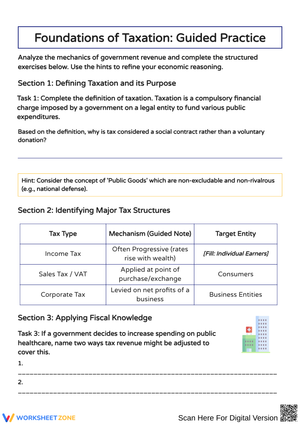
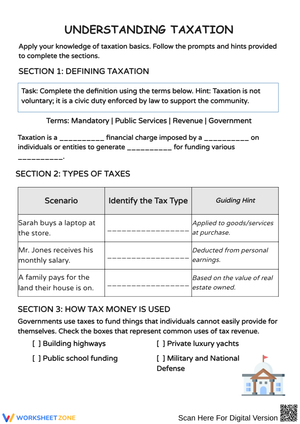
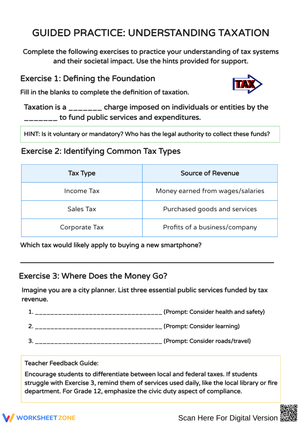
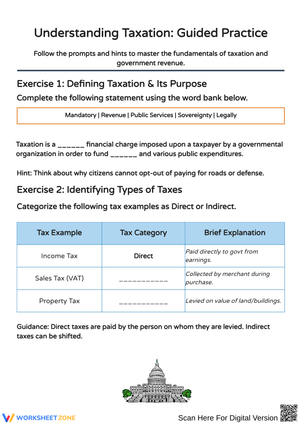
- Progressive, regressive, and proportional tax structures: Students identify and compare all three systems, then analyze how each type distributes the tax burden across income levels. A follow-up task asks them to classify common taxes — income, sales, property, excise, payroll — into the correct category and explain the equity implications of each.
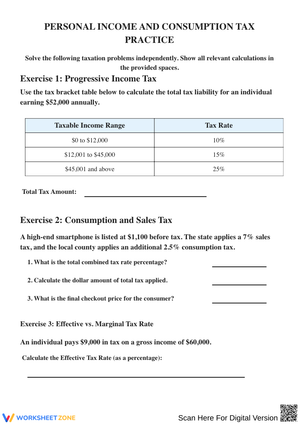
- Marginal vs. effective tax rate calculations: Using a simplified version of current federal brackets, students calculate taxes owed at multiple income levels, then derive the effective rate by dividing total tax by total income. The sequence is deliberate: students do the arithmetic first, then draw the conceptual conclusion.
- Paycheck deductions and FICA: Students work from a sample pay stub — gross wages, federal and state withholding, Social Security, Medicare, and a voluntary deduction like health insurance — to calculate net pay and explain what each line funds.
- Key tax documents: Guided practice with simplified versions of the W-4, W-2, and Form 1040 builds familiarity with forms students will complete or receive in their first year of employment.
- Tax type sorting and case analysis: A sorting activity presents a household scenario at two different income levels and asks students to calculate what percentage of each household's income goes to sales tax versus income tax. The contrast makes the progressive/regressive distinction concrete in a way that definitions alone don't.
Standard Alignment
These worksheets align with CCSS.MATH.CONTENT.HSA-CED.A.1 (creating equations to represent relationships, applied here to tax calculations) and CCSS.MATH.CONTENT.HSF-BF.A.1 (building functions from a context, which maps directly to bracket rate computation). On the personal finance side, they address the Jump$tart Coalition's financial literacy standards for income and careers, specifically the competency around understanding the difference between gross and net income and the factors that affect take-home pay. For social studies teachers embedding this in an economics unit, the worksheets support standards related to government revenue, fiscal policy, and economic equity — the tax structure comparisons in particular connect to broader discussions about how tax policy distributes the burden of funding public goods. Teachers in states using CEE's Voluntary National Content Standards in Economics will find alignment with Standard 16 (role of government) and Standard 20 (fiscal and monetary policy).
Mistakes Students Make That These Worksheets Help You Catch
The most persistent error in any tax bracket exercise is bracket contamination — students apply the highest rate to all taxable income rather than only to the portion that falls within that bracket. A student calculating tax on $52,000 will often multiply the entire amount by 22% rather than splitting the income across the 10%, 12%, and 22% brackets. The worksheet's step-by-step structure surfaces this error clearly: each bracket gets its own calculation row, so the mistake appears as a blank or an inflated number rather than disappearing into a final answer.
A second error is conflating gross pay with taxable income. Students who correctly identify that a W-2 shows total wages still struggle to understand why the amount on line 1 of the 1040 differs from their total gross earnings once pre-tax deductions are factored in. The pay stub worksheet addresses this directly by labeling each deduction and asking students to trace the path from gross to net to taxable. A third, less visible problem: students who understand the W-4 conceptually still freeze when asked to determine whether a new employee should claim a higher or lower withholding allowance. A brief scenario on that worksheet — a student with one part-time job, no dependents, no other income — keeps the decision grounded before it becomes abstract.
How to Build These Worksheets Into Your Lesson Plans
The natural sequence is conceptual first, computational second, applied third. Open the unit with the tax type sorting worksheet — it establishes vocabulary without requiring any arithmetic and gives you a quick read on what students already know. The two-household case study embedded in that worksheet works well as a whole-class discussion: project the income levels, have students calculate the sales tax percentage independently, then compare. The gap between what students expect and what they calculate is usually enough to drive the rest of the unit's motivation.
Move to the bracket calculation worksheet once students can distinguish tax structure types. This is where guided practice matters most. Running the first income scenario together on the board, then releasing students to complete the remaining two independently, follows a gradual release model that prevents students from carrying a procedural misunderstanding through three examples. Reserve the pay stub and 1040 worksheets for later in the week, when students have the conceptual scaffolding to make sense of what each line represents. Partner work on the 1040 simulation is worth the noise — students catch each other's arithmetic, and the conversation about what qualifies as a deduction often produces better questions than any direct instruction moment in the unit.
Adjusting the Worksheets for a Range of Learners
The bracket calculation worksheet is the one that most often requires differentiation. For students who struggle with multi-step arithmetic, a scaffolded version that labels each bracket range and provides the rate pre-filled reduces cognitive load without removing the calculation task itself. The goal is for those students to practice applying the rates correctly, not to spend all their time locating the rates. For students who move through the standard version quickly, a more challenging variant introduces a second income earner in the household, a capital gains amount taxed at a different rate, or a state income tax layer calculated on top of federal liability — all realistic complications that advanced learners can handle and that generate good discussion about why the tax code is structured the way it is.
The 1040 simulation scales well in the other direction, too. Students who find the full simulation overwhelming can complete a stripped-down version that includes only wages, the standard deduction, and the resulting tax owed. That version still teaches the fundamental filing logic. The sorting activity, on the other hand, is accessible to nearly every student at this level and works well as a re-entry point for anyone who missed earlier instruction.
Frequently Asked Questions
Do these worksheets use current tax brackets, or will I need to update them?
The bracket calculation worksheets use a simplified, illustrative bracket structure rather than precise current-year IRS figures. That's a deliberate choice — exact brackets change annually with inflation adjustments, and a simplified version keeps the focus on the procedural skill rather than number memorization. For classes that want to use current figures, the IRS releases updated tax tables each January, and substituting those numbers into the existing worksheet format takes about ten minutes.
How long does the 1040 simulation typically take?
With the scaffolded scenario provided — one W-2, standard deduction, no additional income sources — most seniors complete the simulation in 25 to 35 minutes. Classes that include a brief walkthrough of what each section of the form asks before students begin tend to finish closer to the 25-minute mark. If you're working in a 45-minute period with transition time, the simulation works cleanly as a full-period partner activity.
Are these worksheets appropriate for a personal finance course, or are they geared toward economics?
Both. The pay stub, W-4, and 1040 worksheets fit naturally into a personal finance unit on income and careers. The tax structure and bracket calculation worksheets are more commonly used in economics, where the discussion connects to fiscal policy and government revenue. Several teachers use the full set across both courses at different points in the year — the 1040 simulation in personal finance, and the sorting and bracket work in economics.
What's the best way to use these as formative assessment?
The bracket calculation worksheet is the clearest formative tool in the set. Reviewing student work before the next class takes about ten minutes and immediately shows whether the bracket contamination error is isolated or widespread. If more than a third of the class applied the top rate to total income, that's a signal to re-teach the bracket logic before moving to the 1040 simulation — a student who doesn't understand marginal rates will not be able to make sense of why their simulated refund amount comes out the way it does.
Clear All